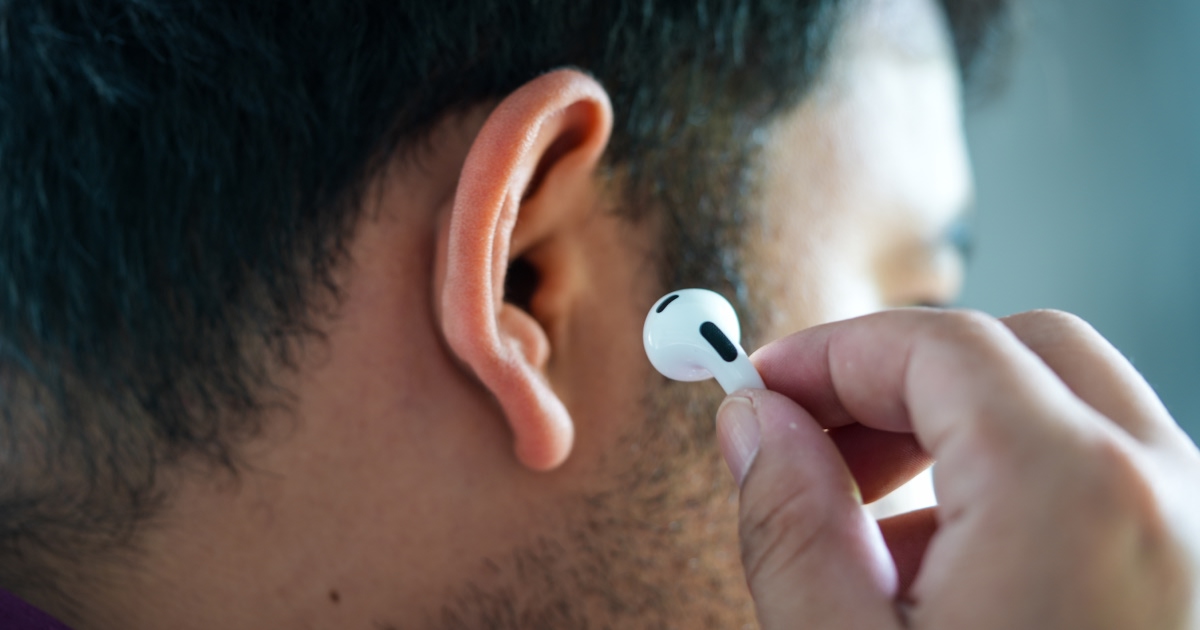

Apple has patented technology for a wearable device that could use electrodes positioned in and around the ear to detect biological signals, including the electrical activity produced by the brain. The system would automatically determine which electrodes were making the best contact and use those signals to produce a clearer reading.
That sounds remarkably close to putting an EEG inside a pair of earbuds.
But there is an important catch: Apple’s patent never mentions AirPods, and a patent is not a product announcement. Apple has not said it plans to release EEG-enabled earbuds, and many patented ideas never make it into something consumers can buy.
Still, the underlying technology is very real. Researchers are already developing in-ear EEG systems, and some companies have begun selling devices capable of monitoring brain activity from the ear.
If that technology eventually becomes as ordinary as a smartwatch, it could change how we monitor sleep, neurological conditions, and even attention. It would also introduce a very different question about wearable technology:
How much access do we want our devices to have to our brains?
How EEG Actually Works
EEG stands for electroencephalography, which is a technical name for recording the brain’s electrical output from outside the skull. Brain cells communicate by generating electrical impulses, and EEG electrodes placed on or near the skull detect the tiny electrical charges that result from that activity. The result is a waveform, a line tracing the collective electrical rhythm of millions of neurons firing in sync.
Different rhythms reflect different mental states. Alpha waves appear during calm, relaxed wakefulness. Beta waves rise during focused mental effort. Delta waves dominate deep, restorative sleep. Gamma waves are associated with active learning and cognitive engagement. None of these patterns reveal specific thoughts, memories, or anything resembling an inner monologue. What they show is the broad state of the brain’s activity – roughly whether someone is asleep, alert, concentrating, or at rest.
The traditional method of capturing these signals requires a cap fitted with up to 64 or more electrodes attached to the scalp with conductive gel. In-ear EEG systems use small electrodes that are easier to wear and require considerably less installation time. The ear canal sits anatomically close to the brain’s temporal regions, which makes it a viable spot to pick up electrical signals.
The engineering challenge has always been consistency. Every person’s ear canal is shaped differently. A fixed electrode that sits flush against one person’s skin might barely graze another’s. Apple’s patent addresses this by packing more sensors than are ever needed simultaneously around the ear tips and using a model to select the electrodes with the best signal quality, then assigning different weights to each electrode to combine all signals into a single, optimized waveform.
What In-Ear EEG Can and Cannot Tell You
In-ear EEG is an emerging method offering advantages in device portability and user comfort. Recent studies have demonstrated that it can record signals qualitatively comparable to scalp EEG, with optimized signal-to-noise ratio and improved electrode stability. Recording a brain state, however, is not the same as reading a mind.
EEG can tell researchers whether a person is in deep sleep or light sleep, whether attention is flagging during a task, or whether abnormal electrical patterns consistent with a seizure are occurring. EEG is the most common diagnostic test for epilepsy, helping identify seizure types and seizure disorders through detection of abnormal electrical patterns. Beyond epilepsy, EEG has emerged as a non-invasive tool to detect aberrant neuronal activity related to different stages of Alzheimer’s disease, making EEG-based identification a current research focus.
EEG cannot extract the content of a thought. It cannot reconstruct what someone is imagining, what words they are thinking, or what they intend to do. The signals are statistical summaries of large neural populations. They describe the texture of brain activity, not its meaning. Any suggestion that consumer earbuds could “read your mind” misrepresents the science significantly.
Sleep Monitoring Is the Most Immediate Application
Polysomnography, the clinical gold standard for evaluating sleep disorders, is expensive, time-consuming, and requires overnight stays in specialized clinics. Its discomfort makes long-term monitoring impractical and introduces bias into sleep quality assessment.
In-ear EEG offers a way around those limitations. Apple’s patent notes that brain activity can be monitored using electrodes on the scalp or inside and around the outer ear, with the latter often preferred due to reduced mobility and visibility. The patent states that biosignal measurements could be used to inform users of various sleep-related conditions and anomalies such as seizures.
Tracking sleep stages accurately from something you’re already wearing in bed could eventually give clinicians a continuous, home-based window into sleep health that current methods cannot provide. For people managing insomnia, sleep apnea, or shift work disorder, continuous EEG data collected without a clinic visit would represent a practical step forward.
Research groups are already working in this space. A 2025 dataset published in Scientific Data describes data from two studies investigating ear-EEG for sleep monitoring in a home environment, with 320 nights recorded across 30 healthy subjects, representing what the authors describe as the most extensive open-access dataset available for mobile EEG development. Apple validated an in-ear EEG sleep classification algorithm using over 1,400 nights of polysomnography data, achieving 97.8% sensitivity for sleep detection.
Beyond sleep, in-ear EEG opens possibilities for monitoring cognitive load during everyday tasks. Researchers studying attention disorders or fatigue already use EEG in controlled settings, but lab conditions inevitably change what they’re measuring. A person sitting quietly under fluorescent lights with electrodes attached to their scalp is not in their natural state. In-ear EEG systems worn throughout the day could produce richer and more naturalistic recordings than lab-based methods allow. While the Apple concept remains on the patent servers, startups are already turning similar ideas into hardware. NextSense has launched in-ear EEG Smartbuds for sleep and brain health monitoring, while Neurable has launched headphones that track focus – and IDUN Technologies markets an in-ear EEG platform for cognitive monitoring.
The Privacy Problem Is Different This Time
Every wearable device you already own collects data about your body. Your smartwatch logs your heart rate, your sleep patterns, your step count, and depending on the model, your blood oxygen levels and skin temperature. Neural data, however, occupies a different category. The Organization for Economic Co-operation and Development defines neural data as “data relating to the functioning or structure of the human brain of an identified or identifiable individual that includes unique information about their physiology, health, or mental states.”
A 2024 audit by the Neurorights Foundation found that 29 out of 30 consumer neurotechnology companies appeared to allow access to consumers’ neural data with no meaningful limitations. That same audit found that 96.7 percent of companies reserve the right to transfer brain data to third parties, with most policies vague on whether that transfer constitutes a sale, and fewer than 20 percent mention encrypting the neural data they collect. Consumer EEG devices are already on the market. The protections governing what companies can do with the data they collect are, in most jurisdictions, still catching up.
The legal picture is shifting. In 2024, Colorado and California enacted the first U.S. state privacy laws governing neural data. California’s law amended the California Consumer Privacy Act to classify neural data as sensitive personal information, giving residents the right to request, delete, and restrict its sharing. On September 24, 2025, Senators Chuck Schumer, Maria Cantwell, and Ed Markey introduced the MIND Act, which directs the FTC to study how neural data is collected, processed, stored, and transferred under existing law and to recommend a federal regulatory framework.
No comprehensive federal law is currently on the books. HIPAA protects health data only when handled by a covered entity such as a provider or insurer. When a consumer uses a wearable to track health metrics, their data isn’t subject to HIPAA. Neural signals collected through consumer earbuds would almost certainly fall outside those protections under current law.
The Trade-Off Worth Taking Seriously
Continuous, comfortable EEG could identify sleep disorders earlier, provide researchers with naturalistic data that lab settings cannot replicate, flag cognitive decline in its earliest stages, and potentially help people with epilepsy receive faster, more accurate diagnoses. For people living with neurological conditions, a device that monitors brain activity passively and comfortably could meaningfully change how they manage their health.
Neural data collected at scale also creates new categories of risk. Who owns your neural data once it leaves your ear? Where is it stored? What inferences can a company draw from years of continuous brain-state monitoring about your emotional stability, your cognitive capacity, or your susceptibility to advertising? These questions don’t have answers yet, because the technology hasn’t arrived at scale yet – and that is precisely when the answers need to be worked out.
The Larger Question
We’ve already become accustomed to wearable devices knowing a remarkable amount about our bodies. Watches can track our heart rate, sleep, movement, temperature, and other health signals, often continuously and with very little effort from the person wearing them.
Brain activity would push that relationship somewhere new.
EEG cannot read your thoughts or reveal an inner monologue. But it can capture patterns associated with sleep, attention, cognitive engagement, and neurological activity. And unlike a traditional EEG performed in a clinic, an earbud could potentially collect those signals quietly for hours at a time.
That could make in-ear EEG enormously useful. It could also create a category of personal data that most people have never had to think about protecting.
Apple has patented the concept. It hasn’t announced the product, and it may never build one. But other companies are already bringing similar technology into the real world.
So the most interesting question raised by Apple’s patent may not be whether future AirPods can monitor your brain.
It’s whether, when that capability becomes convenient enough to disappear into something as ordinary as a pair of earbuds, we’ll be as comfortable sharing our brain activity as we became sharing our heartbeats.
Disclaimer: This information is not intended to be a substitute for professional medical advice, diagnosis, or treatment and is for information only. Always seek the advice of your physician or another qualified health provider with any questions about your medical condition and/or current medication. Do not disregard professional medical advice or delay seeking advice or treatment because of something you have read here.
AI Disclaimer: This article was created with the assistance of AI tools and reviewed by a human editor.
Read More: If You Think an Apple AirTag is Tacking You, Here’s How to Find and Disable Them