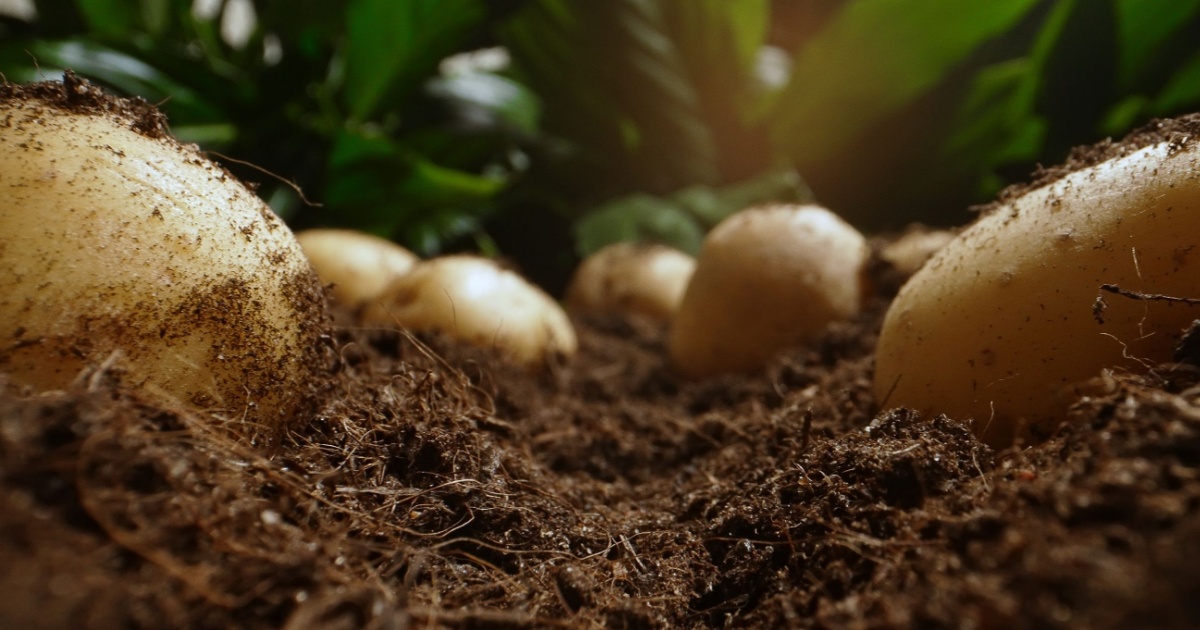

Most of us think of potatoes as a side dish, something humble and starchy that fills the plate around whatever else is happening at dinner. But for one population living high in the Andes mountains of South America, the potato was something else entirely. It was the foundation of survival. And over thousands of years, that survival came at a biological price. Or rather, a biological reward, one that quietly rewrote their DNA.
The story of how a single vegetable helped reshape the human genome is one of those findings that makes you stop and reconsider everything you think you know about evolution. We tend to assume that major genetic changes happen over millions of years, driven by predators, climate shifts, and continental drift. But this story is far more intimate. A crop. A community. A cold, thin-aired plateau thousands of meters above sea level. And a genetic advantage that has now been confirmed by scientists analyzing thousands of human genomes from around the world.
What researchers found is extraordinary, and the implications go well beyond ancient history. They touch on how tightly our biology is still tied to what we eat, and what that might mean for how humans continue to change.
Where It All Started
The potato has a long history that began in the Andes of South America about 8,000 years ago, when communities of hunters and gatherers began domesticating wild potato plants growing around Lake Titicaca. Archaeological evidence confirms that wild potato species evolved in the high-altitude regions surrounding Lake Titicaca, and ancient communities in what’s now Peru and Bolivia began selectively cultivating these wild tubers between 7,000 and 10,000 years ago, transforming small, bitter wild plants into the diverse, edible varieties we recognize today.
Indigenous communities in the high Andes developed sophisticated agricultural techniques to grow potatoes in challenging mountain conditions. They created raised fields that regulated soil temperature and moisture, allowing cultivation at elevations up to 4,000 meters, and selectively bred hundreds of potato varieties adapted to specific microclimates, soil types, and elevation zones. That practice continues among Quechua and Aymara communities today.
Living at those heights was never easy. At 4,000 meters altitude, every lungful of air contains approximately 60% of the oxygen molecules found in a lungful of air at sea level. Scarce oxygen, cold temperatures, and intense ultraviolet radiation make the Andes a tough place to live. Against that backdrop, the potato wasn’t just food. It was fuel for a population already fighting hard to survive.
The Gene That Changed Everything
Indigenous people of the Andes were the first to domesticate the potato, making the starch-rich crop a dietary staple for this high-altitude population long before it spread to the rest of the world. Today, their descendants in Peru carry the highest known numbers of a gene involved in starch digestion of any population in the world. A 2026 study co-led by researchers from UCLA and the University at Buffalo discovered that natural selection began favoring Indigenous Andeans with an unusually high number of salivary amylase genes, called AMY1, during the period when potatoes were first grown in the Andean highlands, roughly 6,000 to 10,000 years ago.
So what exactly is AMY1? The gene helps produce an enzyme that begins breaking down starch in the mouth. Salivary amylase is the enzyme your saliva releases the moment food hits your tongue. It begins the work of breaking starch, which is made of long chains of sugar, into simpler pieces your body can actually use. More copies of AMY1 generally means more of this enzyme in your saliva, which means faster, more efficient starch processing right from the first bite.
Researchers analyzed AMY1 copy numbers in 3,723 individuals from 85 populations, revealing that Indigenous Peruvian Andean populations possess the highest AMY1 copy number globally. Andeans average 10 AMY1 copies, more than any other population studied, reflecting rapid genetic adaptation to a starch-rich diet. For context, the average in other populations around the world is around seven copies. That gap of two to three extra copies on average might not sound dramatic. But at the level of natural selection, it was enough to change who lived and who thrived. The findings were published in Nature Communications.
Selection in Action
Here’s where it gets genuinely fascinating. As Omer Gokcumen, a professor of biological sciences at the University at Buffalo and co-corresponding author on the study, explains, the gene was already present in the population before potato cultivation began, just in varying amounts across individuals. Ancient indigenous peoples in the Andes already had AMY1 in their genomes when they first started cultivating potatoes. Once potatoes became an essential part of their diet, those with more copies of the genes that enabled them to extract more nutrition from them had a distinct evolutionary advantage.
People with 10 or more copies of AMY1 had a 1.24% survival or reproductive advantage per generation over those without, the researchers concluded. That number might sound small. But compound it across hundreds of generations over thousands of years and it produces exactly the kind of population-level shift researchers observed in the data.
To understand how this pattern formed, researchers compared Andean populations with others that share ancestry but different food histories, including the Maya, who did not rely on potato farming in the same way. The Maya carried fewer copies of AMY1, pointing to long-term diet, not shared ancestry, as the key difference.
As Gokcumen noted in the study, “biologists have long suspected that different groups of humans have evolved genetic adaptations in response to their diets, but there are very few cases where the evidence is this strong.”
The UCLA newsroom report on the study described this adaptation as a “digestive superpower” shaped by natural selection, an apt description for a change that was deeply practical rather than dramatic. No enhanced senses, no physical transformation, just a quieter, more efficient relationship between human biology and a single starchy crop.
A Second Layer of Adaptation
The AMY1 story is the headline finding, but the Andean genome holds other clues. A separate line of research published in Science Advances and reported by Emory University found another gene showing strong positive selection in ancient Andean highland populations: MGAM, or maltase-glucoamylase. The strongest genetic signal in that research was the MGAM gene, an intestinal enzyme that plays an important role in the digestion of starchy foods such as potatoes.
Researchers found a different configuration of MGAM in the agricultural ancient Andean genome samples, but not in hunter-gatherers living down the coast, suggesting this shift was specifically tied to the high-altitude agricultural lifestyle. Both ancient and modern high-altitude populations showed strong positive selection on MGAM variants, evident by at least 1,800 years ago, which fits with archaeological evidence indicating that the domesticated potato became a staple in the region.
So Andean bodies didn’t just adapt in one place. Changes appear to have accumulated across multiple points in the starch digestion pathway, from the mouth all the way through the intestine. That’s not coincidence. That’s a population in a cold, oxygen-thin environment doing everything it could, biologically, to squeeze maximum nutrition from the one crop that kept it alive.
The same ancient DNA research also found evidence of genetic differentiation related to the DST gene, with histone modifications in Andean genomes associated with blood and the right ventricle of the heart, possibly correlating with the tendency of Andean highlanders to have enlarged right ventricles. That finding is consistent with adaptation to high-altitude hypoxia via cardiovascular modifications.
What This Tells Us About Diet and DNA
The notion that humans stopped evolving in the distant past simply isn’t true. Our teeth, jaws, and faces have gotten smaller, and our DNA has changed since the invention of agriculture. The Andean AMY1 story is one of the clearest examples of that ongoing process ever documented.
Gokcumen, whose earlier research showed that the initial duplication of AMY1 in hominins occurred at least 800,000 years ago, said the findings clearly demonstrated the role of natural selection in the Andes after potato cultivation began.
Lactose tolerance offers a useful parallel. All humans digest mother’s milk as infants, but until cattle were domesticated around 10,000 years ago, children stopped producing the enzyme lactase after weaning. After humans began herding cattle, it became enormously advantageous to digest milk, and lactose tolerance evolved independently among cattle herders in Europe, the Middle East, and Africa. The AMY1 expansion in the Andes follows the same logic. A new food. A population that needed to survive on it. And over time, the biological machinery to handle it became more abundant in those who had it.
The study opens the door to wider research into the lives of people who live at high altitudes, whose daily realities include access to limited foodstuffs and extreme exposure to cold temperatures and ultraviolet rays, and raises questions about how humans will evolve given modern food environments, particularly as access to global cuisine has become widespread for many people.
Read More: Why Do We Have Bunions? You Can Blame Evolution.
Your Genes Are Still Listening
You’re probably not living at 4,000 meters above sea level and eating potatoes for every meal. But here’s what this research actually tells you: the food your ancestors ate, over generations, shaped the biological toolkit you inherited. And the food you eat now is part of an ongoing relationship between diet and biology, one that operates much faster than scientists previously believed.
That idea has real, practical weight. It means whole, unprocessed starchy foods like potatoes, when prepared simply, are genuinely compatible with human biology in a way that processed substitutes simply aren’t. The potato is a carbohydrate-rich, energy-providing food with little fat. Its protein content is modest but carries excellent biological value, and potatoes are particularly high in vitamin C and a solid source of several B vitamins. The Andean communities who depended on them weren’t wrong to do so.
What this research asks you to consider is this: the foods humans have eaten longest tend to be the ones our bodies handle best. That’s not a romantic idea about the past. It’s a biological argument supported by genomic evidence. People with a high number of AMY1 copies tend to produce more amylase in their saliva and digest starch more effectively, and that trait exists in your genome right now, in some form, as a direct echo of what your ancestors ate. The humble potato didn’t just feed a civilization. For one remarkable population, it helped build one, right down to the level of DNA.
AI Disclaimer: This article was created with the assistance of AI tools and reviewed by a human editor.
Read More: 70-Million-Year-Old Dinosaur Egg Found Intact—May Contain Ancient DNA