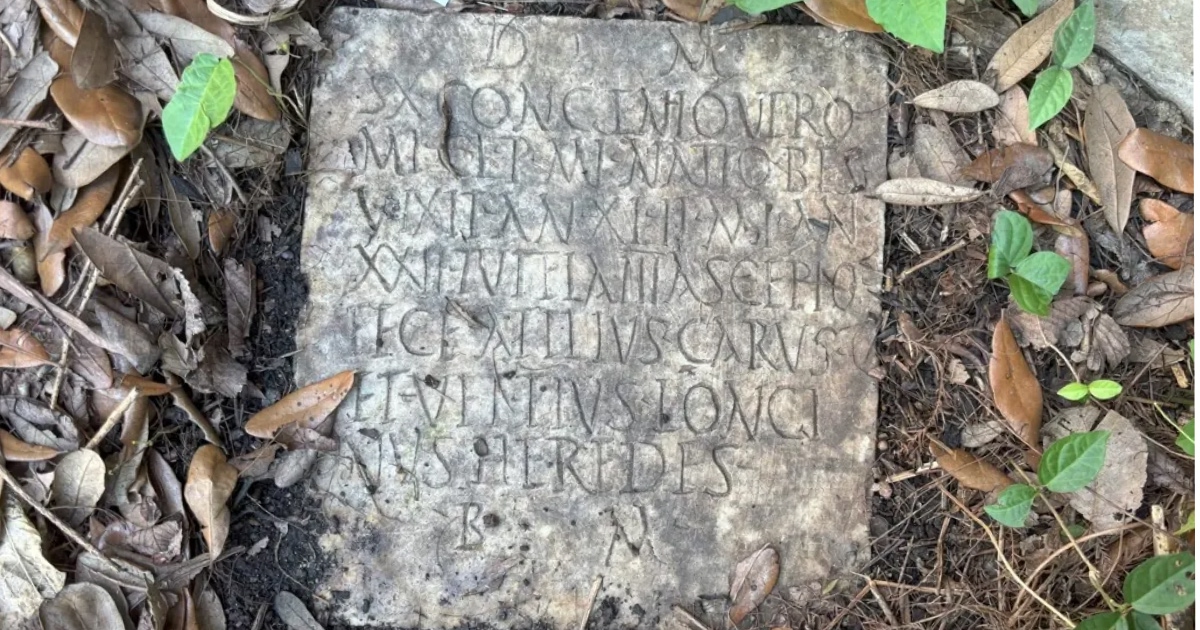

A marble slab barely the size of a welcome mat sat buried under vines and weeds in a New Orleans backyard for more than twenty years. The family that put it there thought it was garden art. Erin Scott O’Brien, who placed the stone in her garden in the early 2000s, later recalled: “I just thought it was a piece of art. I had no idea it was a 2,000-year-old relic.”
Under the weeds was a marble tablet with Latin characters that included the phrase “spirits of the dead.” The full story of how that stone got from a Roman port city to suburban Louisiana – and who it was carved for nearly two millennia ago – took an international team of scholars, archivists, and federal investigators to untangle.
When Daniella Santoro and her husband, Aaron Lopez, went to clear weeds behind their home in New Orleans’ Carrollton neighborhood, they discovered a heavy marble slab with an inscription in Latin. Santoro, an anthropologist at Tulane University, was at first concerned that her house was sitting atop a forgotten local cemetery. “The fact that it was in Latin that really just gave us pause, right?” said Santoro. “I mean, you see something like that and you say, ‘Okay, this is not an ordinary thing.'”
Reading a 1,900-year-old inscription
Santoro found the marble tablet beneath undergrowth in the backyard of her home in New Orleans’ historic Carrollton neighborhood. One surface is densely chiseled with Roman text.
Her first call went to a colleague. Susann Lusnia, a classicist at Tulane University, was “floored” when she first saw a photo of the tombstone. “It was pretty clear to me that it was an original Roman inscription,” Lusnia said. “But it was also very hard to believe at that moment that there’d be something like this in a backyard here in New Orleans.” Using key phrases from the engraving, Lusnia traced the text in the Corpus Inscriptionum Latinarum, a comprehensive database of Latin inscriptions, and found a match to a stone previously documented in Italy.
Photographs were shared with classical scholars in the United States and Europe, and the inscription was translated. The stone was confirmed as a genuine ancient Roman funerary monument – not a modern reproduction or garden ornament.
The inscription opens with Dis Manibus, a phrase that appears on thousands of Roman tombstones across the former empire. In Roman funerary tradition, Dis Manibus – meaning “to the spirits of the dead” – was carved at the top of the stone to announce the grave’s sacred purpose. According to Lusnia’s translation, the inscription begins: “To the spirits of the dead for Sextus Congenius Verus.”
The soldier behind the stone
The inscription identifies the stone as the tombstone of Sextus Congenius Verus, a Roman sailor from Thrace. He served on the trireme Asclepius in the Classis Misenensis – the senior fleet of the imperial Roman navy, based on the Bay of Naples. He died at 42, after 22 years of military service.
His heirs, who commissioned the marker, described him in the engraving as “well deserving.” The inscription names those heirs as Atilius Carus and Vettius Longinus.
Sextus was a Thracian, born into the Bessi tribe. Many young men from Thrace entered Roman military service, and Sextus served on one of the empire’s most prestigious vessels. The Asclepius was named after the Greco-Roman god of medicine, as recorded in Misenensis fleet records.
After his death, his heirs arranged for a marble grave marker to be cut and placed above his tomb at a cemetery in Civitavecchia, a port town northwest of Rome. There it remained, documented and cataloged, for nearly eighteen centuries.
How a world war moved an ancient grave marker
The National Archaeological Museum of Civitavecchia was heavily damaged by Allied bombing raids between 1943 and 1944, and numerous artifacts were lost or displaced. The tombstone was among those later listed as missing.
Researchers found that a postwar inventory listing the tombstone appeared to have been assembled from pre-bombing catalogs rather than a fresh check of the collection. The inventory indicated the stone had belonged to the museum, but did not confirm it was still physically present after the war.
Since the museum reopened in the 1970s, nine of the missing tablets had been recovered – some only as fragments. The New Orleans stone would make ten.
The trail eventually led to a family in Louisiana. O’Brien’s grandfather, Charles Paddock Jr., was a soldier stationed in Italy during World War II. O’Brien knew from older relatives that the tablet was displayed in a cabinet in her grandparents’ New Orleans home along with other heirlooms. Her grandparents died in the 1980s, and how the stone came into their possession is unknown.
When the story of the marble tablet made the news, O’Brien recognized her old home and her old garden stone. She had inherited what she believed was decorative yard art and placed it in the garden in the early 2000s, leaving it behind when she moved. The measurements of the New Orleans stone matched the dimensions recorded by museum archivists in their pre-war catalogs – the same dimensions, the same inscription, the same man.
The investigation that followed
D. Ryan Gray, an archaeologist at the University of New Orleans who helped identify the tablet, had initially assumed the stone was a 19th-century gravestone scavenged from a local cemetery. “When Daniella initially described this, I thought maybe it was a 19th-century gravestone that had been scavenged from a New Orleans cemetery and then discarded,” Gray said. “However, as soon as I saw the photo of the inscription, I immediately suspected this was something very different.”
The investigation drew in university professors, museum staff in Italy, and archivists combing pre-war records. Santoro and the research team handed the artifact over to the FBI’s Art Crime Team, which is handling its repatriation to Civitavecchia.
For O’Brien, the outcome felt right. “It’s amazing,” she said. “It’s wonderful that it’s going back to where it belongs.”
The grave marker had survived Allied bombs, post-war chaos, an ocean crossing, decades in a glass cabinet, and twenty years under vines in Louisiana. The heirs who commissioned it nearly two thousand years ago described Sextus Congenius Verus as “well deserving.”
Read More: Grand Canyon Discovery: Ancient Artifacts Found Dating Back 12,000 Years
What this story shows about wartime cultural loss
The tombstone was one of 21 artifacts that disappeared from the Civitavecchia museum after the Allied bombings. Since the museum reopened in the 1970s, nine of those tablets have been recovered, some only in fragments. Each recovery involves a similar chain: wartime destruction, private acquisition, generations of unknowing ownership, and an accidental rediscovery by someone who thought to ask a question.
The stone that marked a Thracian sailor’s grave in second-century Italy is now in federal custody, awaiting its return to the museum from which it disappeared more than eighty years ago.
AI Disclaimer: This article was created with the assistance of AI tools and reviewed by a human editor.