Trump’s Nickname for Barron Is Not What Anyone Expected
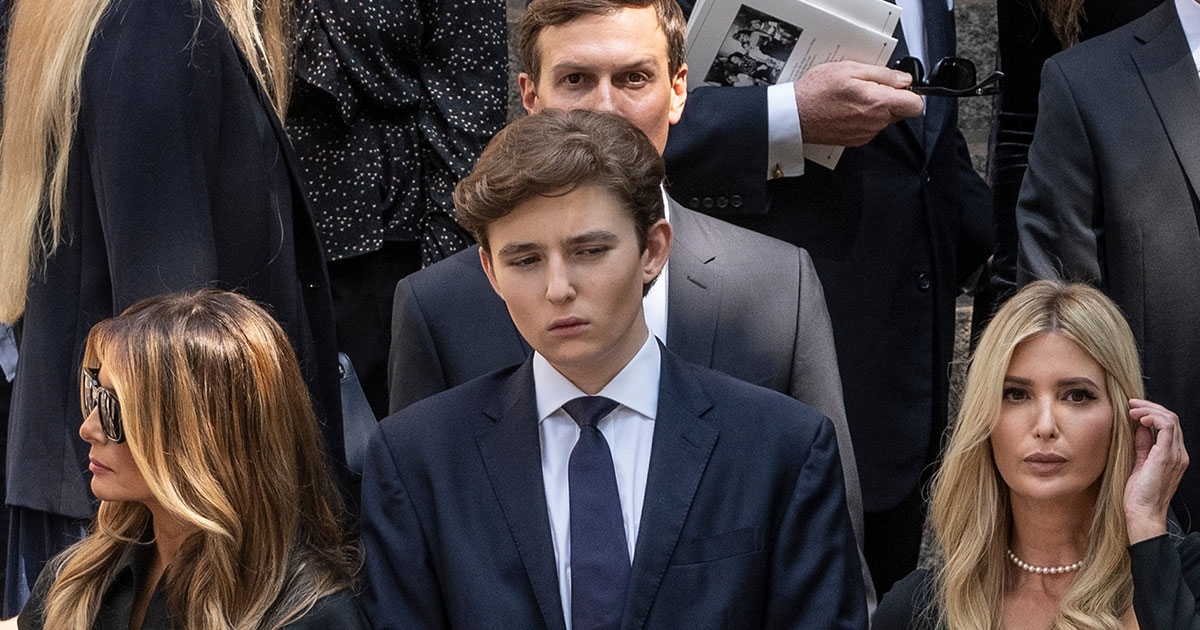
Donald Trump once described his youngest son as a child who had “just passed into something beyond child-dom.” The man he was talking about now stands around 6 feet 8 inches tall, studies business in Washington, D.C., and, according to a new book by two of the country’s most well-sourced political journalists, goes by a nickname that surprises almost everyone who hears it.
The Barron Trump nickname most people would expect – “Little Donald,” maybe, or something presidential-adjacent – turns out to be far simpler. According to Regime Change: Inside the Imperial Presidency of Donald Trump, published by Simon & Schuster on June 23, 2026, President Trump calls his son “Honey.” The detail surfaced in the context of a phone call that took place on September 10, 2025, the day conservative activist Charlie Kirk was fatally shot at Utah Valley University in Orem, Utah, confirmed by the FBI’s own investigation page. Barron reportedly called his father immediately after hearing the news, frantic and worried about the president’s safety. Trump’s response, as recounted in the book: “Calm down, honey, calm down.”
New York Times reporters Maggie Haberman and Jonathan Swan write in their book that after the assassination of Charlie Kirk, Barron called his father straight away after hearing the news. Donald responded, “Calm down, honey, calm down.” The moment is brief in the book, but the nickname it exposes drew immediate public attention – partly because of the tenderness it suggests, and partly because the man being reassured with it is 20 years old and towers over most people in any room.
It’s not the only name Trump has used for his youngest son. Growing up, Donald reportedly called Barron “little boy” – and his mom Melania Trump even calls Barron “little Donald.” That particular nickname from Melania has always made a certain kind of sense. People who have observed Barron closely have long noted personality similarities between father and son: a reserved confidence, a tendency to observe before engaging, a comfort with high-stakes environments most people would find overwhelming.
The Book Behind the Barron Trump Nickname
Regime Change is based on hundreds of interviews and unprecedented reporting from deep within the administration’s most closely guarded rooms, taking readers inside the Situation Room and into secret Oval Office deliberations. The book, published June 23, 2026, by Simon & Schuster, was produced after Haberman and Swan conducted more than 1,000 interviews over three years of reporting, covering the first 14 months of Trump’s second term.
Haberman is a White House correspondent for The New York Times and a Pulitzer Prize winner. Swan is also a White House correspondent for The New York Times and has reported on Donald Trump since 2015, covering all three of his campaigns and his first term in office. He spent six years at Axios before joining the Times in January 2023, and earlier in his career covered Capitol Hill for The Hill. He won an Emmy Award for his 2020 interview of then-President Trump.
The Barron nickname is a minor note in a book packed with major political disclosures – Oval Office recordings, Iran war deliberations, Justice Department directives – but it resonated with readers in a way that many of the larger revelations did not. Haberman and Swan’s account states that during the time of Charlie Kirk’s assassination, Barron had called his father in panic to check up on him and was the first person to inform Donald Trump of the activist’s murder. During their conversation, Barron expressed his worries regarding the safety of his father before explaining how the latter was endangering his life by continuing to address large crowds.
Who Barron Trump Is Today
The 20-year-old at the center of all this is, by most accounts, one of the more private members of an exceptionally public family. Born on March 20, 2006, he grew up largely shielded from media attention – his parents were unusually protective of his public profile throughout his childhood. That changed somewhat when he graduated from Oxbridge Academy, a private preparatory school in West Palm Beach, Florida, in May 2024, and made his next move very publicly.
Barron Trump enrolled in NYU’s Stern School of Business, his father confirmed in an interview with the Daily Mail. According to Axios reporting, the university had an 8% acceptance rate for the incoming undergraduate class. The choice was a departure for the Trump family: the former president and three of his other children all attended the University of Pennsylvania. Donald Trump, Ivanka, Donald Jr., and Tiffany all went through Wharton or Penn. Barron was the first of the five Trump children to break that mold.
New York University’s Leonard N. Stern School of Business became Barron Trump’s college of choice in fall 2024. He started at the Manhattan campus before moving to NYU’s Washington, D.C. campus for his sophomore year in 2025. The D.C. location puts him close to the center of political power, his father now holds – though Barron has made few public statements about his own political ambitions.
He did decline one formal political role. In 2024, he was invited to serve as an at-large delegate for Florida at the Republican National Convention, but turned the position down. The decision was widely read as a signal that, whatever he may be working toward privately, he wasn’t ready to appear on a national political stage on his own terms.
The Crypto Venture Few People Know He’s Part Of
Away from his studies, Barron holds a formal role in one of the Trump family’s most financially significant ventures. Alongside Donald Trump, Eric Trump, Donald Trump Jr., and the Witkoff family, Barron is among the founders of World Liberty Financial. An early internal report listed Barron as “Chief DeFi Visionary,” Eric and Donald Jr. as “Web3 Ambassadors,” and Trump Sr. as “Chief Crypto Advocate.”
DeFi, short for decentralized finance, refers to financial services that run on blockchain technology rather than through traditional banks or institutions. Barron Trump is listed as a decentralized finance “visionary” for the venture. Trump’s financial disclosure showed he received hundreds of millions from the crypto venture World Liberty Financial, which he and his sons helped launch in 2024, according to The Hill.
The Trump family is entitled to 75% of the proceeds from World Liberty’s crypto token sales, according to disclosures made in a document World Liberty published in 2024 describing its token offering. The scale of the financial returns has attracted scrutiny from Democratic lawmakers and ethics watchdogs, with questions raised about conflicts of interest given the president’s simultaneous role in shaping crypto regulation. Barron’s formal involvement in the venture – listed publicly as a co-founder – means he is part of a project that CNBC reported drew immediate attention when it launched for the blurring of lines between presidential power and family commercial enterprise.
For a 20-year-old in his sophomore year of business school, the portfolio is unusual by any measure.
The question of how Barron fits into the broader Trump political project is one that observers have speculated about for years. He’s been largely absent from campaign events, political rallies, and the usual apparatus of family image management. Reporting on Barron’s draft eligibility surfaced another dimension of that public interest: as a 20-year-old male, he falls within the draft-eligible age range under the updated Selective Service rules signed into law in December 2025, and his unusually tall frame has become a talking point in its own right.
What a Nickname Could Reveal
Small details in political books tend to get outsized attention, and the “Honey” revelation is a good example of why. The substance of Regime Change is its documentation of war decisions, loyalty tests, and institutional overreach. But what readers latched onto immediately was a two-word exchange between a father and a son.
The reason isn’t hard to understand. Donald Trump’s public persona is built on dominance, combativeness, and an almost studied aversion to visible tenderness. The nickname doesn’t erase any of that – it just adds something people weren’t expecting. A president who reportedly nicknames his adult son “Honey” in a moment of genuine parental worry is a different texture of person than the one who appears at rallies and press conferences.
Melania’s nickname for Barron – “little Donald” – points toward similarity and succession. Trump’s own “little boy,” used when Barron was growing up, is just the kind of fond diminutive that parents everywhere use for children they watch grow up too fast. “Honey” is something different. It’s the word you reach for when someone you love is scared and you want to bring them back to calm.
Regime Change arrives at a moment when every detail about Trump’s inner life carries amplified weight. The book’s bigger revelations – the Oval Office recordings, the Iran war decisions, the loyalty purges – will shape how historians write about this presidency. But the “Honey” detail is doing something different. It’s filling in a part of the picture that official accounts and campaign imagery never provide: what a family actually sounds like when the cameras are off and the news breaks fast.
Barron Trump remains, by design, a figure who says almost nothing in public. He is a sophomore in Washington, D.C., a listed co-founder of a multi-billion-dollar crypto venture, and the youngest child of the sitting president. The nickname his father uses for him changes none of those facts. What it does is remind readers that behind every public figure, and every carefully managed family image, there are phone calls that happen in real time – unscripted, unplanned, and sometimes surprisingly ordinary.
Whether or not that tells us something meaningful about the Trump family’s private dynamic is a matter of interpretation. The book supplies the specifics. The rest is up to the reader.
AI Disclaimer: This article was created with the assistance of AI tools and reviewed by a human editor.