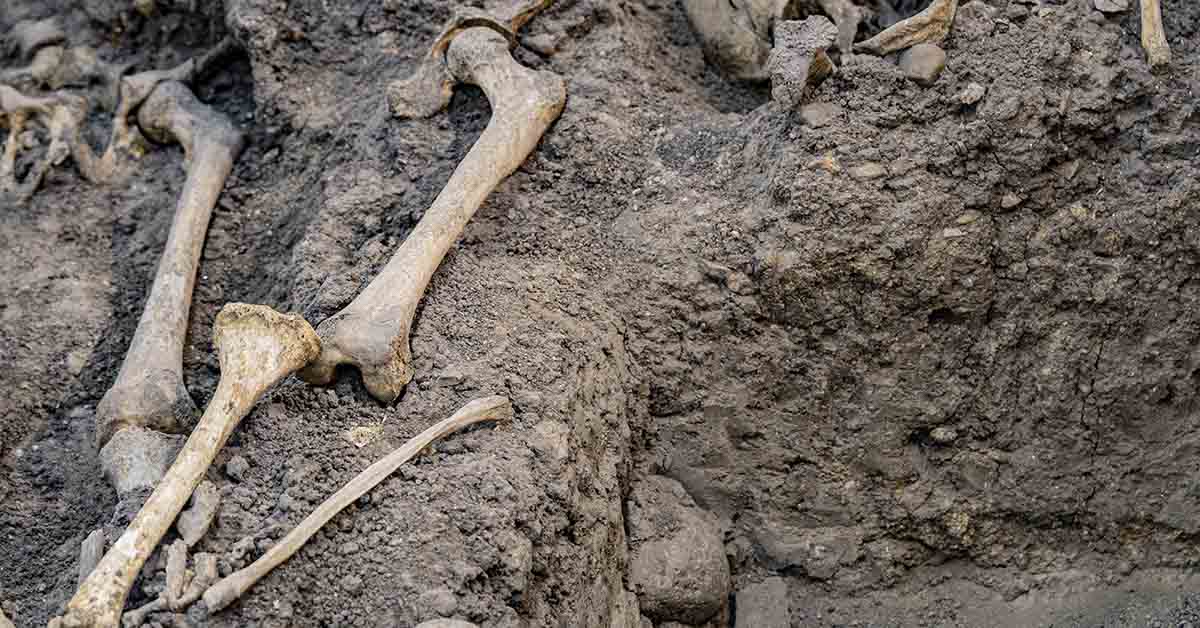
For decades, the Beachy Head Woman existed only as an overlooked set of remains, until new research pushed her into public view. Her remains were discovered in 2012 among the Eastbourne Town Hall collections, boxed and labelled with only rough hints about a 1950s find near the Sussex coast. The first public reconstruction turned her into a headline about early Black history in Britain. Years later, improved ancient DNA methods prompted researchers to revisit the evidence, and this time the data were of much higher quality. The result is a sharper, less speculative picture: she most likely descended from the local population of Roman-era southern Britain rather than from recent sub-Saharan African ancestry.
Back in the light
The Beachy Head Woman did not appear in a dramatic new excavation. She re-entered view through paperwork, storage, and a careful re-check of old holdings. Her remains were brought to light in 2012 after workers uncovered them inside Eastbourne Town Hall collections, with box notes pointing to Beachy Head and a 1950s context that still lacks a recovered excavation record. That gap shaped everything that followed. Without a clear burial report, researchers had to treat her as a person with a known body, an uncertain discovery trail, and a limited surrounding story. Yet even with those limits, bones carry time stamps. Radiocarbon dating placed her death between 129 and 311 CE, during Roman rule in Britain.
Basic osteology also gave a grounded sketch of her life. The teams reported she died aged about 18 to 25, and stood just over 4.9 feet tall. They also noted a healed leg wound, which suggests a serious injury she survived well before death. Chemistry in her bones added another clue: carbon and nitrogen values pointed to a diet with plenty of seafood, which fits a coastal setting. None of this tells you what she looked like in a modern racial frame. It tells you she was real, young, short, injured once, and fed by a landscape that included the sea.
Skull to slogan
Early interpretations leaned heavily on skull form, using morphometric and morphological comparisons to suggest distant ancestry. That approach can sound objective, yet it often operates inside modern categories that biology does not neatly support. The Beachy Head Woman’s “earliest Black Briton” label grew from this phase, when morphometric analysis suggested sub-Saharan African origins, and the idea travelled into museum display and public discussion. Later, an attempt in 2017 extracted only a small amount of low-quality DNA, hinting at Mediterranean connections, but the team judged the data too weak for a journal paper. So the public narrative bounced between bold claims while the underlying evidence stayed thin.
This is not unique to one skeleton. Forensic and bioarchaeological ancestry estimation has a long, contested history, especially when methods map bone variation onto social labels. A 2021 review in Forensic Sciences notes the tension plainly: “However, some biological anthropologists questioned the ethics of even estimating this parameter, fearing that its continued use would endorse racist views.” That critique does not say skull analysis is useless. It says the stakes are high, the categories are slippery, and overconfidence travels fast. In the Beachy Head Woman case, the public absorbed a confident identity claim long before the strongest biomolecular evidence arrived. Once a label sticks, people build lessons, plaques, and pride around it, yet the science may still be mid-process.
The DNA leap
Interestingly, the turning point was not a change in values or a new agenda. It was a change in data quality. The 2025 work used newer DNA sequencing approaches and improved computational comparisons to produce far more usable genetic information than the earlier attempt. UCL’s Andy Walton described the jump in practical terms: “Using newly developed DNA sequencing technology, we were able to retrieve about 10x the amount of DNA from Beachy Head Woman’s remains as the attempt in 2017.” Better coverage means fewer guesses. It lets researchers compare an individual to larger reference datasets, and it reduces the temptation to treat one thin signal as a verdict.
The institutions and leadership were clearly stated in official releases. Scientists at London’s Natural History Museum led the comprehensive analysis, with Dr Selina Brace and Dr William Marsh named as leads, alongside Walton at University College London. In the museum press release, Marsh summed up the core finding: “We show she carries genetic ancestry that is most similar to other individuals from the local population of Roman-era Britain.” That quote is important because it is specific. It does not claim she never travelled. It does not claim that nobody with African ancestry lived in Roman Britain. Rather, it says this person’s genome aligns most closely with local Roman-era British comparators, with no sign of recent African or Mediterranean ancestry in the data they generated.
Many tests, one picture
The peer-reviewed paper behind the headlines used a “multiproxy anthropological and biomolecular approach,” meaning the team did not bet everything on a single method. Additionally, the University of Reading announcement lists the study title and full citation. It also names the author group: Walton, Marsh, Strang, Seaman, Van Doorn, Eckardt, Wilkinson, Barnes, and Brace. This list signals a collaborative build: genetics expertise, archaeological context, and specialist lab work, all pressed into one attempt to reduce uncertainty.
The “proxies” mentioned in official reporting include radiocarbon dating, skeletal analysis, dietary isotope work, and genome-wide DNA comparisons. Radiocarbon dating anchored her to Roman Britain, between 129 and 311 CE. Bone chemistry suggested high seafood intake, which fits the Sussex coast and strengthens the case that her day-to-day life likely unfolded near the sea. Furthermore, the healed leg wound adds a human detail that also helps interpret her mobility and health history. Each proxy has limits, yet together they form a tighter net. DNA suggests broad ancestry relationships. Isotopes speak to diet and geography. Osteology shows age, stature, and trauma. The combined picture reads less like a dramatic reveal and more like a patient reconstruction.
What DNA hints at
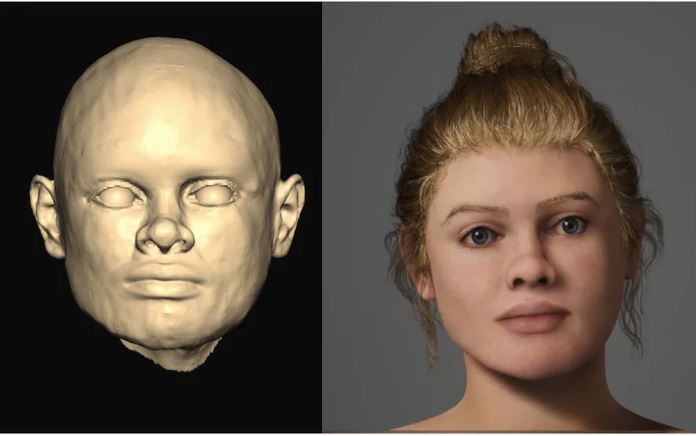
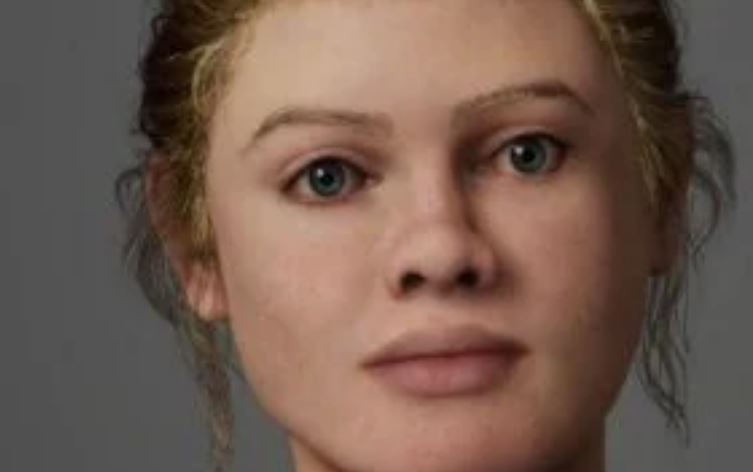
Once researchers had higher-quality DNA, they also used modern forensic-style tools to infer probable traits, including pigmentation. The Natural History Museum’s explainer notes that the new DNA allowed an updated digital facial reconstruction, with predicted “light skin pigmentation, blue eyes, and fair hair.” That kind of prediction can sound definitive, so it needs careful handling. These are probabilistic inferences based on known variant-trait links in present-day datasets, applied to ancient DNA. They can be useful, yet they are not a direct photograph of the past. Still, they are far more grounded than reading ancestry from skull shape alone, especially when older methods get forced into modern racial boxes.
Importantly, the team did not present pigmentation as the central claim. Their central claim is ancestry similarity to local Roman-era Britain. Pigmentation adds texture to the public image problem, because the “earliest Black Briton” label was never only about migration history. It was about how a reconstructed face looked to modern eyes, and how quickly viewers turned that into a fixed identity category. In the museum press release, Brace framed the work as an effort to push for better answers: “Our scientific knowledge and understanding are constantly evolving, and as scientists, it’s our job to keep pushing for answers.” Read plainly, that is a warning against treating a first reconstruction as an endpoint. It also discourages turning a single ancient individual into a stand-in for huge modern debates.
Empire on the move
One misread of this update would be to treat it as proof that Roman Britain lacked diversity. The researchers did not claim that. In fact, the Reading co-author Professor Hella Eckardt underlined movement across the empire and the need to keep migration in view: “We know from inscriptions that people travelled to Britain from across the Roman Empire, which is why it’s so important to consider migration and diversity when studying this period.” That statement fits what historians and archaeologists have said for years: the empire moved soldiers, traders, enslaved people, and families along roads and sea lanes. Britain sat inside those systems, especially in ports and garrison towns.
The Beachy Head Woman’s likely local ancestry does not cancel that wider truth. It narrows the claim about this one person. The Natural History Museum article also points out that, at the height of Roman Britain, the province was connected to a wider imperial network that brought people from across Europe and North Africa, and it cites other research showing mixed ancestries in later periods. So the better takeaway is precise, not sweeping. Roman Britain included movement and mixture, yet individual cases need strong evidence before anyone makes them a symbol of anything. When the evidence improves, the responsible move is to update the record, even if the update disappoints people who preferred the older, simpler claim.
When labels stick
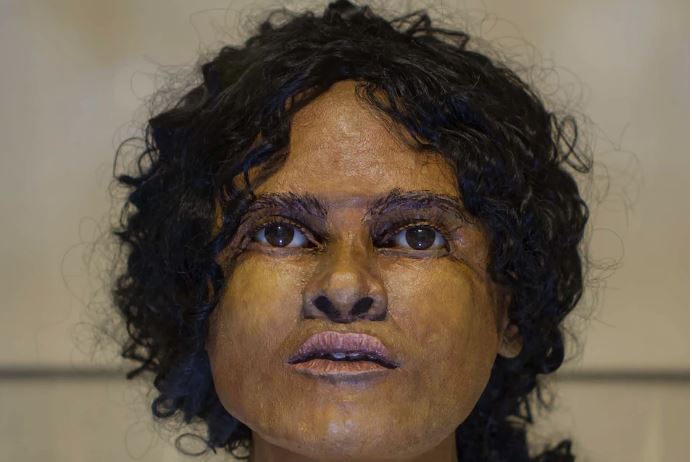
Public history runs on images. Once a museum display and a media framing settle into people’s minds, reversing it becomes emotionally loaded. The Beachy Head Woman’s identity travelled widely after initial analysis suggested sub-Saharan African origins, influencing displays and public discussion. Later, a Mediterranean idea entered the mix through the weak 2017 DNA attempt, but the museum article stresses that the low-quality DNA was not enough to publish, which left the public with ambiguity and rumours. Meanwhile, the “earliest Black Briton” phrasing kept circulating because it was tidy, dramatic, and easy to repeat.
This is where scientific caution collides with public appetite. When institutions honour a claim with signage, reconstructions, or commemorations, they raise the cost of correction. Yet correction is part of honest curation. The Natural History Museum press release states that the shifting identity “shows how important it is for scientists to revisit previous findings using new methods.” That sentence also implies something about museums: they need built-in humility. A display label can leave room for change. A reconstruction can be presented as a working model, not a final portrait. If this case teaches anything practical, it is about how to communicate uncertainty early, before a single interpretation becomes a civic fact.
Read More: Scientists Stunned by Discovery of Unique Golden Shark in Costa Rica
Public science, real corrections
People often ask why the original claim happened at all. The simplest answer is that early methods can point in the wrong direction, and the public rarely sees the uncertainty language that researchers use among themselves. In 1995, anthropologist C. Loring Brace addressed the gap between social expectations and biological complexity in forensic identification debates, writing that the “simple answer” involves “social conventions” shaping the expected result. That insight helps explain why skull-based ancestry talk can slide into cultural categories that feel familiar, even when the biology is messier. It also explains why a confident public label can outlive the evidence behind it.
The more encouraging part is how the correction happened. Teams returned to the same remains, used better sequencing, compared to expanded datasets, and then published the result in a peer-reviewed venue. Marsh explained the benefit of improved reference genomes and tools: “By using state-of-the-art DNA techniques and newly published genomes, we were able to determine the ancestry of the Beachy Head Woman with much greater precision than before.” That is science acting like science. It does not protect old claims. It tests them again when tools improve. It also forces communicators, including journalists and museums, to update what they told the public.
What comes next
Even with stronger DNA results, the Beachy Head Woman remains partly unknown. Her discovery context is still fuzzy because no excavation record has been recovered, and the label trail only points back to the 1950s. That means researchers still cannot place her burial precisely in a cemetery plan, connect her to grave goods, or link her to a documented settlement in a fully secure way. Yet multiproxy work can keep narrowing the options. Additional isotopic sampling, improved local baseline maps, and broader comparative datasets could refine where she lived within southern Britain, and possibly where she spent her childhood.
The bigger lesson is about responsible claims. Walton said, “It’s always a real privilege to be able to work with human remains, so it was really important that we found out as much as we could about Beachy Head Woman and got her story right.” That is the tone this topic needs. Ancient people should not be turned into modern mascots, and they also should not be used to shut down conversations about diversity in the past. Good research keeps both impulses in check. It says what the evidence supports, explains the limits, and stays ready to update again if better data arrives.
A.I. Disclaimer: This article was created with AI assistance and edited by a human for accuracy and clarity.
Read More: Mass Discovery of Cremated Human Remains in Nevada Desert Triggers Federal Investigation