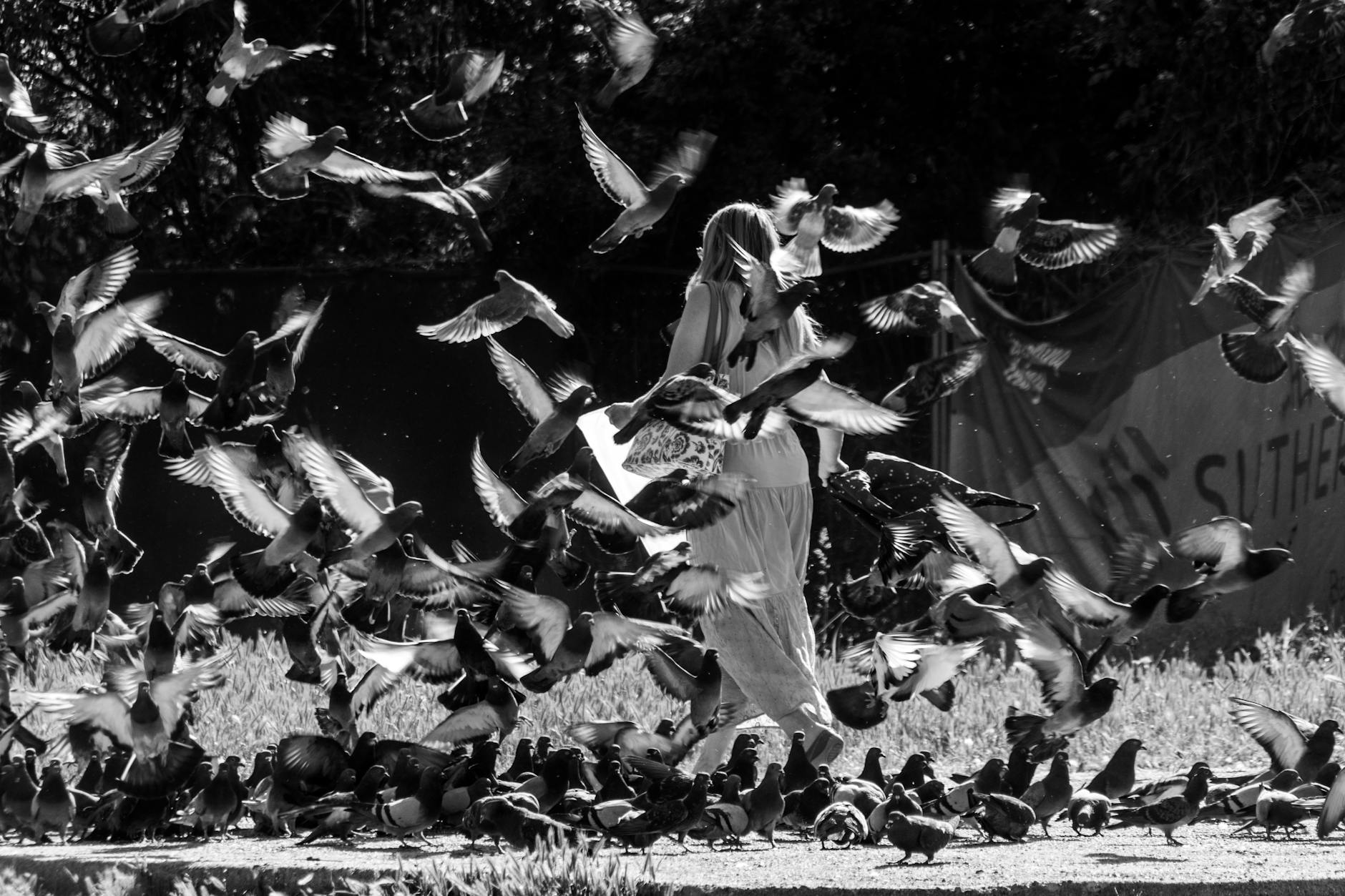

The pigeon on the park bench didn’t budge when the man walked past. A few minutes later, a woman strolled by on the same path, and it was gone before she got close. Birds fear women more readily than they fear men – and a team of researchers who set out to study this properly found they could replicate it across five countries, 37 species, and multiple seasons, without being able to explain it.
A study published in 2026 in the journal People and Nature found that urban birds consistently flee sooner when approached by women than by men. Men could get about a meter closer to birds than women could before the animals flew away. The pattern held across cities, across seasons, and across species that range from the notoriously skittish to the famously bold.
The researchers expected the opposite. If birds have any learned or evolved wariness around humans, the conventional logic says they’d fear men more. Men have historically been associated with hunting across many cultures. Birds, presumably, would have encoded that threat over generations. The outcome defied those expectations: European great tits and 36 other bird species were more afraid of women than men, and researchers have no idea why. And nobody, including the scientists who ran the experiment, can say why.
How the Study Was Designed
Conducted across five European countries, the study involved male and female participants matched for height and clothing walking in a straight line toward birds in urban parks and green spaces. The observers weren’t random volunteers. They were eight expert ornithologists – four men and four women – who collected data across Czechia, France, Germany, Poland, and Spain. Their expertise meant they knew how to approach birds without exaggerating their movements or behaving unusually. They were, as far as a bird can tell, just people walking across a park.
The study, published in People and Nature, found that male participants could get within 7.5 meters of urban birds before the birds flew away, a full meter closer than their female counterparts. The dataset contained 2,701 observations in total, though the researchers caution that these still represent preliminary findings and that more research is needed to confirm the consistency of the observed sex-related pattern.
The Finding That Crossed Every Boundary
The effect wasn’t limited to one city, one country, or one temperamental species. The results were consistent across all five countries, and the finding held across all 37 bird species studied – from species that typically flee early, like magpies, to species that flee late, like pigeons. Species like great tits, house sparrows, and blackbirds were among those studied.
Flight initiation distance (FID) is the point at which an animal decides a threat is close enough to flee from. A longer FID means the bird gives up on feeding sooner; a shorter FID identifies bolder individuals who tolerate more risk. So when a magpie, one of the most alert birds in any European park, flees a woman earlier than it flees a man, that’s the bird calculating a higher threat level from the woman. When a pigeon does the same thing, the pattern is holding across a species that will eat a sandwich from your hand.
This pattern remained regardless of what the men and women were wearing, what their height was, or how they tried to approach the creatures. Clothing was matched. Heights were matched. Walking style was standardized. The researchers removed every variable they could think of. The birds still knew.
The Theories, and Why None of Them Fully Hold
The researchers have a few hypotheses for what birds are detecting – pheromones, body shape, or gait – but say these are speculative and that more research is needed.
Gait is one candidate. Men and women, on average, walk differently. The distribution of body weight, the width of the stride, the movement of the hips and shoulders: these create motion patterns that differ in subtle, consistent ways. A bird scanning its environment continuously for threats might process those patterns faster than any human researcher can consciously observe.
Then there’s scent. The idea that birds have a poor sense of smell has been quietly dismantled over the past few decades. Several bird species use olfaction in meaningful ways, and a 2025 review published in Ibis found that our understanding of the functional importance of olfaction to birds has improved over the past 60 years, largely as the result of experimental studies testing how birds use their sense of smell in different contexts. If birds can detect chemical signals from the environment, they may also be picking up on hormonal or chemical differences between male and female humans – pheromones, skin chemistry, or other signals that humans themselves don’t notice. Whether any of that drives the fear response seen in this study remains a hypothesis without direct evidence.
Body shape is another possibility. Even with height matched and clothing standardized, the physical proportions of men and women differ in ways that are visible from a distance. Birds have exceptional visual acuity and process shape and silhouette as threat cues. A slightly different shoulder-to-hip ratio, or the way mass is distributed in motion, could register as a distinguishing feature. No study has tested this directly in the context of fear responses.
What It Means for Science Itself
Before this study, no published research had tested whether the sex of the observer affects the escape behavior of wild birds. Given observed differences in how laboratory animals respond to the sex of the humans interacting with them, that gap in the field literature was striking.
Much of animal behavior research depends on humans watching animals. Scientists often try to standardize their methods so the human observer becomes, in effect, part of the background. But animals may not agree. To them, the observer is a body, a scent, a motion, a face, a shape, and perhaps a risk.
Dr. Yanina Benedetti, an ecologist at the Czech University of Life Sciences Prague, noted that “many behavioral studies assume that a human observer is neutral, but this wasn’t the case for urban birds in our study.” Benedetti added that urban birds clearly react to subtle cues that humans do not easily notice, and that follow-up studies could focus on individual factors such as movement patterns, scent cues, or physical traits, testing them separately rather than grouping them under observer sex.
Separating out what’s actually inside the variable labeled “sex” is the next research challenge. It could be one signal. It could be several. Some researchers have suggested humanoid robots as a potential future research tool – a robot walks toward a bird, researchers adjust the hip sway, the shoulder motion, the gait pattern, one variable at a time. If the flight distance changes, a specific cue has been identified.
One speculative theory in the paper involves evolutionary history. If women historically caught and killed smaller prey like birds while men pursued larger game, birds may have encoded a fear response to women over generations – and haven’t updated it. The authors acknowledge this is not particularly compelling as a standalone explanation. Dr. Federico Morelli from the University of Turin called this “maybe the most interesting part of our study,” adding: “We have identified a phenomenon, but we really don’t know why. However, what our results do highlight is the birds’ sophisticated ability to evaluate their environment.”
What This Means for You
The birds-fear-women finding raises a practical question for wildlife researchers: has the sex of the observer been quietly shaping field data for decades, without anyone accounting for it? If birds behave measurably differently around male versus female observers, then studies using only male or only female fieldworkers may have collected systematically skewed data on avian behavior.
For anyone who spends time in parks and green spaces, the takeaway is more immediate. Flight initiation distance can be influenced by a range of factors, including the number of people around, the bird’s alertness, and, apparently, the sex of the human approaching. Move slower, approach from a greater distance, keep your posture low and non-confrontational – these remain the best practical strategies for getting close to urban birds, regardless of your sex. The researchers also found that birds tolerate closer approaches in areas with more dense bush cover, where escape routes feel secure. Green spaces with dense ground-level vegetation are your best setting for bird observation.
The findings suggest birds may be able to suss out the sex of a human, though the researchers aren’t sure how. Whatever signal they’re using, it was subtle enough that eight trained ornithologists couldn’t neutralize it by wearing the same clothes and walking the same way. Birds are reading us more carefully than we read them – and we’ve only just started asking the right questions.
AI Disclaimer: This article was created with the assistance of AI tools and reviewed by a human editor.
Read More: Dogs Can Smell If You’re Stressed or Relaxed and Adjust Their Behavior For You