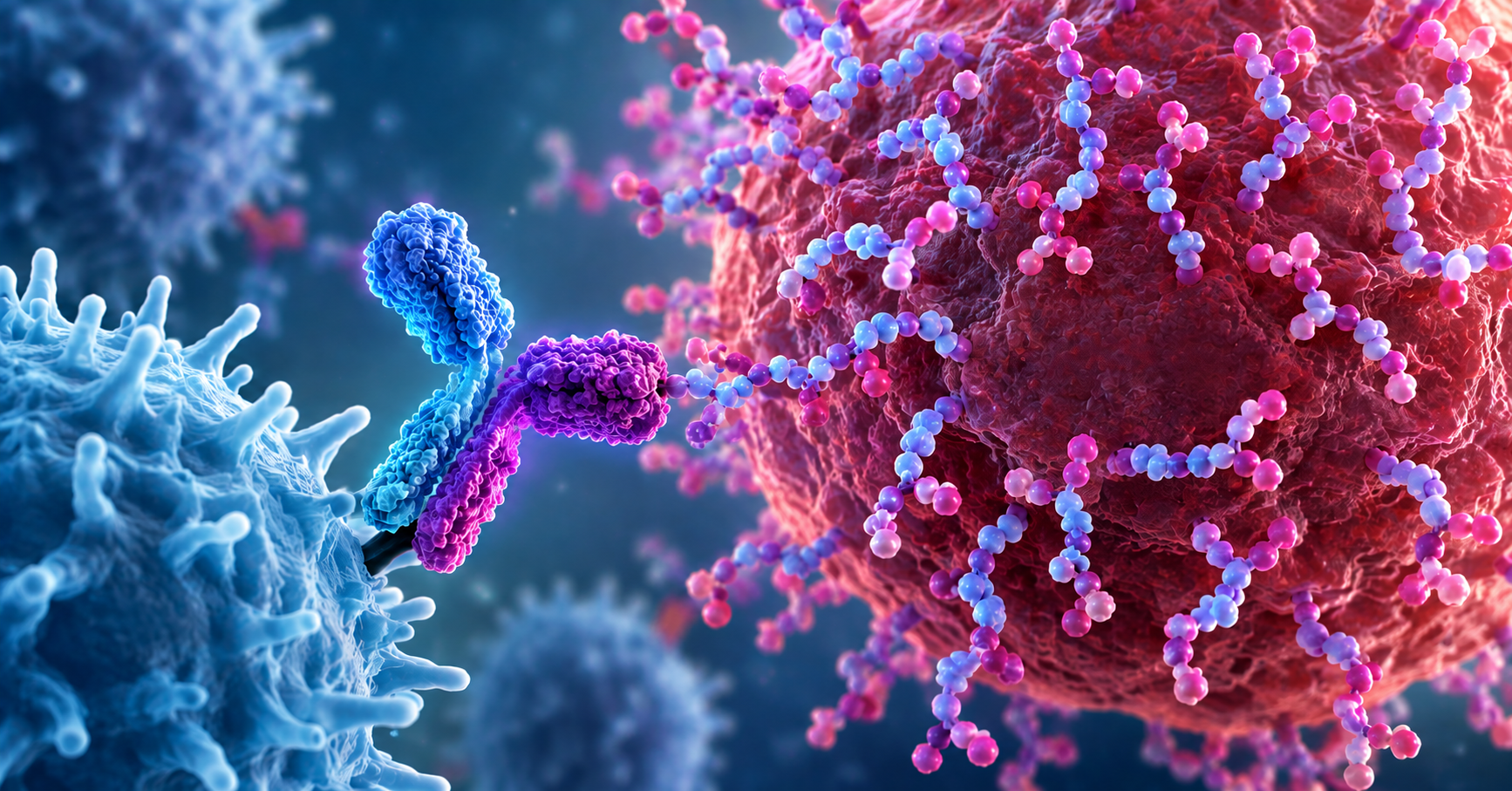

Cancer cells have developed numerous ways to hide from the immune system. One of the strangest may be written in sugar.
Every cell in the human body is covered in a dense layer of sugar-containing molecules called glycans. These aren’t the sugars you eat in food. They’re structures naturally built onto the surface of cells, where they help the immune system recognize what belongs in the body and what doesn’t.
Cancer can take advantage of that system.
Some tumors alter the glycans on their surface in ways that effectively tell approaching immune cells to stand down, helping the cancer escape an attack that might otherwise destroy it.
Researchers at MIT, Stanford, and collaborating institutions have now developed an experimental therapy designed to interfere with those signals.
The approach, described in Nature Biotechnology, uses engineered molecules called antibody-lectin chimeras, or AbLecs, which can target cancer cells while blocking some of the sugar-based signals they use to suppress the immune response.
In laboratory experiments, the molecules helped human immune cells attack cancer cells. Researchers also saw reduced tumor burden when they tested the approach in a humanized mouse model.
It’s very early research. No cancer patients have been treated with AbLecs, and there is no evidence yet that the approach will work safely in people.
But the study points toward an intriguing possibility: some cancers may be hiding behind an immune defense that existing immunotherapies largely don’t target.
And despite some viral headlines, scientists didn’t exactly “remove cancer’s sugar shield.” What they did is arguably more interesting.
How cancer uses glycan immune evasion as a defense
AbLecs are made up of an antibody that targets a particular type of cancer tumor and a protein called a lectin that binds to the tumor’s glycans. Glyco-immune checkpoints are interactions between glycans on cancer cell surfaces and lectin receptors on immune cells. These interactions function as molecular brakes, reducing immune activation and helping tumors avoid destruction.
The specific class of surface sugars most heavily implicated in this process is sialic acids – molecules that cap the ends of glycan chains and play a central role in marking cells as “self” to the immune system. Hypersialylation, the overexpression of glycans capped by sialic acid, is a hallmark feature of cancer. Glycosylation, a post-translational modification, is dysregulated in nearly all cancer types, and tumor cell surface glycosylation is substantially remodeled compared to normal cells.
Sialylated glycans enhance immune evasion by interacting with Siglec receptors – sialic acid-binding proteins expressed on the surface of immune cells. Siglecs are inhibitory receptors, similar to established immune checkpoints including PD-1 and CTLA-4, that suppress anti-tumor immune responses. When a cancer cell loaded with sialic acid glycans encounters an immune cell’s Siglec receptor, the result is suppression – the immune cell receives a molecular instruction to stand down.
No approved cancer immunotherapy specifically targets this sugar-based immune checkpoint axis. Growing research interest in glycan-targeted therapies reflects their potential to enhance or synergize with current immunotherapy approaches, but the clinical toolbox for targeting them remains almost empty.
Read More: A Simple Food Swap May Help Prostate Cancer Survivors Live Longer
What the MIT and Stanford researchers built
The AbLec system began in the lab of Stanford chemist Carolyn Bertozzi and was developed through a collaboration involving researchers at Stanford, MIT, and several other institutions. Bertozzi is also known for pioneering bioorthogonal chemistry, a field that allows chemical reactions to take place inside living systems without disrupting normal cellular chemistry. That work earned her a share of the 2022 Nobel Prize in Chemistry.
The study, published in Nature Biotechnology, describes AbLecs as a modular system for glyco-immune checkpoint blockade. Each AbLec molecule joins two components: a cell-targeting antibody domain and a lectin “decoy receptor” domain that directly binds glycans and blocks their ability to engage inhibitory lectin receptors. One end of the molecule latches onto a specific target on the cancer cell’s surface, while the other end occupies the glycan signals that would normally tell immune cells to stay away.
AbLecs block the immune-suppressive signal those glycans send by occupying glycan-binding receptors on immune cells with a decoy, preventing the cancer cell’s surface sugars from engaging inhibitory Siglec receptors.
In laboratory experiments using human immune cells, AbLecs enhanced antibody-dependent phagocytosis and cytotoxicity of cancer cells – even against tumor cells expressing low levels of the targeted antigen. Tumors can downregulate surface targets to evade therapies that depend on recognizing them, which makes the low-antigen finding practically relevant.
The researchers then tested the approach in a humanized mouse model, where human immune cells were engrafted to make the model more relevant to human biology. AbLecs reduced tumor burden in that model, according to the published findings in Nature Biotechnology.
The system’s modular architecture means AbLecs can be designed to target numerous tumors and immune cell subsets as well as multiple glyco-immune checkpoints. In principle, researchers could swap the antibody component to target a different cancer type or pair a different glycan-binding domain with another tumor target. AbLecs also synergized with blockade of established immune checkpoints in the study – meaning the two approaches worked better together than either did alone, suggesting AbLecs could complement rather than replace drugs like anti-PD-1 therapies.
A reality check on the ‘sugar shield’ headlines
Several outlets described this research as scientists “removing cancer’s sugar shield.” Cancer glycan immune evasion is a documented mechanism, and interfering with it is a legitimate scientific goal. But the phrase misrepresents what the researchers actually did. AbLecs block the immune-suppressive signal glycans send; the cancer cell’s surface sugars remain intact.
No cancer patient has received AbLecs as a treatment. The technology is now being developed by Valora Therapeutics, a biotechnology company co-founded by researchers Jessica Stark and Carolyn Bertozzi. The results described here come from cell culture experiments and a humanized mouse model. Both are meaningful stages of early research, but neither establishes that AbLecs will be safe or effective in people. The path from a promising preclinical result to an approved human therapy is long, and many experimental treatments never make it through clinical development.
Read More: Cancer Vanishes After Immunotherapy Trial, Now Classified as FDA Breakthrough Therapy
Why this research direction matters
Cancer immunotherapy has already changed what is possible for some patients.
Drugs targeting immune checkpoints such as PD-1, PD-L1, and CTLA-4 can essentially release molecular brakes that tumors use to suppress the immune system. In some cancers, the results can be dramatic, but they don’t work for everyone.
That’s one reason the glycan system is attracting attention. Researchers have spent decades studying the protein signals cancer uses to manipulate immune cells. The sugars coating those same cancer cells may represent another layer of that conversation between tumor and immune system.
AbLecs are an attempt to interfere with it.
There is still a long way to go. The findings so far come from laboratory experiments and mice with human immune cells, not cancer patients. Many treatments that look promising at this stage never make it through human trials.
But if the approach eventually proves safe and effective, it could give researchers another way to attack tumors that evade existing immunotherapies, potentially alongside treatments already in use.
Perhaps the biggest takeaway isn’t that scientists have “removed cancer’s sugar shield.”
It’s that researchers are beginning to understand how to read, and potentially rewrite, some of the sugar-based signals cancer uses to hide from the immune system.
Disclaimer: This information is not intended to be a substitute for professional medical advice, diagnosis, or treatment and is for information only. Always seek the advice of your physician or another qualified health provider with any questions about your medical condition and/or current medication. Do not disregard professional medical advice or delay seeking advice or treatment because of something you have read here.
AI Disclaimer: This article was created with the assistance of AI tools and reviewed by a human editor.
Read More: Cancer Patients Are Traveling to China for CAR-T Therapy. Here’s Why