
When a parent reaches into the medicine cabinet for a bottle of children’s ibuprofen, they are trusting everyone involved in getting it there. That includes the chemist who formulated the liquid and the federal regulators whose job is to catch problems before those bottles ever reach a store shelf. Most of the time, that trust holds. The medicine works, the child feels better, and nobody gives a second thought to how it was made.
But over the past several years, that chain has broken more than once. The U.S. Food and Drug Administration has pulled nearly 100,000 bottles of children’s ibuprofen from pharmacy shelves in multiple nationwide recalls. In the most recent case, parents opened bottles to find a gel-like substance and dark particles floating in the liquid. In another, laboratory testing found the medicine contained more ibuprofen per dose than the label stated. That puts infants at risk of an overdose that their caregivers would have no way of knowing.
A parent may have given their child a dose that very morning, and there is no undoing that. Most families keep a bottle somewhere in the house because fevers and teething pain don’t wait for pharmacy hours. So when something that ordinary turns up on a recall list, the question is not abstract. It is whether the bottle you already opened is safe.
None of the recalls covered here has been linked to serious reported injuries. The oversight system did what it was designed to do, identifying and removing affected products. But the next recall is a matter of when, not if. And most parents won’t hear about it until after the bottle is already open.
The March 2026 Recall. Gel-Like Masses and Black Particles
On March 2, 2026, the FDA published an enforcement report confirming a nationwide recall of children’s ibuprofen. The recall covered 89,592 bottles of Children’s Ibuprofen Oral Suspension. The berry-flavored liquid is a pain reliever and fever reducer for children ages 2 to 11. It came in 4 fl. oz. bottles at a concentration of 100 mg per 5 mL. Strides Pharma manufactured it in India for Taro Pharmaceuticals USA, Inc. of Hawthorne, New York.
The enforcement report identified two affected lot numbers, 7261973A and 7261974A, both expiring January 31, 2027. The recall number is D-0390-2026. Strides Pharma Inc. of Bridgewater, New Jersey, voluntarily initiated the recall after receiving consumer complaints that bottles contained a gel-like mass and black particles. The product had already reached retailers nationwide before the company pulled it, but the FDA did not publish a list of stores that carried it. Without that list, parents have no way to know whether their pharmacy stocked the affected lots short of checking the bottle itself.
On March 16, the FDA classified the action as a Class II recall. The agency uses that designation when a product may cause temporary or medically reversible health effects, but the FDA considers serious harm unlikely. It sits one tier below a Class I recall, which the agency reserves for products that carry a reasonable chance of causing serious injury or death.
Beyond the consumer complaints, the enforcement report offered little detail. It did not explain how the foreign material entered the product, what it was composed of, or how many complaints the agency received before the recall began. FDA enforcement reports typically list only the affected product, the reason for the recall, and its classification. They do not include full investigative findings.
ABC News was the only outlet to secure a direct comment from the manufacturer’s parent company. Jeremy Allen, vice president of corporate affairs at Sun Pharma, said the company is committed to maintaining quality standards across all Taro-labeled products, including those manufactured by third-party partners like Strides. Allen added that Sun Pharma is in close contact with Strides as it investigates the root cause and works to meet all regulatory expectations. Strides Pharma did not issue a separate public statement at the time of the recall announcement.
As of the enforcement report’s publication, the FDA said it had not received reports of serious adverse health effects tied to the recalled product. The recall continues, but the FDA has recalled children’s ibuprofen over manufacturing failures before.
The 2018-2019 Tris Pharma Recall
In December 2018, the FDA announced that Tris Pharma had voluntarily recalled three lots of Infants’ Ibuprofen Concentrated Oral Suspension. The New Jersey-based company pulled the product after testing found ibuprofen concentrations higher than what the label stated. The medicine came in small 0.5 oz. and 1 oz. bottles designed for infants. That’s a far younger and more vulnerable population than the children covered by the 2026 recall.
Walmart, CVS, and Family Dollar sold the recalled medication under their store-brand labels. Tris Pharma manufactured all three, Equate, CVS Health, and Family Wellness, from the same affected batches. A parent shopping at Walmart would have had no reason to connect their bottle of Equate infant ibuprofen to a pharmaceutical company in New Jersey.
In January 2019, Tris expanded the recall to six lots and confirmed that some units contained ibuprofen concentrations up to 10% above the specified limit. A healthy adult might never notice that kind of overage, but an infant’s body weight is a fraction of an adult’s, and their kidneys and other organs are still developing. Tris warned that the excess could cause gastrointestinal problems ranging from nausea to bleeding, and in infants, permanent kidney damage.
The ibuprofen recall was not an isolated failure. Between July and December 2016, Tris had received at least 24 complaints about roughly 1,000 leaking or underfilled bottles of morphine sulfate oral solution. The company blamed the damage on shipment conditions, and the defective product stayed on the market for eight months before Tris pulled it. Tris also manufactured Quillivant XR, an extended-release liquid used to treat ADHD that Pfizer sold under its own name. Five lots failed testing meant to confirm that the drug releases the correct amount of medication in the body. Pfizer recalled all five.
In March 2018, months before the ibuprofen recall, the FDA sent Tris a warning letter. It cited both the morphine and Quillivant failures. The letter called out the company for inadequately investigating product defects and failing to take corrective action. The letter noted that inspections in 2011, 2012, and 2014 had found the same violations. The problems were documented, the warnings were on the record, and the ibuprofen recall happened anyway.
Pfizer later told CBS News it no longer does business with Tris. A February 2019 CBS News investigation connected these manufacturing failures to the ibuprofen recall. Erika Lietzan, a University of Missouri law professor and food and drug regulation expert, told reporters her instinct was that the company had serious manufacturing problems over a multiyear period. Whether Tris had fixed them, she said, was “completely in a black box.”
Tris Pharma received no reports of serious adverse events during the recall period, and the FDA has since terminated the recall. But that outcome owed more to luck and attentive parents than to any safeguard that caught the problem before the bottles shipped.
What These Recalls Tell Us About Children’s Medication Safety
The FDA does not test children’s medicine before it ships. Manufacturers do that themselves, and the entire regulatory structure treats their self-reporting as sufficient. When a company’s internal controls fail, the FDA steps in only after the product has already reached stores. The system is built to remove contaminated bottles from shelves, not to keep them from getting there. That design depends on the FDA having a clear view of what happens inside the factories producing these medications.
It doesn’t. Strides Pharma manufactured its recalled children’s ibuprofen in India. A 2025 White & Case analysis found the FDA preannounced nearly 90% of its foreign inspections in fiscal year 2023, giving manufacturers weeks or months to prepare before inspectors arrived. Domestic factories get no such warning. But even with time to get ready, foreign sites failed at more than twice the rate of domestic ones. Facility staff at some sites destroyed documents while inspectors were still in the building. If manufacturers are failing inspections they knew about in advance, what a surprise visit would find is a question the FDA has mostly avoided asking.
It did ask once. From 2014 to 2015, the agency ran an unannounced inspection pilot in India. It found widespread misconduct and falsified quality records at the sites it visited, then discontinued the program. Republicans on the House Energy and Commerce Committee flagged the decision. A second unannounced inspection pilot began in India in 2022. But a 2025 Government Accountability Office report found that roughly 2,000 pharmaceutical manufacturers had not seen an FDA inspector since before the pandemic as of May 2024.
The pressure eventually produced a public response. In May 2025, the FDA announced it would expand unannounced inspections beyond India and China to foreign facilities worldwide. Commissioner Martin Makary called preannounced foreign inspections a ‘crazy system’ where American manufacturers are put through the wringer with inspections, and the foreign sites get off easy with scheduled visits.’ Whether the agency can follow through is an open question. But for the first time, the FDA has acknowledged what critics have been saying for years.
That same GAO report counted 225 vacancies across the inspection workforce as of June 2024, nearly four times the pre-COVID number. Fifty-one of those sat among the investigators responsible for verifying drug manufacturing quality. Former inspectors can earn more than double their government salary in private industry, so the agency keeps losing the people trained to do the work faster than it can replace them. The result is an agency that is years behind on inspections it already committed to completing, and cannot hold onto the staff it needs to catch up.
Unannounced inspections are already standard at domestic facilities, and at Tris Pharma, the FDA used them. Inspectors found the same violations across multiple visits and put them on the record. But a warning letter is just a record. It documents what the FDA found and what it told the company to fix, then leaves the fixing entirely to the company. Nothing about it shuts down a production line or pulls a product from shelves. What happens between one inspection and the next is something only the manufacturer knows.
The label on a bottle of children’s ibuprofen does not say who manufactured the liquid inside, when the FDA last inspected that facility, or whether the company has a history of quality failures. The lot number and expiration date are there, but the information a parent would actually need to evaluate risk is nowhere on the packaging. Children’s ibuprofen remains safe and effective when manufactured correctly. The products currently on shelves that are not part of any recall met the FDA’s standards. But both recalls followed the same sequence, and the people who broke it were not regulators or executives. They were parents who opened a bottle and decided something wasn’t right.
How to Check Your Medicine Cabinet and What to Do Next
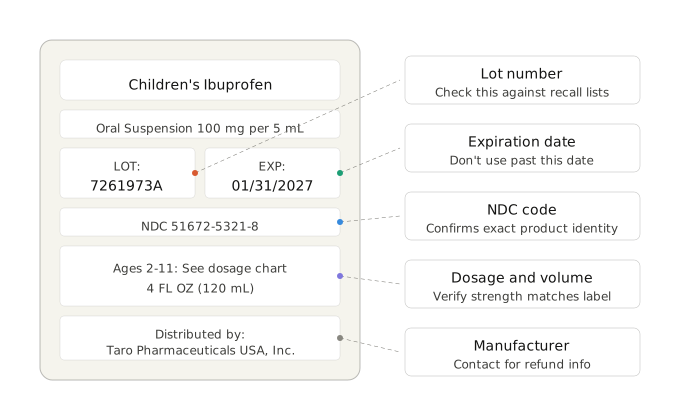
Start with the bottle. The lot number is printed on the label or stamped near the barcode, and the expiration date usually sits right next to it. If either number matches a recalled lot, stop using the medicine and set it aside. You can return it to the store where you bought it for a full refund, or contact Taro Pharmaceuticals directly for refund information. The packaging also carries a National Drug Code of 51672-5321-8. That’s worth knowing if the label is smudged or hard to read. It gives you a second way to confirm you’re looking at the right product.
Even if your bottle is clean, get into the habit of checking any children’s liquid medication before you give it. Hold the bottle up to a light source and tilt it slowly. The liquid should look uniform in color and texture, with nothing floating, clumping, or settling in a way that doesn’t clear when you shake it. It takes a few seconds, and it is the one quality check that happens after the bottle leaves the factory.
If your child has already taken a dose from a recalled ibuprofen bottle and seems fine, that’s a good sign. The FDA classified the contamination as unlikely to cause serious harm, and no one has reported a severe reaction to the affected product. Still, watch for stomach pain, vomiting, diarrhea, or any symptom you can’t explain in the days after. Call your pediatrician and mention the recall. Poison Control runs a 24-hour hotline at 1-800-222-1222. They can tell you whether what your child consumed warrants a trip to the doctor.
There is one more thing you can do, and most parents skip it because it feels bureaucratic. If you find something wrong with a medication, report it. The FDA’s MedWatch program accepts reports from anyone, not just doctors, and you can file one online at fda.gov/medwatch or by calling 1-800-332-1088. The form asks for the product name, what you found, and your contact information. Anyone can fill it out, and a report about a quality problem counts whether or not the product hurt someone.
This is worth doing because consumer complaints are what triggered the 2026 recall in the first place. Parents opened bottles, saw something wrong, and told someone. Strides Pharma did not catch the contamination through its own testing, and the FDA did not flag it during an inspection. The entire recall happened because enough people looked at what was in the bottle and refused to shrug it off. Every report that reaches MedWatch becomes part of the data the FDA uses to spot manufacturing failures across the industry. As of late 2023, that database held more than 28 million reports. It is the closest thing the agency has to a real-time warning system, and it runs on what ordinary people decide to file.
To stay ahead of future recalls, the FDA maintains a searchable list of all active recalls at fda.gov/safety/recalls-market-withdrawals-safety-alerts. You can sign up on that page for email alerts, which send new recall notices as they’re published. It’s a free service and covers every product the FDA regulates, from drugs to food to medical devices.
Check the lot number. Look at the liquid. And if something seems off, say so to someone who can act on it.
Read More: Trader Joe’s Recalls Popular Product After Selling 9M+ Pounds Across 43 States