
During a recent excavation in the United Arab Emirates, archeologists unearthed a 1,400-year-old plaster cross. This exciting discovery has helped to prove the long-held theory that the dwellings that were found in the 1990s were once part of a Christian monastery. Maria Gajewska from Abu Dhabi’s Department of Culture and Tourism is encouraged by this find, stating, “This is a very exciting time for us. We never had concrete proof [the houses] were inhabited by Christians.” The discovery of the Christian cross in Abu Dhabi comes from the first large-scale field season in this region since the 1990s.
The Discovery of the Christian Cross in Abu Dhabi
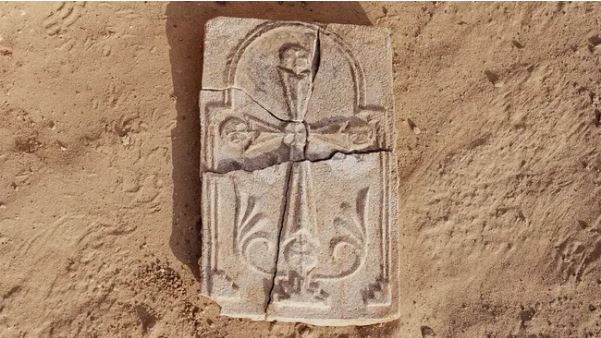
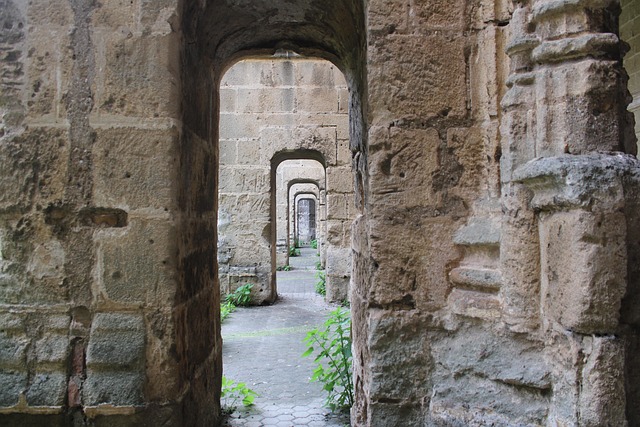
Sir Bani Yas is an island located 110 miles southwest of Abu Dhabi. In 1992, archeologists excavated nine courtyard houses. Not too far from these houses, a church and monastery from the 7th and 8th centuries were unearthed. However, at that time, it remained unclear whether these houses were associated with the monastery. Yet that all changed when they returned for further excavations this year. While excavating the courtyard of one of the houses, they discovered the 30 centimeter long stucco plaque bearing the Christian cross.
According to Gajewska, they have “now proved these houses were part of a Christian settlement.” It is likely that the senior monks resided in these small houses for solitary rest and prayer before returning to the monastery. The Chairman of the DCT, His Excellency Mohamed Khalifa Al Mubarak, said in a statement that, “The discovery of this ancient Christian cross on Sir Bani Yas Island is a powerful testament to the UAE’s profound and enduring values of coexistence and cultural openness.”
Christianity In the Region Before Islam
The discovery of the Christian cross in Abu Dhabi reveals the religious landscape of the Gulf region at that time in history. From the 4th to the 6th centuries, Christianity spread along the maritime corridors of the Arabian Gulf. The design of the plaque is similar to other crosses discovered in Kuwait and Iraq and is linked to the Church of the East, which originated in Mesopotamia. This similarity of design in crosses across the region suggests that the community at Sir Bani Yas wasn’t an isolated outpost.
Rather, it seems it was part of a religious network that extended from modern-day southern Iraq all the way to India. From studying texts from the time, as well as unearthed artifacts, archeologists have shown that in the early Islamic period, Muslims and Christians regularly co-existed, living side-by-side across the Gulf. It appears that Sri Ban Yas was one of those places. After the rise of Islam in the 7th century, the monastery continued to function for several decades before eventually fading out of the records in the 8th century.
Historians are still unsure as to why the site was abandoned. No single cause has yet been identified in any of the records. However, it is likely that settlement patterns and trading routes changed during the early Abbasid era. It seems most likely that the ending was not a dramatic one brought about by conflict or persecution. According to another archeologist from Abu Dhabi’s Department of Culture and Tourism, Hager Hasan Almenhali, this new excavation, “helps us better understand the nature of life and the relationships that connected the inhabitants of the island with the surrounding regions.”
Read More: 2,000-Year-Old ‘Jesus Boat’ Discovered Near the Sea of Galilee
Similar Monasteries in the Gulf

A similar monastery was discovered north of Dubai on Siniyah Island in 2022. Like Sir Ban Yas, this island is situated on a coastal route used for both pilgrimage and commerce. This reveals that these little Christian communities were not remote little communes, but were part of the bustling maritime life of the region. Another Christian settlement containing houses and churches was discovered during excavations on Failaka Island in al-Qusur, Kuwait.
It was occupied from around the 7th to 9th centuries and was also potentially associated with the Church of the East. The Christian cross in Abu Dhabi is important because it helps link these once-unconnected places to a network of Christian monastic communities that once thrived in the region. Its discovery has helped reinterpret the surrounding structures as monastic cells rather than simply generic housing. It has helped shed light on a period of peaceful coexistence between several religions in the region.
The church and monastery at Sir Banu Yas are now open to the public for tours, and new field seasons are currently underway. For the archeologists, there is still much to learn from these courtyard houses, and they plan to continue excavating there. Who knows what they may discover next and how it will help redefine our understanding of this region’s past. Inspired by this ancient site, a multi-faith church has also been constructed next to the visitor center.