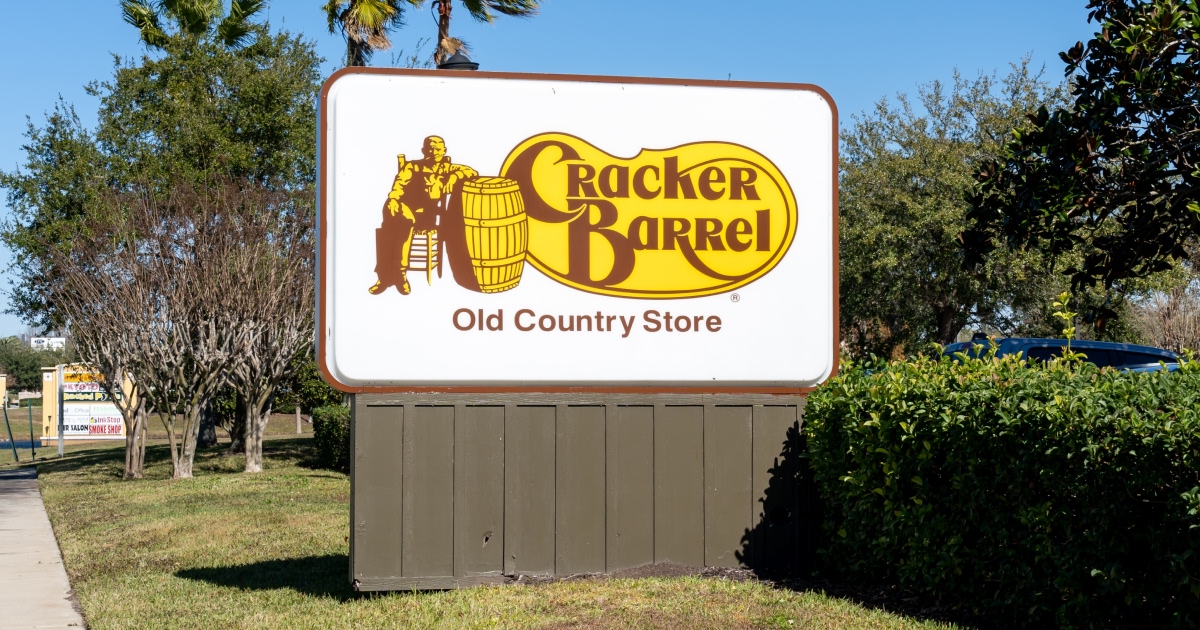

A sketch of an old man sitting on a barrel, drawn on a napkin in 1977, became one of the most recognizable logos in American dining. For nearly five decades, that figure anchored Cracker Barrel’s identity on roadsides across the country. Then, in a single week last August, the chain erased him. The blowback that followed set off a chain of events now ending with the Cracker Barrel CEO stepping down and a new leader taking the wheel.
On July 27, 2026, Cracker Barrel announced that David Deno has been appointed as its next Chief Executive Officer, effective August 10. He succeeds Julie Masino, who will step down as CEO and leave the company’s board on the same date. Masino will remain with the company in an advisory capacity until October 9, 2026, to support a smooth leadership transition.
The departure closes a turbulent chapter for one of America’s most recognizable roadside chains. Masino had taken over Cracker Barrel in 2023 and embarked on a plan to revive the struggling casual dining chain. What she couldn’t have anticipated was that a single design change would become the flashpoint that defined her entire tenure.
The Logo That Sparked a National Firestorm
The new, text-only logo for the country restaurant chain was unveiled on August 19, 2025, as part of the company’s ongoing modern rebrand. It marked the first time in 48 years that the logo had not featured the familiar old-timer in overalls sitting on a wooden chair leaning against a barrel. Cracker Barrel fans know him as Uncle Herschel.
Cracker Barrel rolled out the new logo as part of a larger rebranding effort across the nationwide country-themed chain, which also included menu updates and remodels of 40 of its 660 locations, according to the Wall Street Journal. The intent, according to what Cracker Barrel told Snopes, was “to make Cracker Barrel easier to find on new platforms, including digital channels and screens of all sizes.”
The public reaction was swift and severe. The redesign ran into a political and cultural firestorm on social media. Critics on the right bashed the changes as “woke” and accused the company of embracing “radical left-wing politics,” including promoting gay rights and policies to hire and promote more minority candidates. President Donald Trump weighed in and encouraged the company to reverse course. Specifically, Trump argued the company should bring back the old logo, writing in a social media post: “Cracker Barrel should go back to the old logo, admit a mistake based on customer response (the ultimate Poll), and manage the company better than ever before.”
Masino drew media attention last August when the new logo sparked public outcry and caused the restaurant chain’s value to drop by almost $100 million. The Uncle Herschel figure had deep roots: while the original 1969 Cracker Barrel logo was also text-only, the 1977 addition of the now-iconic imagery became a staple of its branding. According to Newsweek, Nashville designer Bill Holley sketched that figure on a napkin in 1977 – and it outlasted nearly everything else that changed at the chain over the following five decades.
After the backlash, Cracker Barrel reversed course: “Our new logo is going away and our ‘Old Timer’ will remain,” the company said in a statement, referring to the classic illustration of a man known as Uncle Herschel. The reversal came within a single week of the logo’s debut. Masino explained that the effort missed the mark and had stemmed from an effort to improve the guest experience at its locations.
An Activist Investor Fight and a Vote of Confidence
Surviving the logo disaster didn’t insulate Masino from what came next. The controversy attracted activist investor Sardar Biglari, chairman and CEO of Biglari Holdings, which owns Steak ‘n Shake. Biglari holds a 3% stake in Cracker Barrel and stated in a letter to investors: “Our campaign is about saving Cracker Barrel from a board and management team that are out of touch with Cracker Barrel’s customer base.”
Despite the pressure, Masino survived the activist investor fight last November after shareholders voted in favor of keeping her. Board member Gilbert Dávila, a longtime marketing and diversity specialist, didn’t receive enough votes to stay on the board and resigned. His re-election had been opposed by influential shareholder advisory firms Institutional Shareholder Services and Glass Lewis.
The shareholder vote gave Masino a lifeline, but it didn’t silence the scrutiny. Masino largely kept quiet after the blowup, speaking only on earnings calls, at a conference, and during a lengthy November interview with conservative radio and television host Glenn Beck. “I feel like I’ve been fired by America,” she told Beck. She noted that executives had failed to recognize how deeply customers identified with the traditional branding, and stated that patrons “see themselves in the logo,” while firmly rejecting claims that the modernization efforts were tied to political or ideological motives: “We’re not trying to make political statements… No, it’s pancakes. Not even one time.”
The Financial Fallout
The damage to Cracker Barrel’s business didn’t evaporate when the original logo returned. Foot traffic and revenue slumped. Cracker Barrel stopped the updates in their tracks, reverting to its old logo and canceling plans to remodel restaurants.
The company’s earnings came in below expectations in December, with Masino acknowledging at the time that there were “unique and ongoing headwinds” that left the company with more work to do in regaining the trust and confidence of its customer base. The sales slump continued into the new year, with the March 2026 earnings release also showing a drop in quarterly revenue and profits from the prior year, though performance topped Wall Street’s expectations.
Masino’s departure comes as the company is still struggling to return traffic to where it was before the rebranding controversy. Cracker Barrel said in its third-quarter earnings that traffic was improving relative to the recent trend, though it remained lower than in the prior year. Cracker Barrel CFO Craig Pommells noted that comparable store sales decreased 2.6%, with traffic down 6.7%, though he added: “Although traffic remained negative, we are encouraged by the gradual improvement in the underlying trend.”
One bright spot came alongside the leadership announcement: Cracker Barrel completed a sale-leaseback involving 26 company-owned restaurants, generating approximately $77 million in net proceeds that it plans to put toward debt reduction.
Masino’s Exit Package – and an Unusual Security Provision
A transition agreement filed with the Securities and Exchange Commission disclosed that Masino will receive $4.63 million over the two years following the end of her employment at Cracker Barrel. The filing also indicated that Cracker Barrel will continue to pay for Masino’s protective services for a “reasonable period of time” after the end of her advisory role.
The security provision is notable by any measure. One precedent is Starbucks, which agreed to provide security for Howard Schultz for up to ten years following his 2023 departure. The broader shift in executive protection has been unmistakable since the December 2024 killing of Brian Thompson, the chief executive of UnitedHealth Group’s insurance arm, who was shot outside a Manhattan hotel. That incident prompted companies across the country to scrutinize whether their leaders were adequately protected.
Data from compensation research firm Equilar shows median spending on CEO security at S&P 500 companies has more than tripled since 2021, to roughly $136,000, and about 40% of those companies now disclose such benefits.
Who Is David Deno?
Deno is a restaurant and retail industry executive with more than four decades of experience. He most recently served as CEO of Bloomin’ Brands from 2019 to 2024, where he strengthened its financial foundation and expanded its international presence. Bloomin’ Brands owns Outback Steakhouse, Carrabba’s Italian Grill, Bonefish Grill, and Fleming’s Prime Steakhouse and Wine Bar.
Before becoming CEO, Deno served as Bloomin’ Brands’ Executive Vice President and Chief Financial Officer from 2012 to 2019, leading the company through its initial public offering. He joined Bloomin’ Brands from Best Buy, where he served as President of Asia and CFO for the International Division. Prior to that, his career included 15 years at Pizza Hut and Yum Brands, where he held roles including CFO for Pizza Hut, CFO for Yum’s International Division, and COO of Yum. He began his hospitality career at Burger King, where he held various finance positions.
Deno currently serves on the boards of Krispy Kreme and Panera Brands. Per a 2026 SEC filing, Cracker Barrel’s independent Chairman Carl Berquist stated that Deno brings “decades of experience across the restaurant and retail industries, with a strong track record of leading businesses through growth and a demonstrated commitment to operational excellence, guest experience, and team member engagement.”
On the compensation side, Deno most recently served as CEO of Bloomin’ Brands, the owner of Outback Steakhouse and other restaurant chains. His pay at Cracker Barrel reflects the seriousness of the turnaround task ahead. According to Action News JAX, he will be paid a $1 million base salary, an annual bonus, and company equity. He will also receive $465,000 to cover relocation expenses to Nashville, Tennessee, including a corporate apartment and two trips a month to his home in St. Petersburg, Florida, for six months.
The Road Ahead for Cracker Barrel
Though Cracker Barrel shares took a hit during the logo controversy, the company’s stock has surged nearly 100% year-to-date as of the announcement Monday. That recovery suggests investors see the leadership change as a stabilizing move rather than a sign of deeper dysfunction.
Masino had been appointed CEO in July 2023 with a mandate to innovate and attract new customers to the chain’s 660 restaurants across 43 states. Her initiatives included introducing updated menu items and remodeling the company’s traditionally antique-filled restaurants with lighter walls and more comfortable seating. Some of that work may still shape what Deno inherits, even if its most visible symbol, the logo overhaul, has been fully reversed.
Read More: The 100-Year-Old Kentucky Soda That Was So Good, Coca-Cola Sued Them
What This Means for the Chain
Deno steps into a company that is operationally stable but still rebuilding trust with its core customer base. The CEO succession follows a difficult period for Cracker Barrel, which suffered significant political and consumer backlash over a rebranding effort last year. Since then, it has faced traffic declines and activist investor pressure, including an unsuccessful effort to oust Masino.
The Cracker Barrel CEO stepping down situation is also a striking case study in how quickly brand equity can erode. Credit and debit transaction data showed a sharp drop in customer traffic between August 19 and 26, 2025. The restaurant chain also lost nearly $100 million in market value while facing intense backlash. All of it traced back to removing a figure sketched on a napkin nearly 50 years ago.
For Deno, the playbook appears to be stability over experimentation. Cracker Barrel operates nearly 660 corporate-owned locations across the US, and during his tenure at Bloomin’, Deno was credited with strengthening profitability and its balance sheet, including navigating the company through the COVID pandemic and optimizing its international portfolio. That experience managing a large casual dining enterprise through turbulent conditions is precisely what Cracker Barrel’s board says it was looking for. Whether Deno can convert improving traffic trends into genuine growth at a chain still shaking off one of the most visible brand stumbles in recent memory will define what comes next for this American institution.
AI Disclaimer: This article was created with the assistance of AI tools and reviewed by a human editor.