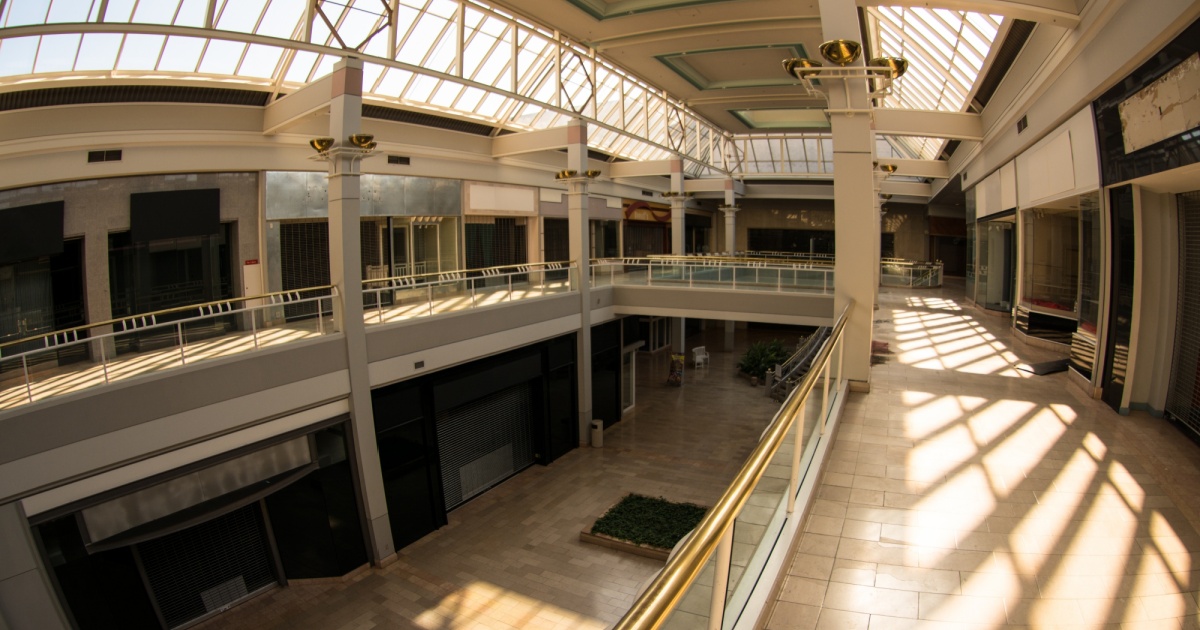

Roughly one in four enclosed American malls are now sitting largely empty, and at least one of them was converted into a $2 billion hospital trauma center. That’s not a quirky real estate footnote. It’s a signal that something structural is happening to the buildings that defined American suburban life for 40 years, and the industries moving into their footprints are not the ones most people would expect.
The connection between dead malls and dead retail is obvious. The next step is less so. When a JCPenney or Sears goes dark, the instinct is to imagine apartments, fulfillment warehouses, or a gym. What’s happening instead, with increasing speed, is that hospitals, surgical centers, imaging clinics, and specialty care hubs are quietly filling those cavernous spaces – from Nashville to Alexandria, Virginia, to suburban Rochester, New York. And the story of why that’s happening, and what it costs to pull off, is more complicated than a simple win for community health.
Dead mall repurposing has become one of the most unusual cross-sector trends in American real estate right now, sitting at the intersection of retail collapse, a healthcare access crisis, and the economics of construction. Understanding who benefits from it – and who pays the hidden price – requires looking at what malls offer that health systems actually need.
The Scale of the Vacancy Problem
As traditional malls struggle with declining foot traffic and high vacancy rates, health systems are converting them into outpatient clinics, medical malls, and specialty care hubs. The raw numbers behind this shift are striking. Malls had an 8.8% vacancy rate at the start of 2026 – nearly double the overall retail vacancy rate – and in the first quarter of 2026 alone, there was negative net retail mall absorption of 1.2 million square feet, meaning more space emptied out than was leased. That data comes from a 2026 Capital One Shopping analysis of the current state of American mall real estate.
Approximately 1,200 malls remain in the U.S., but projections suggest only 900 will still be operating by 2028. The attrition is physical, too. 2.6 million square feet of mall space was demolished in 2025 alone, and closed malls sit empty for an average of nearly four years before any redevelopment begins.
Into that vacuum, healthcare has stepped with unusual speed. According to Appraisal Economics, at least 32 enclosed U.S. malls have already been transformed into healthcare facilities, with the pace of conversions accelerating since the pandemic. Across all vacant mall redevelopments, 4% have become healthcare, hospital, or medical facilities – a modest percentage that nonetheless represents dozens of communities gaining clinical care where a food court used to be.
Why Malls Actually Work for Healthcare
The logic is not immediately obvious. A shopping mall is built for browsing, not for sterile procedures or emergency care. But the physical bones of a large enclosed mall solve several problems that health systems face when they try to build new facilities from scratch.
Former malls are typically located in high-traffic zones with ample parking, road visibility, public transit access, and proximity to population centers – all ideal for patient access. Large, open floor plates with minimal internal columns, high ceilings, and structural flexibility are well-suited to medical equipment, exam rooms, and outpatient surgery.
Medical office building construction is projected to decline 26% by 2026, reaching its lowest level in over a decade, according to CBRE’s December 2025 healthcare real estate outlook. Across the healthcare sector, owners and developers are increasingly turning to retail conversions, driven by rising construction costs, prolonged development timelines, and a systemic shift away from large campus models toward decentralized care.
The time savings alone can be decisive. When the University of Rochester Medical Center needed to expand its orthopedic department, it purchased a vacant single-story Sears store at the Marketplace Mall in suburban Henrietta, New York. The decision to adapt the 242,000-square-foot space cut more than six months off the project schedule compared to building on a new site. According to Scott Hansche, principal architect at the S/L/A/M Collaborative (SLAM) – the project’s architect of record – the conversion came out ahead because site infrastructure including roads, utilities, parking, and stormwater systems were already in place, allowing the team to focus entirely on the clinical build-out. URMC estimated the project was completed a full year earlier than a greenfield build, with construction costs running approximately 10% lower than they would have been otherwise.
The patient access argument is also compelling on its own terms. According to a Matthews Real Estate analysis, 51% of patients say convenient access to care is the most important factor in deciding where they receive healthcare services. A former Sears anchor store with 500 parking spaces and two highway off-ramps is, by that metric, an ideal medical facility site.
The Conversions Already Happening
Vanderbilt University Medical Center moved first and most visibly. Vanderbilt now operates 22 specialty clinics at the former One Hundred Oaks mall in Nashville, Tennessee, spanning approximately 500,000 square feet. The medical center occupies the second floor of the mall while the first floor remains retail space, and near-full occupancy has demonstrated the model’s success.
In Alexandria, Virginia, the transformation is even more dramatic. Inova Health System is converting the former Landmark Mall into a $2 billion hospital complete with an emergency room and trauma center – arguably the most ambitious mall-to-hospital project in the country.
The Medical University of South Carolina took a more targeted approach. The university converted a former JCPenney into the West Ashley Medical Pavilion, which opened in 2019 and houses ambulatory surgery, imaging, and infusion centers.
In New Jersey, Hackensack Meridian Health converted two adjacent vacant stores – a former Designer Shoe Warehouse and Toys ‘R’ Us – into a single destination. The project consolidated approximately 45,000 square feet and now houses a central urgent care center with 36 flexible exam rooms, as well as spaces for cardiac care, primary care, imaging, neurology, rehabilitation, women’s oncology, and lab services.
These are not fringe experiments. Contemporary medical malls increasingly feature leasing structures that consolidate large groups of practitioners – from primary care physicians to urgent care providers – alongside cardiologists, neurologists, OB/GYNs, and oncologists, often with onsite imaging and laboratory testing.
The Hidden Engineering Problem
Dead mall repurposing sounds clean on paper. The reality of converting a retail shell into a functioning medical facility is anything but. The gap between what a mall is built to do and what a healthcare facility requires is enormous, and closing it is expensive.
Medical-grade electrical systems, HVAC, backup generators, plumbing, and sterile air systems often require complete overhauls. Long corridors and maze-like interiors require extensive redesign to ensure navigational clarity for patients and staff. Anyone who has gotten lost in a large mall looking for a specific anchor store can imagine the problem that creates in an emergency care setting.
Insulation is another costly gap – retail buildings typically have significantly lower and less effective insulation levels than modern healthcare facilities, requiring expensive upgrades to meet clinical standards. And HVAC performance – the kind that controls airborne transmission of pathogens and maintains strict indoor air quality – is critical in ways it simply isn’t in retail. Research published in a 2024 engineering journal found that HVAC performance plays a crucial role in controlling airborne viral transmission within healthcare facilities – a reminder that the stakes of getting air systems wrong in a medical setting are clinically significant, not just regulatory.
The structural issue at the University of Rochester project illustrates the depth of the problem. Because mall structures are built right to code with little residual strength, engineers had to reinforce the roof to support more robust air handling equipment, adding new steel between the girders to handle added utility loads.
None of this is cheap. But it’s still cheaper than building from scratch – which explains why health systems keep choosing it. Healthcare Design Magazine noted in May 2026 that health systems treating these conversions as part of a long-term outpatient strategy – rather than opportunistic real estate moves – are the ones positioned to benefit from them.
The Equity Argument
There’s a case that this trend is genuinely good for public health, particularly in communities that have been underserved by both retail and medicine for decades.
Medical malls are increasingly serving healthcare-underserved areas, particularly in Class B and C mall locations in historically disinvested communities, bringing primary care, imaging, women’s health, dialysis, and therapy services to populations that previously lacked convenient access to any of them.
At The Shops at RedBird in southern Dallas, UT Southwestern Medical Center converted a former Sears into an outpatient primary care and specialty clinic. The new facility now offers infusion therapy, advanced imaging, cardiology, neurology, and primary care in a neighborhood that had long been overlooked by investors. Peter Brodsky, the private equity investor who bought the struggling mall in 2015 and led its $200 million redevelopment, described southern Dallas as a part of the city that rarely attracts investment – a reality the UT Southwestern clinic was specifically designed to address.
According to the Health Resources and Services Administration (HRSA), approximately 20% of the U.S. population lives in a primary care Health Professional Shortage Area – a designation given to geographic areas with too few primary care providers relative to population. Dead malls, concentrated in the suburban and exurban corridors where retail hollowed out first, often sit squarely within those shortage zones. The building is already there. The parking is already there. The only question is whether anyone will fund the conversion.
Read More: More Than 2,000 Stores Are Set to Close Across the US in 2026. Full List
What This Means for You
Mall redevelopments that preserve some share of retail space are common – which means the mall near you, even if it’s visibly shrinking, is unlikely to disappear overnight. What’s more likely is a gradual transformation: an anchor store replaced by an urgent care center, a wing converted into specialist clinics, parking lots that used to empty out by 8 p.m. now filling up with patients at 7 a.m.
If you live in a community where a mall has been struggling, paying attention to what health systems are eyeing those empty spaces is worth your time. These conversions take years from announcement to opening, but they tend to change the healthcare geography of a region permanently. The Vanderbilt model in Nashville, the University of Rochester project in Henrietta, and the Inova trauma center in Alexandria aren’t isolated experiments. They’re a pattern, and it’s accelerating. The retail era of the American enclosed mall is ending. What replaces it will, in many communities, be where you go when you’re sick.
AI Disclaimer: This article was created with the assistance of AI tools and reviewed by a human editor.