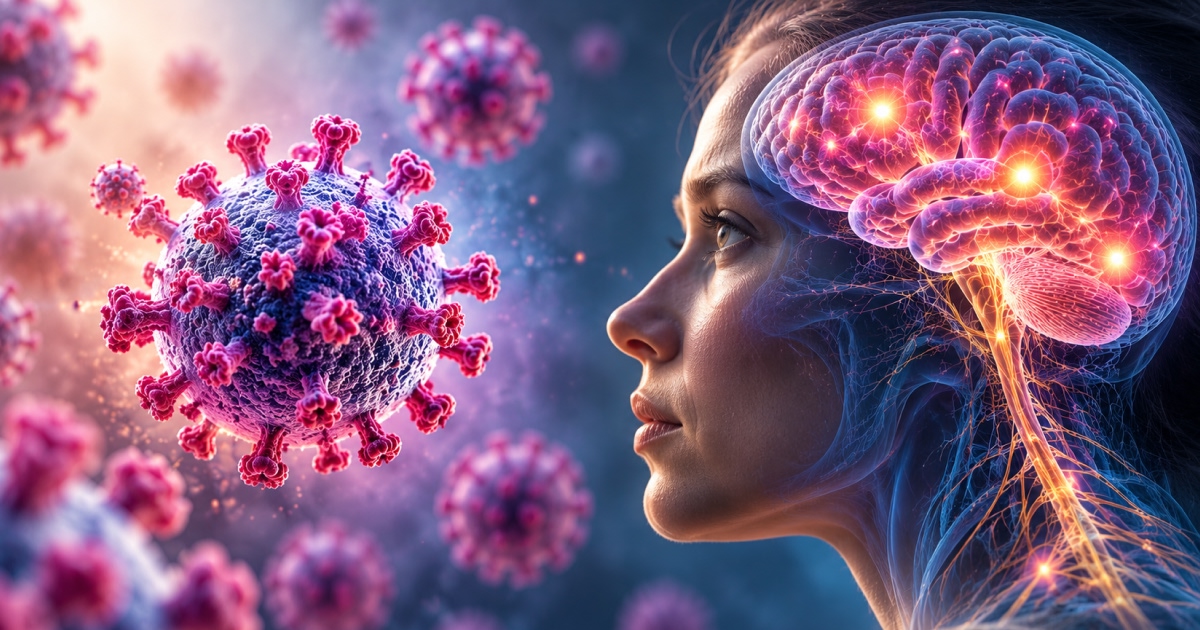

The “kissing disease” may have a much more serious connection than its nickname suggests.
Epstein-Barr virus (EBV), best known as the cause of infectious mononucleosis, or mono, has emerged as a major focus in the search for what causes multiple sclerosis (MS). The virus is extraordinarily common, infecting more than 90% of adults worldwide, yet only a small fraction ever develop MS.
One landmark study published in Science following more than 10 million U.S. military personnel found that EBV infection almost always occurred before MS developed. Of 35 people who were initially EBV-negative and later developed MS, 34 became infected with the virus before their diagnosis.
The evidence has become strong enough that some researchers now describe EBV as a necessary trigger or causative factor in MS, rather than simply another risk factor. But if almost everyone encounters EBV, why do so few develop the disease?
Researchers are now piecing together how genetics, the immune system and the timing of infection may help explain the connection, and whether preventing EBV infection could someday help prevent MS itself.
The Military Cohort That Changed the Conversation
The pivotal military study tested the hypothesis that MS is caused by EBV by analyzing stored serum samples collected over a 20-year period. Researchers identified 955 people who developed MS during their military service, with blood samples from 801 cases available for EBV testing.
Nearly all individuals with MS were EBV seropositive, and longitudinal data demonstrated that EBV infection preceded MS onset. More specifically, among people who entered the military without prior EBV infection and later developed MS, 34 out of 35 became infected with EBV before their diagnosis.
The scale and design of this study made the findings difficult to dismiss. Micah Luftig, PhD, the Allen Geller Distinguished Professor of Immunology at Duke University School of Medicine, addressed the implications at ACTRIMS 2026, the Americas Committee for Treatment and Research in Multiple Sclerosis. Luftig stated that EBV should be characterized as “an essential trigger or a necessary causative agent of MS rather than merely a risk factor.”
The study also found that 800 of the 801 MS cases, or 99.9%, were EBV positive in their last stored sample, compared with 97% of controls.
Why Only Some EBV Carriers Develop MS
EBV infects more than 90% of the global population, yet MS develops in only a small fraction of those people. The answer appears to lie in a convergence of genetic, immunological and environmental factors that together may amplify the virus’s effects in susceptible individuals.
EBV infection commonly occurs during childhood or adolescence. For many people, infection causes few or no noticeable symptoms. When primary infection occurs in adolescence or young adulthood, however, EBV can cause infectious mononucleosis.
Most people who acquire EBV never develop noticeable long-term problems, and fewer still ever develop MS.
The Genetic Amplifier: HLA-DRB1*15:01
Among the genetic factors associated with MS risk, the major histocompatibility class II allele HLA-DRB1*15:01, a specific inherited gene variant that shapes how the immune system recognizes pathogens, is among the strongest identified.
Research suggests this genetic factor may interact with EBV in ways that increase susceptibility to MS. However, carrying the variant does not mean someone will develop the disease.
The sex disparity in MS may also be relevant to this genetic and viral picture. Women are substantially more likely than men to develop MS. Researchers suspect that differences in immune responses and other biological factors may partly contribute to this disparity, although this remains an active area of investigation.
The Mononucleosis Signal
A 2026 population-based study published in Neurology Open Access added another piece to the puzzle. Led by Jennifer L. St. Sauver, PhD, of the Mayo Clinic, researchers found that people with EBV-positive infectious mononucleosis had more than three times the risk of subsequently developing MS compared with matched controls. The researchers cautioned that the number of MS cases was relatively small, resulting in wide confidence intervals around the estimate.
Earlier research found a similar pattern. A German cohort study published in Frontiers in Immunology followed 32,116 people with and without documented infectious mononucleosis. MS incidence was 22.6 cases per 100,000 person-years among those who had experienced mono, compared with 11.9 among those who had not.
The association was strongest among those ages 14 to 20, adding to evidence that the timing and nature of the body’s encounter with EBV may matter. However, the study was observational and cannot establish that mononucleosis itself caused the later MS diagnoses.
How EBV May Affect the Brain
One of the biggest remaining questions is why a virus that infects nearly everyone appears to contribute to MS in only a small fraction of people. New research suggests part of the answer may lie in how the immune system responds to EBV.
In a 2026 study led by researchers at the Harvard T.H. Chan School of Public Health, scientists compared blood samples from people without MS, people with untreated MS, and people receiving MS treatments. They found that people with untreated MS had roughly double the immune response to EBV, measured by increased activity among EBV-specific CD4+ T cells.
The researchers also found that commonly used MS treatments significantly reduced these EBV-specific immune cells and eliminated detectable EBV in saliva. The findings don’t establish that this immune response alone causes MS, but they provide another clue as to why EBV may behave differently in people who develop the disease.
As study author Kjetil Bjornevik explained, researchers are now trying to understand the immune response itself, with the hope that doing so could eventually lead to EBV-targeted treatments, vaccines or antiviral approaches.
Molecular Mimicry May Help Explain the Connection
One leading explanation for how EBV could contribute to MS is known as molecular mimicry. If a viral protein and a human protein are structurally similar enough, an immune response trained to recognize the virus may also mistakenly recognize the body’s own tissue.
Research published in Nature identified high-affinity molecular mimicry between the EBV protein EBNA1 and GlialCAM, a protein found in the central nervous system. Antibodies produced against EBNA1 can cross-react with GlialCAM, providing one possible mechanism through which an immune response to EBV could contribute to an autoimmune attack.
The researchers also found evidence supporting the biological relevance of this cross-reaction, including experiments in an animal model. The findings don’t establish that molecular mimicry explains every case of MS, but they provide a plausible mechanism connecting EBV infection with the autoimmune processes involved in the disease.
The Risk Is Not Absolute, but the Association Is Strong
The landmark military cohort found that MS risk increased 32-fold following EBV infection. Researchers also found that levels of neurofilament light chain, a biomarker of neuroaxonal degeneration, increased only after EBV infection, strengthening the evidence that infection occurs before biological signs associated with MS.
But relative risk needs context.
EBV infects the vast majority of adults, while only a small minority ever develop MS. Even most people who carry genetic risk factors will never develop the disease.
The emerging picture is therefore not that EBV infection inevitably causes MS. Rather, EBV appears to be an important part of a much larger combination of viral, genetic, immune and environmental factors. As the NIH noted when discussing the military study, EBV itself is not sufficient to trigger MS, meaning other factors must also be involved.
Could an EBV Vaccine Help Prevent MS?
If EBV plays a necessary or near-necessary role in the development of MS, preventing infection becomes an intriguing potential prevention strategy.
Researchers have been developing several experimental approaches to EBV vaccination, including mRNA and nanoparticle-based vaccines designed to generate immunity against the virus. The growing evidence connecting EBV and MS has added another potential reason to pursue that work.
However, no EBV vaccine has been shown to prevent multiple sclerosis. Establishing whether vaccination can reduce MS incidence would require large studies and potentially many years of follow-up.
Still, the research has created a possibility that would have seemed far more speculative just a few years ago: preventing or controlling a common viral infection might someday help prevent at least some cases of a serious neurological disease.
Read More: 12% of Cancer Cases Are Linked to Infections. These 5 Are Behind Nearly All of Them
What This Means If You’ve Had Mono
For anyone who has had mono, the connection between EBV and MS can sound alarming. But the most important point is that the overwhelming majority of people infected with EBV will never develop multiple sclerosis. Even among people with additional genetic risk factors, MS remains relatively uncommon.
What this research changes is our understanding of how MS may begin. EBV appears to be an important piece of the puzzle, but infection alone is not enough. Genetics, immune responses and other environmental factors appear to help determine who ultimately develops the disease.
There is currently no recommendation to screen the general population for EBV-related MS risk. Instead, researchers are looking toward the future, including whether an EBV vaccine could eventually prevent some cases of MS. That possibility remains unproven, but it represents a striking shift: a virus once known mainly for causing the “kissing disease” may eventually give researchers a new way to understand, and perhaps prevent, a serious neurological disease.
Disclaimer: This information is not intended to be a substitute for professional medical advice, diagnosis or treatment and is for information only. Always seek the advice of your physician or another qualified health provider with any questions about your medical condition and/or current medication. Do not disregard professional medical advice or delay seeking advice or treatment because of something you have read here.
A.I. Disclaimer: This article was created with AI assistance and edited by a human for accuracy and clarity.
Read More: Researchers Find Strongest Link Yet Between Epstein-Barr Virus and Lupus