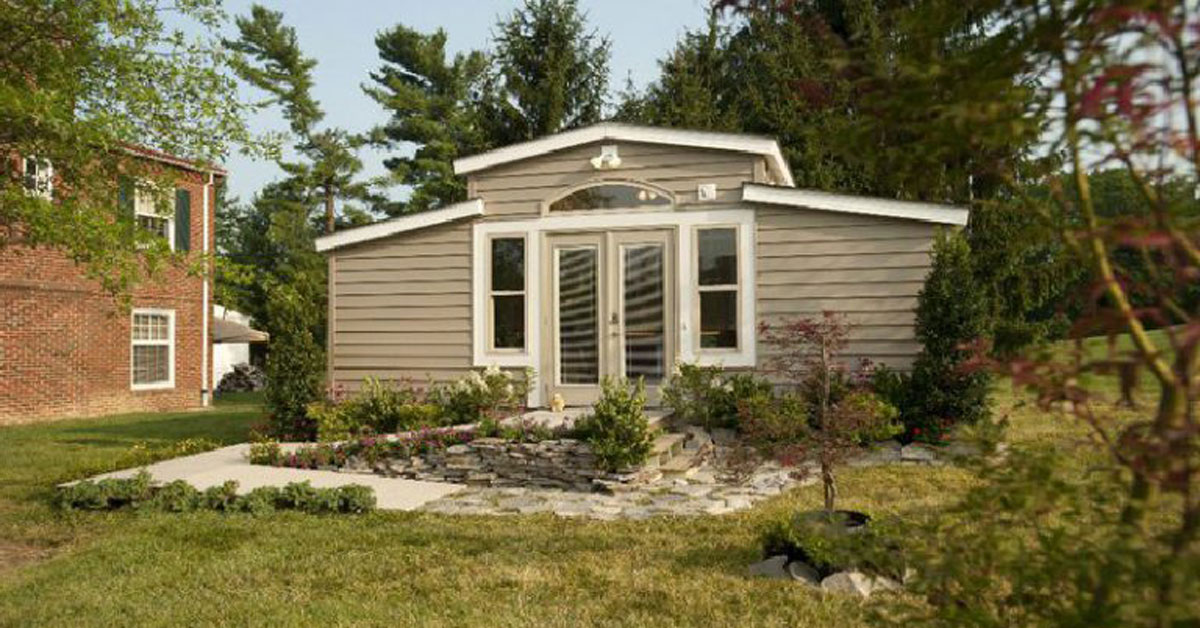

A growing number of American families are making a housing move that would have seemed unusual a generation ago: putting a small, fully furnished home in the backyard specifically for an aging parent. These compact structures, widely known as granny pods, are a type of accessory dwelling unit (ADU) – a self-contained living space built on the same residential property as a primary home. According to the American Association of Retired Persons (AARP), ADUs are rapidly becoming one of the most practical multigenerational housing solutions available to families navigating the competing demands of aging relatives, childcare, and housing affordability.
An ADU can take several forms. English basements, tiny homes, backyard cottages, in-law suites, carriage houses, casitas, and garage apartments are all names for accessory dwelling units, or ADUs – self-contained living spaces that typically share the property with a single-family residence and may be attached, detached, or incorporated seamlessly into the main home. When families build or place one of these units specifically to house an aging relative, it becomes what many people call a “granny pod” – a term that has gained mainstream recognition even though the technical classification remains ADU.
The concept is straightforward: instead of moving an aging parent into the main house (which can mean everyone sharing a kitchen and losing personal space) or into a formal care facility (which can cost a small fortune), families put up a private, age-friendly home right on the same lot. The older relative keeps their independence. The family stays close. And both sides retain their own front doors.
What an ADU for Aging Parents Actually Looks Like
Granny pods generally range from 250 to 900 square feet and include essential amenities such as a living area, bedroom, bathroom, and often a small kitchen. While they serve as independent living spaces, they are usually connected to the main house’s utilities, including water, electricity, and sewer systems.
Related Videos:
The design of these units matters more than square footage alone. Units built with aging in place in mind – meaning they support older adults who want to stay independent rather than move to a facility – typically include wide doorways for wheelchair or walker access, grab bars in the bathroom, walk-in showers without a lip to step over, even and level flooring, and good lighting throughout. When building a granny pod, important accessibility features include ramps, wider doorways for easier wheelchair access, grab bars for easy movement, and cushioned floors for extra safety, with good lighting being essential. Some families also install webcams and two-way communication systems so both households can check in easily without making the arrangement feel like surveillance.
Prefabricated (or “prefab”) units are factory-built homes that are assembled off-site and then transported and placed on your property. They’re often faster and sometimes cheaper than building from scratch. Custom-built units, by contrast, are designed and constructed on-site and can be tailored precisely to your property layout and your relative’s specific needs. Prefab granny pods offer faster installation, predictable pricing, and minimal construction disruption, while custom-built granny pods allow families to personalize layouts, materials, and accessibility features.
What Does AARP Recommend for Multigenerational Housing?
AARP has been one of the most consistent institutional voices in favor of ADUs as a multigenerational housing solution, backing legislative reform in state after state and publishing practical guides for homeowners considering building one. Their position is rooted directly in what their members say they want.
AARP’s national 2024 Home and Community Preferences Survey reveals that a strong majority of adults aged 50 and older – 75% – wish to remain in their current homes as they age, and 73% hope to stay in their communities, significantly higher than younger adults aged 18-49, but existing housing policies and community infrastructure are not keeping pace with this increasing need. That gap between what older adults want and what’s available to them is exactly the problem AARP sees ADUs helping to solve.
According to AARP’s 2024 survey data, one in four older homeowners say they would consider building an accessory dwelling unit to provide space for a loved one who needs care or a place to live. That’s a remarkable level of interest, and it reflects something real: families are under financial and logistical pressure, and many are recognizing that keeping generations nearby – while preserving everyone’s privacy – is smarter than the alternatives.
Family members or caregivers can live nearby in an ADU, or these units can serve as a source of rental income for the primary homeowner. According to the AARP 2024 survey, one in four homeowners aged 50 and older have thought about building an ADU on their property.
AARP has also been pushing hard for policy changes that make ADUs easier to build. “By supporting small-scale housing production, this bill will make it easier to build accessory dwelling units – an option that can help families meet housing needs across generations,” said Jenn Jones, AARP’s vice president of government affairs. In Iowa, that advocacy paid off in a concrete way: during the 2025 legislative session, AARP advocated for a statewide ADU bill that requires all cities and counties in Iowa to allow homeowners to build an ADU on their property, and the bill, SF 592, passed in both chambers with broad bipartisan support and was signed into law by Governor Reynolds on May 1, 2025.
The Financial Case for Building an ADU for Aging Parents
The cost conversation cuts in two directions. Building an ADU is not cheap. But neither is the alternative. According to the 2024 Cost of Care Survey conducted by Genworth and CareScout, assisted living community costs increased 10% to an annual national median of $70,800 per year, while the cost of a private room in a nursing home increased 9% to $127,750. Those figures are annual. They’re also trending upward every year, with inflation identified as the top driver of cost increases.
Connects viewers to the specific AARP research and advocacy referenced in the article title.
The average accessory dwelling unit costs $180,000 nationally, but most homeowners spend between $40,000 and $360,000 building their unit, at an average cost of $150 to $300 per square foot. The range is wide because so much depends on where you live, whether you build from scratch or use a prefab unit, and what accessibility features you install. A garage conversion will run far less than a new detached structure. A prefab unit on a cleared, level lot in a rural area will cost less than a custom-built unit with a foundation in a high-cost urban market.
The real-world story of Denise Martin, a 65-year-old retired financial advisor from Arizona, illustrates how this can work in practice. Martin moved into a miniature home right in her daughter’s backyard in Bend, Oregon, primarily because she wanted to be close to her grandchildren. Spindrift Homes, the tiny home company that built her unit, manufactures homes for typically under $160,000. Martin’s arrangement, reported by Fortune in February 2026, reflects a broader economic pattern: Jason Waugh, president of global real estate brokerage Coldwell Banker Affiliates, told Fortune that he’s witnessed an influx of granny pod requests as families try to make ends meet, saying multigenerational living is on the rise largely out of “economic necessity,” driven by mortgage interest rates, overall economic conditions, and a shortage of housing inventory.
There’s also a childcare dimension that often gets overlooked. With grandparents nearby, the multigenerational “granny pod” setup eases the burden of childcare costs – a welcome relief when the amount it takes to raise a child has surpassed rent in dozens of US cities, with childcare costs averaging $297,674 and reaching as high as $362,891 over 18 years, according to a 2025 analysis from LendingTree.
And the ongoing expenses inside the unit can be minimal. Martin’s utility costs run to around $35 a month in propane, according to Fortune’s reporting. That’s a very different picture from $5,900 a month for an assisted living room.
Can You Build a Backyard ADU for Your Aging Parents?
The short answer is: it depends on where you live, and you need to check before you plan. Zoning laws, local building codes, lot size requirements, and homeowners association rules all play a role. The rules vary significantly from city to city and county to county across the US.
The good news is that the regulatory picture has been improving rapidly. Under a series of new state laws that took effect on January 1, 2025, ADUs became easier to build in California than ever before, with new legislation eliminating owner-occupancy requirements except for junior ADUs, expanding the number of detached ADUs allowed on multifamily properties, providing a path to legalization of previously unpermitted ADUs, and relaxing setback requirements while increasing height limits.
Massachusetts moved similarly. The Affordable Homes Act amended state law to allow accessory dwelling units under 900 square feet to be built by-right in single-family zoning districts. “By-right” means no special permit or discretionary approval from a planning board – you submit plans, meet the standards, and you can build. Those regulations took effect on January 31, 2025.
California went further in late 2025. Governor Newsom signed four new ADU bills into law, including AB 462, AB 1154, SB 9, and SB 543. Among other changes, the new legislation expressly stated that local ordinances governing ADUs cannot unreasonably restrict the ability to create them. That’s a significant shift in how the state defines the relationship between homeowners and local planning rules.
For families looking to explore multigenerational living options for elderly relatives, the practical starting point is always your local planning or zoning office. Call and ask for their ADU handout and fee schedule. Ask specifically about setback requirements (how far from property lines the structure must be), maximum size limits, height restrictions, parking requirements, and utility connection rules. Also check with your homeowners association if you have one, as HOA rules can sometimes prohibit detached structures even where municipal zoning allows them.
What the Research Says About Multigenerational Housing and Health
Beyond the financial arithmetic, there’s a case to be made on health and wellbeing grounds. Living in close proximity to family – with your own private space – offers something that neither a nursing home nor a completely separate household does: daily, low-friction contact.
Daily interaction and support matters because aging adults typically become more isolated over the course of their lives, and having multigenerational housing allows them to continue to have that daily interaction. Additionally, according to the National Council on Aging, 80% of older adults have at least one chronic condition. Having family nearby helps with management of those conditions – catching changes in mood or physical function early, being available for appointments, noticing when something seems off before it becomes a crisis.
Studies suggest that older adults in supportive, multigenerational households may live longer, maintain stronger social connections, and enjoy a greater sense of purpose. This isn’t a minor footnote – social isolation is increasingly recognized as a significant health risk for older adults, on par with more traditional risk factors like physical inactivity and diet.
Research also suggests that when it comes to financial fraud and scams, a key driver to becoming a victim is social isolation, and that having connectedness and proximity to family reduces the chance of developing a relationship with a stranger online. For families with aging parents who spend significant time alone, that’s a concrete protective benefit.
There are genuine trade-offs, though. A granny pod or ADU for aging parents works best when the older adult needs some support but not 24-hour nursing care. Granny pods work best for seniors who need some help but not 24/7 skilled nursing. If an older relative’s needs intensify significantly over time – due to dementia, serious mobility loss, or complex medical conditions – the backyard unit may no longer be sufficient, and families should plan for that possibility from the start.
How to Get Started with Accessory Dwelling Units for Aging Relatives in Your Backyard
Planning a multigenerational housing arrangement for elderly parents takes time. Allow four to eight months from first inquiry to move-in, and be aware that permitting often takes longer than construction itself. Here’s where to start.
Research your zoning first. Contact your city or county planning department before spending any money on design or construction. Get clarity on what’s allowed on your specific lot, including size limits, setback rules, and whether a detached structure is permitted at all.
Decide between prefab and custom-built. Prefab units are faster to install and come with more predictable pricing, typically in the $40,000 to $160,000 range depending on size and specifications. Custom-built units take longer and cost more but can be designed precisely around your lot’s constraints and your relative’s accessibility needs. Most homeowners building an ADU nationally spend between $40,000 and $360,000 depending on type, size, and location.
Budget for the full picture. The unit itself is one line item. Add permitting fees, site preparation, foundation work, utility connections (water, sewer, electricity), landscaping, and furniture. New or upgraded water, sewer, gas, and electric connections alone can cost anywhere from $10,000 to $35,000. Go in with eyes open about total project cost.
Design for accessibility from the start. It costs far less to build accessible features into a new unit than to retrofit them later. Wide doorways, roll-in showers, level entries, good lighting, and grab bars in the bathroom are the baseline. Consider the older adult’s likely needs five or ten years from now, not just today.
Have honest conversations. The physical housing is only part of this arrangement. Clarity on expectations, finances, routines, privacy, and what happens if care needs change is just as important as the building permit.
What This Means for You
Accessory dwelling units have moved well past a fringe housing concept. They’re backed by AARP’s research and lobbying, accelerating through state legislation across the country, and increasingly recognized by real estate professionals as both a practical family solution and a property value asset. Adding a granny pod or other ADU can potentially increase the overall property value, especially if designed and built well, as many buyers view ADUs as a valuable bonus for multigenerational living, rental income potential, guest space, or future flexibility.
For families with aging relatives who want to maintain their independence while staying close, the calculus is increasingly favorable. The upfront cost of building a well-designed ADU for aging in place, while real, is often far less than the cumulative cost of assisted living or a private nursing home room over even two or three years. The arrangement also offers something no facility can fully replicate: daily proximity to the people who matter most, with everyone retaining their own front door. If you’re thinking about this for your family, the right time to start researching local zoning rules and talking to your relative honestly about what they want is now, before you’re making decisions under pressure.
—
A.I. Disclaimer: This article was created with AI assistance and edited by a human for accuracy and clarity.