
A traveler in Spain once stripped the beds and organized the trash into bags before checking out of a hotel – and was charged €60 for it. The room had been flagged as “messy.” That story surfaced in the comments of a Facebook post that quietly became a viral hospitality debate, and it captures exactly why a question that sounds simple has turned out to be anything but.
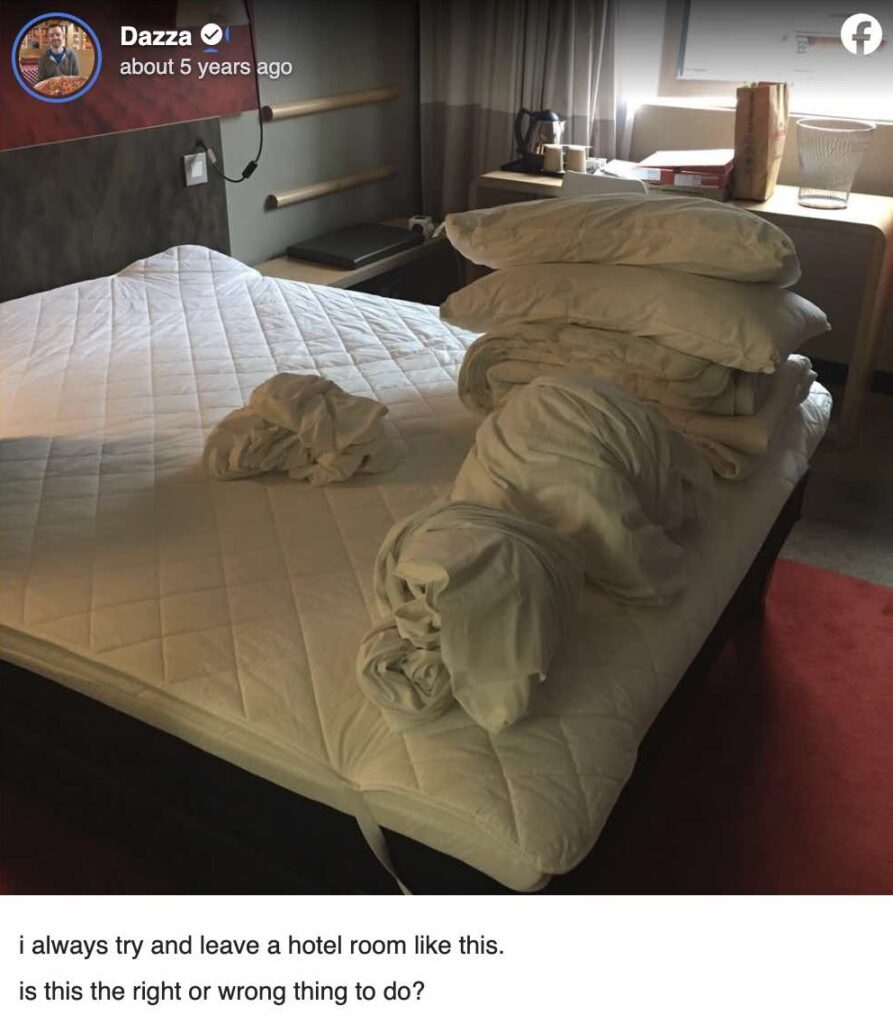
The post, originally from August 2021, came from Darren Dowling, a Scottish content creator known online as Dazza, best known for his “Does It Fry?” cooking videos. Before leaving a hotel room, Dowling strips the bed completely – removing the duvet cover, pillowcases, and sheets, then folding everything neatly at the foot of the mattress. His question to his Facebook followers was direct: “I always try and leave a hotel room like this. Is this the right or wrong thing to do?” The post sparked an immediate divide, with thousands of people suddenly taking sides over a hotel checkout habit many had never stopped to consider.
The responses landed in every direction imaginable. Current and former housekeeping staff largely praised the gesture. People who had never worked in hospitality largely dismissed it as unnecessary effort. And somewhere in between, the debate opened up a wider conversation about what guests actually owe – or don’t owe – the people who clean up after them.
What Housekeeping Staff Actually Said
Housekeepers who saw the post praised Darren and others who strip the bed before leaving. One commenter wrote: “As a housekeeper, this makes me very happy when customers do this, saves us an extra job and makes it easier.”
Another added: “Housekeeping is a thankless hard job. The condition some rooms are left in is astonishing, even after just one night.” That response reinforced something that rarely makes it into guest-facing hotel communications: the sheer physical scale of what housekeeping teams handle every day.
Multiple housekeepers in the thread noted that staff work against strict time targets per room, and that stripped beds make a “massive help” in hitting those targets. According to industry standards tracked by SafetyCulture, housekeepers are typically assigned 12 – 16 rooms per shift, with a full checkout clean running 30 – 45 minutes per room. With that kind of workload, even small reductions in per-room time can have a real ripple effect across a shift.
A second habit also emerged from workers in the thread: “That’s good, as a former housekeeper I also like to leave all wet and dirty towels set in a corner.” Separating wet towels prevents moisture from spreading across the room and lets staff collect laundry more efficiently.
The Case for Leaving It Alone
Not everyone agreed that guests should be stripping beds at all. Many questioned why guests would go to that trouble when cleaners are paid to do it themselves. “I have never done this. I never leave the room in a state but it would never occur to me to strip the bed for them,” one commenter wrote.
That perspective has actual support from professional etiquette circles. Myka Meier, founder of Beaumont Etiquette, told Travel + Leisure that there’s no need to tidy the bed before checkout: “The bed will be immediately stripped, so you don’t have to worry about making it.”
Her reasoning is grounded in how hotel linen systems actually work. According to HotelsByDay, hotel sheet policy at established properties requires changing sheets between every single guest stay as standard practice – regardless of how neatly or messily they’ve been left. ProStay’s hospitality operations guide notes that hotels strip beds completely and replace linens washed at 160°F, a temperature that kills pathogens without damaging fabric. A guest who strips the bed isn’t changing the cleaning outcome – the linens are going into the laundry either way.
The standard full departure service, as outlined in the Snapfix hotel housekeeping checklist, includes opening ventilation, stripping beds, removing waste, cleaning and disinfecting the bathroom top to bottom, dusting bedroom surfaces, and remaking beds – every time, for every checkout. Stripping the bed yourself doesn’t remove any steps from that checklist. It just reorders one of them.
Why the Spain Story Matters
The traveler charged €60 for stripping their bed points to the real problem at the center of this debate: there is no single rulebook for what guests should or shouldn’t do. Coverage of the debate confirmed there is no official hotel etiquette guide that every property follows. Expectations often depend on local customs, management preferences, and operational procedures.
That inconsistency is partly structural. ISO 9001 is the most widely referenced voluntary quality framework for hotel housekeeping globally, giving hotels a structure for creating and documenting standards – but it’s voluntary, not universal. Different properties, different countries, and different management cultures all produce different expectations. What reads as thoughtful in one hotel could confuse or even complicate workflow in another, depending on how that property’s housekeeping system is organized.
The ambiguity extends to short-term rentals too. As Today noted, many Airbnb and short-term rental properties leave specific instructions telling guests whether they should strip the bed or not – suggesting that explicit guidance matters more than assumed norms. Hotels rarely provide that same clarity, which is exactly why a single Facebook photo generated thousands of comments.
The Demands Behind the Door
HotelsByDay estimates that most hotels clean each room approximately 3,000 times per year. That figure alone puts the physical demands of hotel housekeeping into perspective. It’s a role that rarely gets acknowledged by guests who experience only the finished product – a remade bed, folded towels, and a room reset to neutral.
According to EHL Hospitality Insights, housekeeping staff undergo extensive training before they clean their first room, learning proper techniques for each task – from making beds with hospital corners to mixing cleaning solutions at correct concentrations – skills that go unseen by guests but directly affect hygiene outcomes. Beyond daily turnover, guest rooms are deep cleaned between two and four times per year, with high-traffic areas requiring more frequent attention.
People who had never worked in hotels were more likely to view stripping the bed as unnecessary because they had little insight into the pace and physical demands of housekeeping. Commenters who had worked in the industry described it as one of the hardest jobs in any hotel – workers clean room after room while racing against strict deadlines, often without guests ever seeing the effort involved. Those two groups talked right past each other for 87,000 comments, and that gap was as much the point as the bed sheets themselves.
Stacking restaurant plates, making beds at an Airbnb, tidying cinema seats before you leave – these small, unrequired gestures all produce the same split reaction Dowling’s post did. Each one divides people along the same fault line: those who see unprompted consideration as natural, and those who see it as labor that wasn’t asked of them.
Read More: 12 Hotel Tips From The Pros You Need To Know Before Your Next Stay
What To Do Before You Check Out
Cleanliness is the top factor for hotel guests when choosing where to stay. EHL Hospitality Insights reported that even before recent years, 78% of hotel guests rated cleanliness as the most crucial factor affecting their accommodation choice. That expectation flows both ways. The hotel is responsible for delivering a clean room. Guests aren’t responsible for cleaning it – but how they leave it does affect the people who come in after them.
The most practical guidance comes down to a few specific actions. Myka Meier, in her comments to Travel + Leisure, recommends hanging used towels or leaving them neatly stacked in the bathroom, and specifically warns against leaving wet towels on the carpet or furniture, as moisture can damage fabric and cause mold that may not dry before the next guest arrives. Gathering loose trash into the provided bin, not leaving room service trays in the hallway, and collecting any scattered items are all low-effort steps that make a housekeeping shift run noticeably faster.
As for stripping the bed: if you want to do it, do it. If you’d rather just leave the room reasonably tidy and let the housekeeping team handle the linens as trained, that’s exactly what they’re there for. What Dowling’s post made clear – probably more than he intended – is that the act of pausing to ask the question at all is rarer than it should be. Many readers admitted they had never once thought about what happens after they close the hotel room door for the final time. Others said they had worked in hospitality for years and automatically stripped beds whenever they stayed elsewhere precisely because they understood the workload involved. The gap between those two groups is what 87,000 comments were really about.
AI Disclaimer: This article was created with the assistance of AI tools and reviewed by a human editor.
Read More: Would You Sleep Here? World’s Deepest Hotel Opens 1,375 Feet Below Earth