
Ivan Gradoboev, 35, from Sofia, Bulgaria, started building his first tiny house in September 2020 with $11,000 in savings, no construction experience, and no knowledge of off-grid living. He moved in on New Year’s Eve the same year. That first house eventually sold for nearly three times what it cost to build – and the second one, where he lives now, is a different structure entirely with its own, higher price tag.
He bought a 200-square-metre plot of agricultural land outside Sofia with that $11,000. The land purchase left almost nothing for the build itself. His solution was YouTube. “I watched hundreds of hours of YouTube videos on construction, and funnily, the more I was learning about modern off-grid systems, the more exciting it all felt,” he says, “as I realised I could actually become independent not only from rent, but from the monthly utility bills as well.”
The project began in 2020 because Ivan wanted a place to play drums without bothering neighbors in his rental apartment. A music room became a house when he discovered that connecting the property to the electrical grid would be prohibitively expensive or impossible. He had no choice but to go fully off-grid, and somewhere in the research process, he realized that was exactly where he wanted to be.
The First Build: $23,000, Four Months, and a New Year’s Eve Move-In
Ground was broken in September 2020, and Ivan moved into the house on New Year’s Eve, around four months later. He moved in before it was finished, intentionally, so he could redirect rent money straight back into completing the build. Starting from what he called “absolute zero,” he taught himself subjects including modular construction, timber framing, and solar power.
The psychological cost was real. “I’d be lying if I said I never doubted the initial decision to get into all this,” Ivan told UNILAD. “Sometimes I’d look around and ask myself – man, what the hell are you even doing, building some house in the middle of freaking nowhere, completely on your own? It definitely wasn’t the easiest year of my life mental-health-wise, but it was totally worth it.”
After about two years in the first property, Ivan sold it. That first tiny house cost €20,000 (roughly $23,000 USD), and he sold it for €54,000 – almost three times what he put in. The profit funded a second build where he wouldn’t have to compromise on anything he’d given up the first time around.
The Second House: More Sophisticated, and More Expensive
The 420-square-foot home Ivan lives in now is his second build, and it’s a distinct project with its own price tag. He says it cost around €50,000 – more than double what he spent on the first house – reflecting the lessons learned, better materials, and a full-sized kitchen he didn’t have before. Describing the second build, Ivan said it felt like “pure childlike joy” compared to the uncertainty of the first.
The current home uses solar panels for electricity, propane for cooking, and a well for water. The only bill Ivan pays is his 5G internet, included in his monthly phone plan. For someone who watched rent consume a fixed percentage of every paycheck, the contrast is significant.
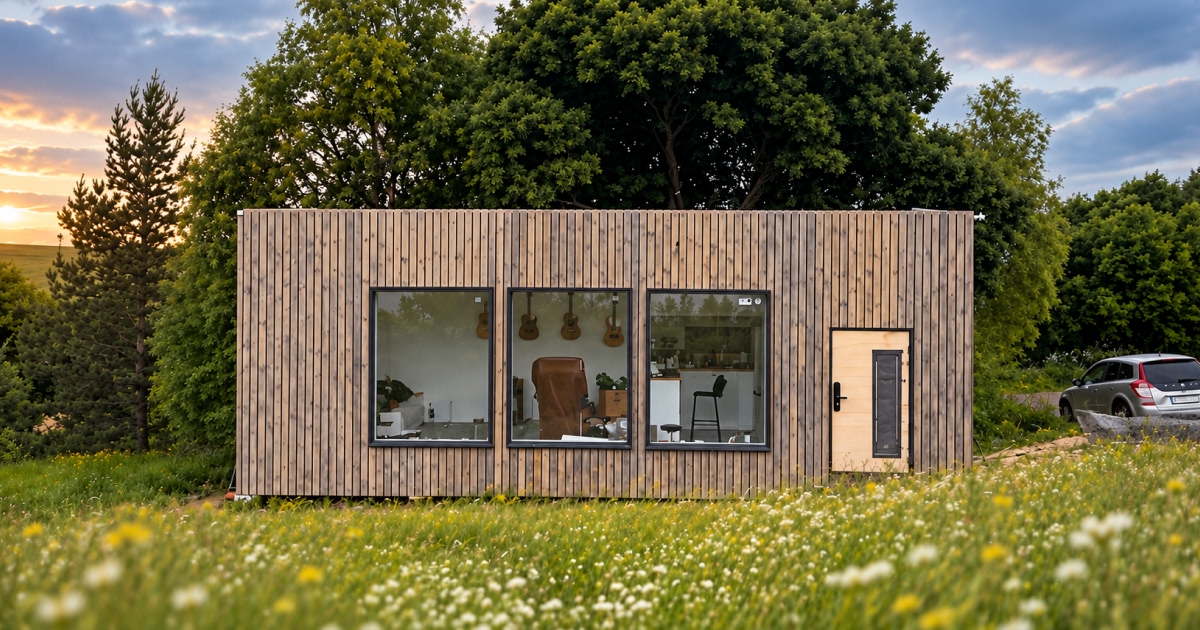
A video tour described the space near Sofia as an “off-grid studio apartment.” Set on concrete pillars on agricultural land, the tiny house was arranged to meet rules requiring it to remain movable. That detail matters: the structure’s legal classification as movable was a direct response to local land-use rules, not an aesthetic choice.
How the Off-Grid System Actually Works
Going off-grid means no longer receiving electricity from a utility company. For Ivan, solar panels capture sunlight and convert it to electricity, stored in a battery bank that powers the home. Off-grid systems need to be sized to handle reduced sunlight during cloudy days and winter months. Ivan reported that in practice, winter stretches required a gasoline generator as backup, and a rainwater-collection effort he attempted failed to work as expected.
For readers who associate solar with plug-and-play simplicity, EnergySage’s off-grid overview offers useful context: installing an off-grid solar-plus-storage system for an average-sized house often costs $115,000 or more. Ivan’s build is far smaller than an average house and his costs were lower, but off-grid electricity at scale is not cheap.
Propane handles cooking. Water comes from a well. Ivan describes having “unlimited freshwater” now – but he still conserves deliberately. “My batteries almost never go below 80 percent,” he explains, “but I still use A+++ appliances and turn on the water heater only when I’m about to use it. I finally have a well with unlimited freshwater, but I still use the urinal and close the tap while brushing my teeth, because it just feels stupid not to.” The habits of conservation didn’t go away once the systems improved. They became part of how he lives.
What the Numbers Actually Tell You
The two builds are separate structures with separate costs. The first house cost €20,000 (about $23,000 USD) and sold for €54,000 ($63,000). The second house, where Ivan currently lives and which appears in photos and video tours, cost around €50,000. The current 420-square-foot home was not built for $23,000.
Ivan has lived in the current home for three years, with six years having passed since he started his tiny-house journey overall. In that time, his monthly expenses have dropped to one line item: his phone plan. The profit from his first house sale added €34,000 above his original €20,000 investment. That return was possible only because he owned the land, built the structure himself, and was willing to live in an unfinished home while completing it.
For comparison, HomeAdvisor’s cost data puts the average cost to build a tiny house in the US at $45,000, with most projects falling between $30,000 and $60,000.
The Realities Beneath the Headlines
Ivan’s story travels well on the internet because the headline numbers are extraordinary. A close read of what he actually describes reveals a more complicated picture. He taught himself an entirely new skill set over hundreds of hours before breaking ground. His experience pointed to the less-polished side of DIY housing – backup power, filtration, maintenance, and physical safety during construction. The systems he relies on require ongoing attention, and when they break, he’s the one fixing them.
The off-grid life Ivan describes is not one of passive bill-free comfort. He monitors his battery levels, conserves water by habit, and maintains every system himself. The absence of utility bills is real, but it comes with a corresponding requirement to understand and maintain what replaces them.
Zoning and building law adds another layer of complexity for anyone thinking about replicating this approach. Zoning laws govern what can be built on a piece of land, while building codes specify what a structure must include – and ignoring them can result in fines, permit denials, or being forced to remove the structure entirely. Off-grid tiny homes face stricter zoning scrutiny because many jurisdictions require approved utility hookups for residential structures, though rural areas are often more flexible. Ivan’s solution in Bulgaria – building on concrete pillars to keep the structure legally “movable” – was a direct workaround for local land regulations. That workaround exists in that specific legal context. The rules differ country by country, state by state, and often county by county within a single state.
For anyone considering building a tiny home cheaply, feasibility depends heavily on whether you already own land, what your local zoning allows, whether off-grid utilities are permitted without standard hookups, what permits and inspections are required, your climate and its effect on a small solar-plus-battery system, and your ability to do the construction work. Those variables can shift the economics dramatically in either direction.
A Specific Solution to a Specific Problem
Ivan Gradoboev spent six years learning, building, maintaining, and improving. The financial result – no rent, no utility bills, a sold property that nearly tripled in value – is genuine. So is the work it took to get there.
Housing is the single largest monthly expense for most adults, and reducing it meaningfully changes what the rest of a financial life looks like. Whether that reduction comes through a tiny house, a lower-cost city, a paid-off mortgage, or some other path is secondary. Ivan framed his own motivation plainly: “I just hated the feeling of being in a never-ending rat race. You just can’t stop, because if you do, it’s only a matter of time before your life starts falling apart.”
Ivan says he is developing a free YouTube series that walks first-time builders through the tiny-house process, step by step. His goal isn’t to tell everyone to do what he did. “I’m not saying that everyone should move into a tiny house,” he says. “But for me it definitely was a turning point and a solution to a problem I thought was unsolvable.”
It was a solution to his specific problem, on his specific land, in his specific country, built with skills he spent years acquiring. For some people in some situations, that path is genuinely open. For others, the zoning rules, the climate, the upfront costs, or the absence of land they own will make it a non-starter. The honest version of Ivan’s story includes both the result and the conditions that made it possible.
AI Disclaimer: This article was created with the assistance of AI tools and reviewed by a human editor.
Lead Image: Ivan Gradoboev’s self-built, wood-clad tiny house. Image credit: Screenshot via Ivan Gradoboev/YouTube
Read More: Walmart Selling a Modern Two-Storey Home for $30k