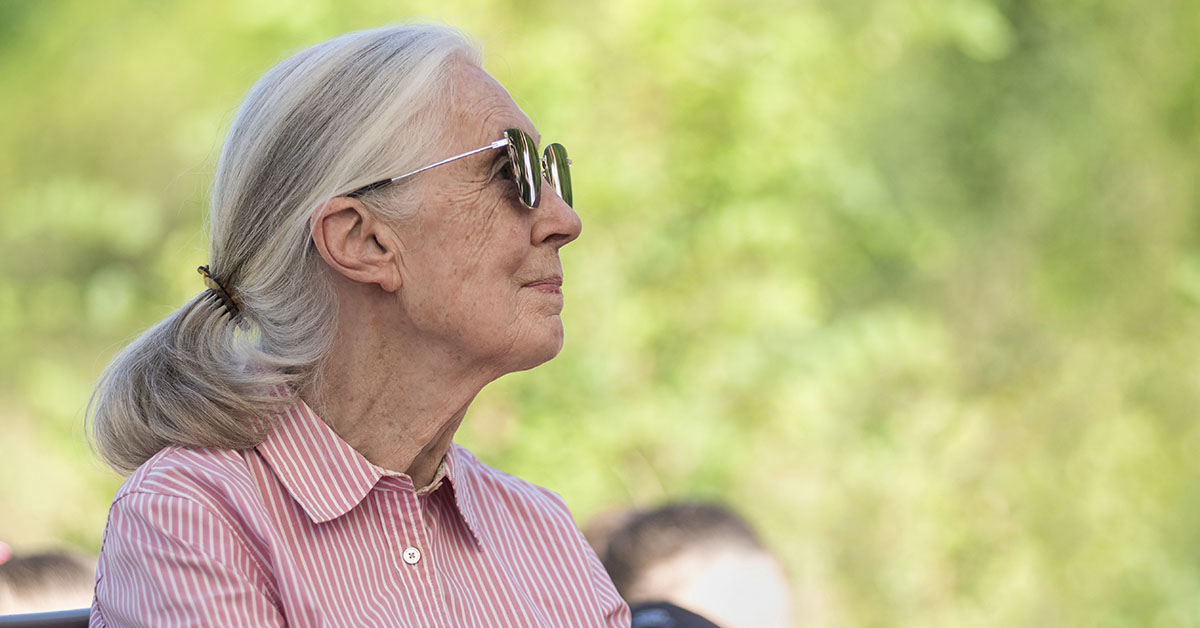

Students gathered in Pasadena on October 1, 2025, expecting to hear the legendary anthropologist speak about protecting the environment and what young people could do to change the world, but Jane Goodall had died that morning in her sleep at 91 in Los Angeles, and the cause of death was natural.
Months before her death, Goodall had recorded something. She sat alone in front of a camera for Netflix’s Famous Last Words, a series where public figures record conversations that air only after they die. Goodall talked about hope, apathy, her life, and what she believed about death.
“I want to make sure that you all understand that each and every one of you has a role to play,” Goodall said. “Your life matters, and you are here for a reason. Every single day you live, you make a difference in the world, and you get to choose the difference that you make.”
From London to Kenya
Goodall was born in London in 1934. At 8 years old, she read the Tarzan books and fell in love with Africa. She wanted to live among wild animals and write about them. Everyone laughed except her mother, who told her that determination and hard work could make it happen.
Her family had no money for college. Goodall attended secretarial school in South Kensington and took whatever jobs she could find, waiting tables and working for a documentary film company. Every penny went into savings. In 1956, a friend invited her to visit Kenya. At 23, she jumped at the chance and bought a one-way boat ticket.
Nairobi welcomed her in March 1957. Louis Leakey, a famous paleoanthropologist at the local natural history museum, became her first stop. The appointment turned into a job offer that same day. Leakey hired her as his secretary. No degree, but years of reading about Africa and animals meant she could answer his questions with depth and enthusiasm.
The job opened doors. Goodall traveled with Leakey, his wife, and another young woman to the Serengeti and Olduvai Gorge. She saw giraffes, zebras, antelopes, a rhino, and a young lion that followed them for some distance. Leakey watched how she moved through that landscape. He realized she was the person he had been looking for.
The Chimpanzees
Leakey wanted someone to study wild chimpanzees at Gombe Stream Game Reserve in Tanzania. He believed Goodall’s lack of formal training would help her observe without academic bias. British authorities refused to let a young woman enter the bush alone, so her mother joined her.
Goodall arrived on July 14, 1960, at age 26. She caught malaria soon after and spent weeks crossing rough terrain without finding chimpanzees. When they finally appeared, they fled. She wore the same clothes each day, watched from a rocky ridge, and waited.
An older male finally let her watch. She called him David Greybeard. Researchers saw this as taboo. They used numbers, not names. But Goodall believed each chimpanzee had a personality. David Greybeard accepted her, and others began to tolerate her presence.
One day, she watched him strip leaves from a twig to fish termites from a mound. He was making a tool. Leakey sent a telegram. “Now we must redefine ‘tool,’ redefine ‘man,’ or accept chimpanzees as humans.”
The finding overturned long-held ideas. Chimpanzees hunted, made tools, and showed complex emotions. They kissed, embraced, and formed lasting friendships. They also waged organized wars against neighboring groups.
Goodall entered a doctoral program at Cambridge in 1962 without an undergraduate degree. Many scholars dismissed her approach as emotional and unscientific, but she earned her PhD in 1965 and continued her research at Gombe for two more decades.
Seeing the Destruction
Goodall founded the Jane Goodall Institute in 1977 with Genevieve di San Faustino to protect chimpanzees and their habitats through research, conservation, and education. The work felt important but manageable. Then, 1986 changed everything.
She attended a primatology conference in Chicago that year. Every presenter mentioned the same problem. Deforestation was destroying chimpanzee habitat at study sites around the world. She flew over Gombe after the conference and saw what was happening on the other side of the park. Miles of bare hills stretched where forests had once stood. She could no longer simply observe. And she had to act.
The institute grew. In 1991, she started Roots & Shoots, a youth program that encourages young people to take action on environmental and humanitarian issues in their communities. Today, the institute has offices in 25 cities worldwide. Roots & Shoots operates in more than 60 countries.
Jane Goodall’s Natural Cause of Death
Goodall spent her later years traveling nearly 300 days a year. She spoke around the world, met with leaders, and visited schools and universities. In January 2025, President Joe Biden awarded her the Presidential Medal of Freedom. She had already been named a UN Messenger of Peace and a Dame Commander of the British Empire, and she also wrote dozens of books.
Jane Goodall lived a long, full life, and the cause of her death was natural. Her passing reflected the peaceful rhythm of a life shaped by curiosity, compassion, and dedication to the world she loved.
At Gombe, there is still one chimpanzee who knew her from the very beginning. Fifi was a small infant when Goodall arrived in 1960. She is now the last living link to those early years when a young woman with no scientific training walked into the forest and changed what it means to be human. The Gombe research continues today as one of the longest-running wildlife studies in history.
In a 1999 NPR interview, Terry Gross asked if she preferred chimps or people. Goodall’s answer summed up her view of life: “Chimps are so like us that I like some people much more than some chimps, and some chimps much more than some people.”
Read More: Gorillas Seen Self-Medicating By Using Same Antibacterial Plants As Traditional Healers