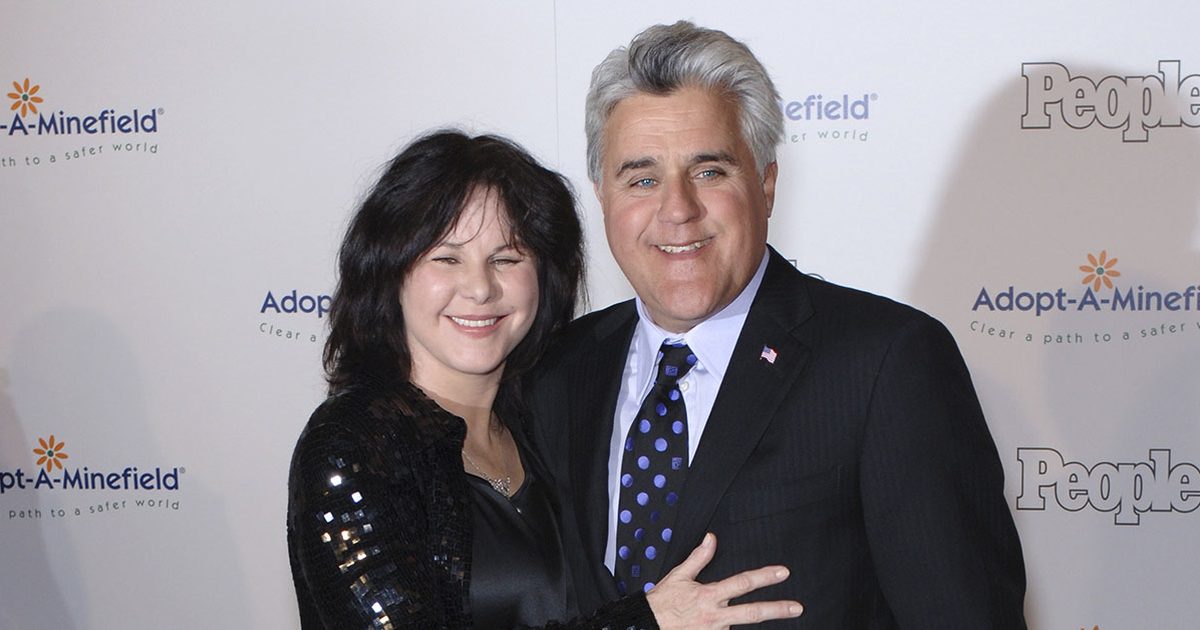

For roughly three years, every morning arrived the same way in the Leno household. Mavis would wake up and grieve her mother’s death for the first time. The phone call, the news, the loss were fresh each day, and devastating each time.
In a conversation with AARP, Jay Leno, then 75, said the hardest part of caring for his wife, Mavis Leno, 79, was that “every day she’d wake up and realize someone had called today to tell her her mother had passed away.” Her mother, he said, “died” every day for about three years. He later described the same experience in a November 2025 interview on TODAY with Hoda Kotb. Mavis had been progressively losing capacity and orientation to space and time for several years before her condition became widely known. Jay has been her primary caregiver ever since. His tasks include feeding her, changing her, and carrying her to and from the bathroom. He calls the last one “Jay and Mavis at the prom.”
Jay Leno’s caregiving story gives many families a public picture of what advanced dementia can look like inside a home. It is the texture of daily life, not a clinical summary.
What does advanced dementia do to the brain, and to the people around it?
Advanced dementia is marked by far more than memory loss. When a person’s mind declines while their body stays physically capable, a gap opens. That gap can create caregiving demands that are hard for one household to absorb on its own.
According to the American Speech-Language-Hearing Association, dementia is a syndrome. It is marked by a progressive decline in memory and in other thinking skills needed for independent daily living. In its advanced stages, the brain can no longer form new long-term memories. Each day truly begins without the previous one.
This is what made Mavis’s mornings so painful. Because people with dementia cannot form new memories, each reminder can feel like hearing the news for the first time. The full weight of grief hits without any buffer of prior processing. For Mavis, that grief was about her mother. Jay watched it happen every single day for roughly three years. In her mind, that loss never moved to the past tense.
In moderate to advanced stages, many care experts recommend against repeated re-telling. The person can experience fresh emotional pain each time the news is delivered. There is no buildup of comfort. There is only the raw moment, again.
Read More: Type of Grief No One Talks About
How has a marriage of more than 43 years been reshaped by daily care?
Jay Leno and Mavis have been married for more than 43 years. By his own account, the relationship looks different now than it ever has. He feeds her, changes her, and lifts her physically to get her to the bathroom. These are the literal tasks of his days.
He was granted conservatorship over Mavis’s estate in April 2024 because she had been, in the words of a court petition, “progressively losing capacity and orientation to space and time for several years.” According to CNN, the conservatorship was necessary. Mavis could no longer manage her own financial affairs. He filed for conservatorship in January 2024.
He has described finding humor in the daily work of it. When he carries Mavis to the bathroom, he narrates it as a prom moment. The two of them are slow-dancing across a floor in a high school gym, all those decades ago. He turns routine tasks into moments of dignity and connection.
Mavis has not forgotten him. Jay has said this clearly in his AARP interview, and it matters enormously to him. He understands she might, eventually. But for now, she still looks at him and knows who he is.
In severe dementia, caregivers must provide consistent hands-on help. That includes bathing, dressing, eating, and toileting. That is the full range of physical support that was once unneeded. For Jay Leno, there is no rotation of shifts or facility schedule. He is the constant.
Who lives with dementia, and who does the caring?
The Alzheimer’s Association Facts and Figures estimates that 7.4 million Americans age 65 and older are living with Alzheimer’s in 2026. About 1 in 9 people age 65 and older, roughly 11%, has Alzheimer’s dementia. Almost two-thirds of Americans with Alzheimer’s are women. That puts millions of families in a situation structurally similar to the Lenos’, where a spouse becomes the primary person responsible for another person’s whole life.
Dementia caregivers carry a heavier load than caregivers for other conditions. Caregiver research puts the average at 92 hours of care per month for dementia, versus 65 hours for other conditions. That is 27 extra hours a month. That gap represents more than a full additional work week of unpaid labor every month.
What kind of grief begins before the goodbye?
What Jay describes with Mavis, watching her wake each morning into fresh loss, is what researchers call anticipatory grief. Family members of people with advanced dementia can feel grief, including separation distress, while the person is still living. The loss does not arrive in a single moment. It unfolds over years. Both the person with dementia and their caregiver cycle through repeated experiences of separation and disorientation.
Spousal caregivers and those with greater caregiving involvement tend to report higher levels of this kind of grief. Jay Leno fits both criteria. He has provided hands-on physical care daily since the conservatorship process began in 2024.
Who is Mavis Leno?
Before her dementia became the defining fact of her public profile, Mavis Leno was a serious activist. According to TODAY, she was nominated for the Nobel Peace Prize in 2002 for her work supporting women in Afghanistan under the Taliban. She chaired the Feminist Majority Foundation’s campaign that brought international attention to gender apartheid under Taliban rule.
Jay has spoken about how fiercely independent she always was. He views caregiving as an extension of the vow he made more than 43 years ago.
What has Leno actually said about his own experience?
In his interviews, Jay Leno said the toughest part was watching Mavis relive her mother’s death every morning. It was not over days or weeks, but for about three years. He said each instance was not a milder rerun of the same news. She was learning it for the first time, with the same shock and rawness every time.
He said Mavis still recognizes him. He said she seems comfortable and content. He said he enjoys taking care of her, and that this is not a performance of optimism but his genuine experience.
He also said she can no longer travel, something she loved. He fills that gap with YouTube travel videos and nature programs, sitting with her and watching the world she can no longer reach. The world narrows. You find ways to bring it inside.
What does this mean for families doing this work?
The experience Jay Leno describes belongs to millions of people without a public platform. The repetition, the grief cycles, the physical demands, and the daily improvisation are well known features of advanced dementia care. They are not exceptional circumstances.
Getting support is not a departure from your caregiving role. That support might be a local memory care group. It might be a caregiver support group. Or it might be a talk with a primary care doctor about your own mental health. It is what makes sustained caregiving possible.
Leno himself has said that caregiving is not something you can simply decide you’re up to. His exact words, delivered in his TODAY interview: “Don’t think you’re up to caregiving because you’re not.” The work is harder than the commitment. Knowing that ahead of time is more useful than finding out in year three.
Mavis has not forgotten him. For now, that is what matters most to Jay Leno, a detail that is specific and may not last, and one that many caregivers in this situation will recognize at once. If you are caring for someone with dementia, talk with a doctor about support for both of you.
Disclaimer: The author is not a licensed medical professional. The information provided is for general informational and educational purposes only and is based on research from publicly available, reputable sources. It is not intended to constitute, and should not be relied upon as, medical advice, diagnosis, or treatment. Always consult a licensed physician or other qualified healthcare provider regarding any medical condition, symptoms, or medications. Do not disregard, avoid, or delay seeking professional medical advice or treatment because of information contained herein.
AI Disclaimer: This article was created with the assistance of AI tools and reviewed by a human editor.