
Somewhere between genius and necessity, the best inventions tend to begin not in a research lab but in a kitchen, a garage, or a backyard. The kind of place where someone gets frustrated enough with a problem to actually try solving it. That’s exactly where this story starts – in a home in Warrenton, Virginia, where 18-year-old Mia Heller got tired of watching her family spend time and money replacing water filters and decided there had to be a smarter way.
What she built next caught the attention of scientists, engineers, and public health experts worldwide. And the fact that she was 18 years old when she did it makes the story harder to set aside.
Drinking water is something most people in the developed world take for granted. Turn on the tap, fill the glass, drink. But the reality behind that simple act is increasingly complicated. The question of what else is in that water – particles too small to see but potentially large enough to cause harm – is one that researchers and regulators are still grappling with, often without satisfying answers.
The Problem in Your Tap Water
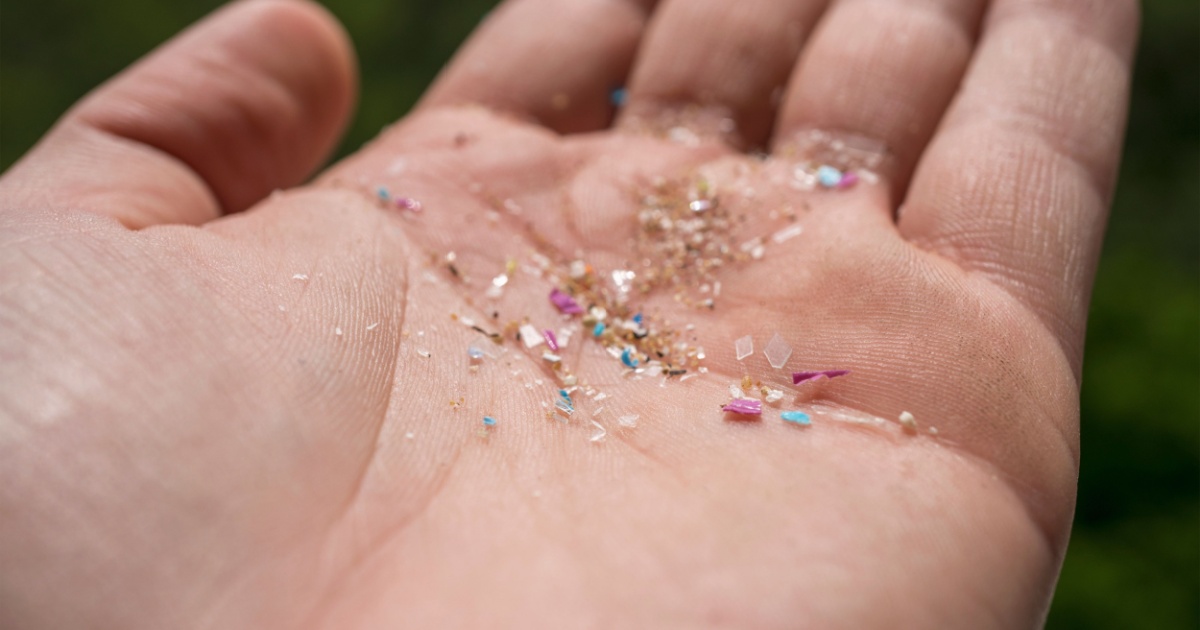
Microplastics – plastic fragments up to 5 millimeters long – are inescapable. An estimated 10 to 40 million metric tons of these particles are released into the environment every year, and if current trends continue, that number could double by 2040. They get into water supplies through the breakdown of plastic packaging, synthetic fibers from laundry, plastic pipes, and industrial runoff. They’re in the water we drink, the food we eat, the clothes we wear, and the air we breathe. They’ve pervaded every ecosystem on earth, from coral reefs to Antarctic ice. And they’ve infiltrated the human body, lodging themselves in everything from brain tissue to reproductive organs.
Research reviewing more than 140 studies found that people consume between 39,000 and 52,000 microplastic particles every year. Those who regularly reach for bottled water thinking it’s the cleaner option may be making the problem worse. Individuals who drink bottled water regularly ingest up to 90,000 more particles each year than those who drink mainly tap water.
The health picture is still being filled in, and scientists are careful not to overstate what they know. The emergence of microplastics in drinking water supply systems has become a significant environmental challenge, though the potential impacts on human health remain incompletely understood. Still, early signals are hard to ignore. One of the first papers to directly examine the risks of microplastics exposure in humans, published in The New England Journal of Medicine in March 2024, studied patients undergoing surgery to remove plaque from their arteries. More than two years after the procedure, those who had microplastics in their plaque had a higher risk of heart attack, stroke, and death than those who didn’t.
The situation inside the human brain is equally unsettling. A 2025 study published in Nature Medicine found that brain samples collected in 2024 contained significantly more microplastics than those taken eight years earlier. Researchers found the amount of plastic in the brain had increased by about 50%, roughly equivalent in weight to an entire plastic spoon. The study also found that people with dementia had three to five times more microplastics in their brains than those without the condition – though the research doesn’t yet establish whether the plastics cause the disease or simply accumulate alongside it.
Compounding the issue, Americans are also dealing with a separate but related contamination crisis. New EPA testing data confirms that 176 million people in communities throughout the U.S. have drinking water that has tested positive for PFAS – per- and polyfluoroalkyl substances, synthetic “forever chemicals” that don’t break down in the environment. Exposure to PFAS is linked to cancer, reproductive harm, immune system damage, and other serious health problems, even at low levels. Public concern is mounting fast. A March 2025 survey of more than 1,100 U.S. adults found that 87% – nearly 9 in 10 Americans – are at least somewhat concerned about the quality of unfiltered tap water in their homes, up from 73% in 2021.
One Teenager, One Garage, One Big Idea
Mia Heller, an 18-year-old high school student, was looking to make a difference in her neighborhood of Warrenton, Virginia’s water quality. After local reports revealed the area’s water was contaminated with both PFAS and microplastics, her family installed a home filtration system. But watching her mother swap out filter membranes again and again, Heller started asking a different question entirely.
“It inspired me to design a filter without the use of membranes, to decrease the costs and maintenance needs associated with water filtration,” she explained.
The answer she arrived at was ferrofluid. It’s a substance most people have never heard of – a magnetic liquid made of tiny iron-based particles suspended in a carrier oil. For her prototype, Heller used a canola oil-based ferrofluid pumped into microplastic-contaminated water. What happens next is elegant in its simplicity. As Heller explains it: “My design starts with a ferrofluid, which is essentially just a magnetized powder and oil. When you have water and microplastics and you combine the ferrofluid with the water, the microplastics are going to be more attracted to the ferrofluid because of its polarity. It’s not because of magnetism or anything, just based on how the properties of water and microplastics differ.”
When contaminated water flows through the system, the ferrofluid attaches to the plastic fragments. A magnetic field then pulls the entire mixture out of the water stream. The ferrofluid is subsequently recovered and reused in a closed loop.
Over time, Heller’s design evolved into a three-part system: one chamber for the water, one for the ferrofluid, and a smaller unit where the actual separation happens. The finished prototype fits inside a container roughly the size of a bag of flour – small enough to sit under a kitchen sink. If you want broader context on why microplastics in household water are such a growing concern, our guide to drinking water and microplastics covers the key risks and what filters actually help.
How It Works, and How Well
To measure her results properly, Heller went a step further and built her own turbidity sensor. Turbidity is a measure of how cloudy or murky a liquid is, and it’s used to detect the concentration of suspended particles. She used the sensor to precisely gauge the amount of ferrofluid and microplastics in the water, and it also calculated the weight-based percentage of microplastics removed by her filter.
The numbers she recorded were striking. According to her tests, her prototype successfully removed 95.52% of microplastics from the water and recycled 87.15% of the ferrofluid. For context, traditional drinking-water treatment plants remove about 70 to more than 90% of microplastic components – meaning Heller’s homemade device matched or exceeded what some municipal systems achieve at industrial scale.
Unlike traditional filtration systems, many of which are costly and rely on chemical treatments, a ferrofluid-based process offers a “cost-effective, energy-efficient, and sustainable solution” to microplastics and their increasing presence in drinking water. The recovery and reuse of the ferrofluid is particularly important from a cost standpoint. The process allows most of the ferrofluid to be collected and reused, which could help keep costs down over time.
Heller’s project was registered at Regeneron ISEF 2025 as “ENEV053 – Self-Recycling System for Microplastic Removal: Development of a Novel Ferrofluid-Based Filtration Technology for Affordable Water Treatment.” Competing against nearly 1,700 students from 49 states and 62 countries, Heller impressed judges with her novel filtration system. She earned a special $500 award from the Patent and Trademark Office Society, and earlier in the year, she had earned top honors at the Virginia Piedmont Regional Science Fair, where out of 92 high school participants she was one of only two students to win a Grand Award, also placing first in the Chemistry category and receiving the North Fork Innovator Award.
What Scientists Are Saying
The scientific community has responded with genuine interest, alongside careful caution. Experts note that the ferrofluid approach is genuinely novel in the home-use space. Unlike conventional filtration methods dependent on solid membranes or expensive chemical processes, the ferrofluid system offers an approach that’s reusable and low-waste.
But researchers have also flagged important questions that still need answering. One concern is ensuring the extracted microplastics are captured in a way that allows them to be safely discarded or destroyed. The system also shouldn’t “leave some other pollutant residue that we have to deal with.” In other words, solving one contamination problem while creating another would defeat the purpose.
The data draws attention because it approaches, and in some cases exceeds, the efficiency range reported for conventional drinking water treatment systems. Still, the comparison requires caution. Academic studies show that the efficiency of treatment stations varies according to the size, shape, and composition of particles, as well as the operational design of each plant. The performance observed in the domestic prototype does not, by itself, authorize a direct equivalence with industrial structures operating on a much larger scale.
Scale is also a real constraint for now. Heller considers the system best suited as an at-home, under-the-sink filtration device. “Because ferrofluid is currently expensive to produce at a large scale,” she notes, “I see this as a system for individual home use.”
She’s planning to have her results professionally tested before thinking about what comes next. That kind of methodical thinking, in a person this young, is exactly what the scientific community wants to see.
The Bigger Picture – A Regulatory Moment
The timing of Heller’s invention couldn’t be more pointed. In April 2026, for the first time in the EPA’s Contaminant Candidate List program’s history, the agency designated both microplastics and pharmaceuticals as priority contaminant groups – a direct response to the concerns of millions of Americans who have long demanded answers about what they and their families are drinking every day.
At the same time, regulatory progress on the chemical side has been uneven. According to the EPA’s own announcement, in May 2025 the agency rescinded the regulations for several PFAS compounds including PFNA, PFHxS, GenX chemicals, and PFBS, and also extended the compliance deadline for PFOA and PFOS from 2029 to 2031. The result is that millions of Americans remain exposed to chemicals in their water with no enforceable standard protecting them.
As Heller herself wrote in her project summary: “Microplastics have been found from the Mariana Trench to Mount Everest, and from the human brain to the placenta of unborn fetuses.” That kind of scope – the scale of the contamination we’re dealing with – explains why a working home filtration prototype matters, even if it can’t yet scale to a municipal level.
Read More: No Filter Needed: The Cleanest Drinking Water by Country, Ranked
What This Means for You
Heller’s prototype is not yet a product you can buy. It hasn’t been independently verified at scale, and she’s still in the early stages of having her results professionally reviewed. But what she’s demonstrated is that the core principle – using ferrofluid and magnetism to remove microplastics without disposable membranes – produces results that rival, and in some tests exceed, what conventional treatment plants achieve. That’s a genuine proof of concept, built by a teenager in a garage.
For now, the most practical step you can take is understanding what’s actually in your tap water. The Environmental Working Group’s Tap Water Database lets you look up your local water system’s contamination data. If PFAS or microplastics are a concern in your area, activated carbon filters and reverse osmosis systems are the current best available options for home use. They’re not perfect, and they don’t solve the underlying problem – but they reduce your exposure meaningfully while better solutions continue to develop.
The deeper takeaway here isn’t just about one teenager or one invention. It’s about where the next solutions might come from. Not every answer to a global contamination problem will arrive from a corporation or a government agency. Heller’s interests span environmental science and public policy, and she plans to explore both further as she moves toward university. The work she’s already done is the kind of contribution that tends to matter – not because it solves everything, but because it shows that everything can be questioned, including the filter under your sink.
Disclaimer: This information is not intended to be a substitute for professional medical advice, diagnosis, or treatment and is for information only. Always seek the advice of your physician or another qualified health provider with any questions about your medical condition and/or current medication. Do not disregard professional medical advice or delay seeking advice or treatment because of something you have read here.
AI Disclaimer: This article was created with the assistance of AI tools and reviewed by a human editor.
Read More: Solar Device Desalinates 20L of Drinking Water a Day with 93% Efficiency