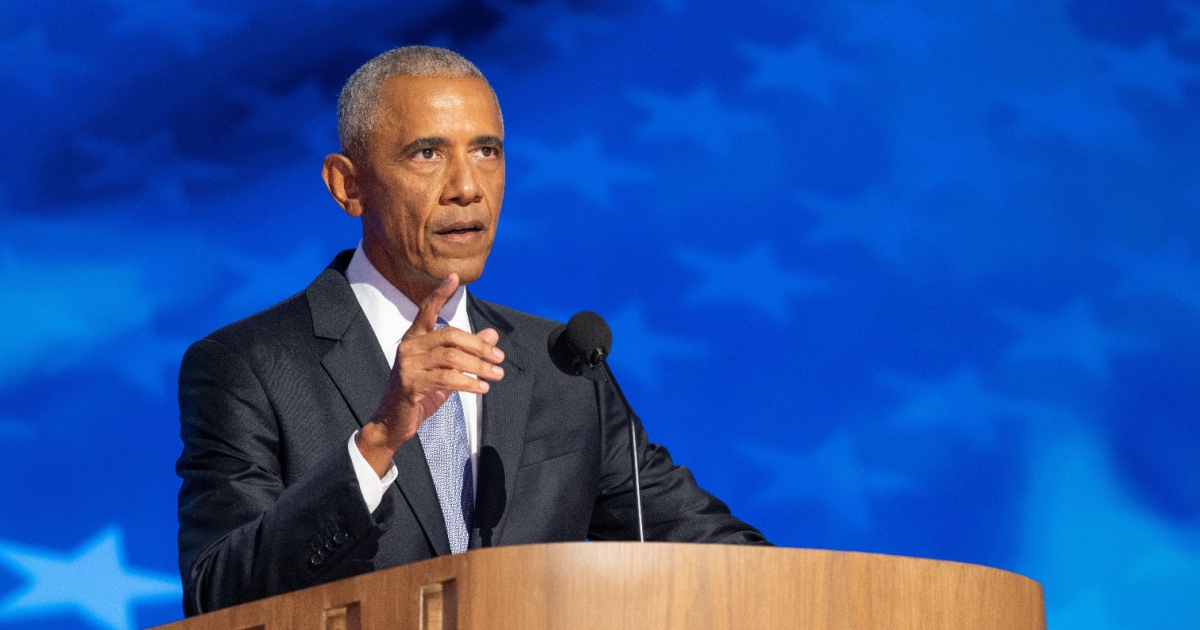

Barack Obama turns 65 this August, and the former president has a brand-new NBA-regulation basketball court waiting for him at his recently opened Presidential Center in Chicago. There’s just one problem: he doesn’t plan to use it the way most people would expect.
When asked whether he’d be getting into pickup games at the new facility, Obama’s answer was blunt: “Now I will take folks on for a game of Horse… I am not running up and down that court because I want to protect my knees and my Achilles. I don’t want to be in a boot.” For a man whose love of basketball has defined his public image for decades, that’s a significant admission.
He was equally candid about lateral movement: “I’m in good shape if I’m just running north-south. You start getting me sideways and I start worrying about something kind of going wrong.” Michelle, who has been getting deeply into tennis, had her own diagnosis of her husband’s situation. She told People that Barack “has got to stretch out those calves or he’s going to pop something.” Obama’s response was as succinct as his policy memos: “Don’t want to do that.”
The exchange got a lot of laughs. But behind the humor is a set of real physical concerns that any active adult in their 60s will recognize immediately.
Why Knees and Achilles Tendons Take the Worst of It
Basketball is unforgiving on aging joints. Research published in a PMC journal confirms the sport requires players to perform repeated high-intensity activities, including sprinting, shuffling, jumping, and rapid direction changes – precisely the kinds of movements Obama says he’s now avoiding.
The Achilles tendon worry is well-founded. According to the Ultra Ankle Institute, tendons naturally weaken with age, making middle-aged athletes especially vulnerable to Achilles injuries. Achilles injuries are particularly common in adults between 30 and 50 years old who participate in recreational sports, and the risk doesn’t improve as people move into their 60s, it just shifts from high-load explosive activity to the accumulated toll of years of use.
The knee side of the equation is equally clear-cut. A 2022 study published in the PMC database found that, according to CDC data, an average adult loses approximately 1 degree of knee flexion and extension ROM (range of motion) for every 10 years of age. Over decades, that’s not a trivial loss. By the time someone reaches their 60s, the cumulative reduction in knee mobility begins to matter most in exactly the situations Obama described – the quick cuts, the shuffles, the sudden changes in direction that basketball demands.
A 2026 SingleCare analysis found that nearly a quarter of adults in the U.S. have arthritis – and for recreational athletes approaching 65, osteoarthritis of the knee is often the condition quietly accumulating in the background.
The Calf Problem Nobody Talks About
Michelle Obama’s comment about her husband’s calves wasn’t idle ribbing. Tight or undertrained calves are one of the most underappreciated injury risks in aging athletes, and they have a direct relationship to both Achilles health and basketball-specific movement.
The Cleveland Clinic notes that people over age 40 may be more likely to get strains during physical activity, and the mechanism is often straightforward. People with tight or short calf muscles have a higher risk of calf muscle strains. The Achilles tendon connects the calf directly to the heel – so what happens in the calf reverberates through the tendon. When Obama said he worries about sideways movement, he was essentially describing the exact loading pattern that most stresses both the calf and the Achilles: rapid eccentric load (the muscle contracting as it lengthens) combined with a direction change.
Research indicates that strong calves contribute to better gait and reduce the risk of falls in older adults, which makes calf strengthening one of the more consequential exercises people in their 60s can prioritize. It’s not glamorous. But it’s the kind of foundational work that keeps people on the court – even if just for Horse.
Flexibility Isn’t Optional After 50
Obama acknowledged that Michelle is “way ahead” of him on stretching and flexibility, and said that’s his “next stage.” That’s not a minor gap to close. Research cited on BodyMusclematters.com, drawing from PMC (NIH) data, found that people typically lose approximately 6 degrees of range of motion per decade after age 50 – a rate of decline that significantly outpaces the 1-degree-per-decade loss seen in earlier adulthood.
A study found that older adults who participated in regular exercise programs maintained significantly better flexibility than sedentary peers over a 5-year period. The implication is that the gap between active and inactive adults isn’t fixed – it’s determined largely by what people actually do.
A 2023 study published in a peer-reviewed journal found that flexibility training improves joint ranges of motion, postural balance, and reduces the risk of falling in elderly people. For someone like Obama, whose concern is specifically lateral movement and the risk of “something going wrong,” flexibility work is the most direct intervention available. You can’t fully protect against the unpredictability of a basketball bounce, but you can meaningfully expand the range within which your joints operate safely.
Research on athletic performance in aging adults adds context to why Obama’s instincts here are sound. A study published in Movement & Sport Sciences found that the rate of decline in athletic performance across age groups accelerates with age, with the steepest reductions between ages 65 and 89. Obama is right at that threshold. The shift from full-court play to shooting games isn’t giving up – it’s adapting intelligently to a real biological curve.
Exercise Remains the Best Medicine for Joint Health
None of this means people at 64 should sit down. In fact, the evidence points strongly in the opposite direction. A 2026 ScienceDaily report noted that despite osteoarthritis affecting nearly 600 million people worldwide, the most powerful treatment available remains exercise. Not surgery. Not medication alone. Movement.
A 2026 systematic review and meta-analysis examining randomized controlled trials found significant benefits of exercise therapy for osteoarthritis in terms of both pain reduction and functional improvement. The key is matching the exercise to what the joint can tolerate – exactly what Obama appears to be doing when he swaps full-court runs for shooting contests.
The CDC recommends that adults, including those with arthritis, get at least 150 minutes per week of moderate-intensity aerobic activity. That’s 30 minutes on five days, not necessarily a pickup game. Walking, swimming, cycling, and yoga all count – which is presumably why Obama signed off on the yoga mat idea with a cheerful “Namaste.”
It’s also worth noting that Obama’s Presidential Center Home Court is designed for more than just basketball. The facility features flexible programming rooms designed for community programming, wellness workshops, and special events – precisely the kind of environment where yoga, stretching classes, and lower-impact fitness programming could help Obama close the flexibility gap he openly admitted to.
Read More: 10 Nutritious Foods to Improve Joint Health and Help With Joint Pain Relief
What This Means for You
Obama’s candid self-assessment in a joint interview with People magazine on June 25, tied to the opening of the Presidential Center in Chicago, is the kind of health conversation most people have privately at 60 – if they have it at all. The specifics he named (knees, Achilles, calves, flexibility) map directly onto the most common injury patterns in recreational athletes over 40.
The practical takeaway from the biology is this: the earlier you start calf strengthening, regular stretching, and reducing the highest-impact components of your sport, the more activity you can preserve into your 60s and 70s. Eccentric calf raises (lowering your heel slowly below a step) are one of the most evidence-backed exercises for Achilles tendon health. Daily calf stretching against a wall for 30 seconds per side costs nothing and directly addresses the tightness Michelle flagged.
For the knees specifically, quad-strengthening exercises – particularly single-leg work – reduce the load on the joint during lateral movement. And if you’re in your 50s or 60s and still playing recreational basketball, tennis, or any stop-start sport, it’s worth having a conversation with a physical therapist about whether your current warm-up routine is actually preparing your tendons for the demands you’re placing on them.
Obama can still win at Horse. The joints he’s protecting today are the ones that will keep him walking comfortably at 75. That’s not modesty – it’s good math.
Disclaimer: This information is not intended to be a substitute for professional medical advice, diagnosis, or treatment and is for information only. Always seek the advice of your physician or another qualified health provider with any questions about your medical condition and/or current medication. Do not disregard professional medical advice or delay seeking advice or treatment because of something you have read here.
AI Disclaimer: This article was created with the assistance of AI tools and reviewed by a human editor.
Read More: Barack Obama Admits Their Marriage “Hasn’t Been Equal” — Michelle Agrees