

Deep in the high desert of central Oregon, a rock shelter hid two small scraps of hide for more than twelve thousand years. No one knew what they were for most of that time, and when they were first pulled from the earth in 1958, the man who found them had no way of knowing what modern science would eventually reveal. The fragments sat in private hands for decades, then in a regional museum, waiting. What researchers finally uncovered when they turned the full power of modern analytical chemistry on them has sent ripples through the archaeology world, and for good reason.
This is not a story about a single bone or a chipped flint flake. It is a story about a piece of tailored clothing, needle-and-thread construction, and a community of Ice Age Americans who were doing something that no physical evidence had ever confirmed before. The find puts Oregon at the center of one of the most significant prehistoric discoveries in recent memory, and it forces a fundamental rethinking of how sophisticated early North Americans truly were.
The conclusions arrive at a moment when the deeper story of human migration into the Americas is being redrawn, piece by painstaking piece. Every fragment of organic material that survives from this era is precious. Most don’t. The fact that these did – and that what they show us is this remarkable – makes the Oregon cave sites unlike almost anywhere else on the continent.
The Study: What Was Found and Where
Cougar Mountain Cave and the nearby Paisley Caves in central Oregon are Late Pleistocene archaeological sites with two of the most extensive assemblages of rare perishable artifacts in the world. Perishable artifacts – items made from organic materials like plant fiber, hide, and wood – are rarely preserved due to their organic nature, but the desert-like conditions in central Oregon enabled preservation for very long periods.
Cougar Mountain Cave was excavated by amateur archaeologist John Cowles in 1958. He kept the artifacts until his death in the 1980s, when they were transferred to the Favell Museum in Klamath Falls, Oregon. The trove became available for scientific analysis only recently.
The research, titled “Complex perishable technologies from the North American Great Basin reveal specialized Late Pleistocene adaptations,” appeared in Science Advances on February 4, 2026. The international research team was led by Richard Rosencrance of the University of Nevada, Reno and Katelyn McDonough of the University of Oregon.
The researchers analyzed radiocarbon data from two of the largest Late Pleistocene perishable assemblages in the world – Cougar Mountain Cave and Paisley Caves. Those data included 66 radiocarbon dates on 55 items made from 15 different plant and animal taxa, including the oldest known physical remains of sewn hide. The eyed bone needles documented from four regional sites are described as among the finest bone needles made during the Pleistocene.
A Methodological Toolkit
The research team employed radiocarbon dating, zooarchaeological methods, the implementation of mass spectrometry, and other approaches to identify the materials retrieved from both Cougar Mountain Cave and Paisley Caves. The ZooMS technique – Zooarchaeology by Mass Spectrometry, a method that identifies animal species from collagen proteins in bone and hide – was critical for confirming exactly which animals contributed to the collection.
The hide was dated three times to confirm an age of roughly 12,000 years, and chemical analysis confirmed it came from a North American elk. That triple-dating process matters: it rules out contamination or statistical outliers, giving the age assignment a high degree of confidence.
The Sewn Hide: What Makes It Historic
A fragment of elk hide found in Cougar Mountain Cave has a cord running through its margin. The cord, made from a mix of plant fiber and animal hair, exits the edge of the larger hide piece and extends into a smaller fragment, where it is knotted to keep from pulling through. The item dates to between 12,600 and 12,060 years ago, during a climatic interval called the Younger Dryas. As far as anyone knows, it is the oldest sewn hide ever recovered.
The radiocarbon dates were 12,600 to 11,880 years before present (BP), calibrated to 1950, meaning the hide is 12,676 to 11,956 years old – predating the construction of Egypt’s Great Pyramid at Giza by more than seven millennia.
Rosencrance was direct about the physical evidence. The fragments are “definitely sewn, because we have cordage sewn into a hide that comes right out and goes into another piece of hide,” says Richard Rosencrance, of the University of Nevada, Reno.
The fragment may have been “the margin of a piece of tight-fitted clothing, moccasin, bag or container, or part of a portable shelter,” though the researchers can’t “unequivocally confirm” its purpose, according to the study in Science Advances. What they can confirm is the intentionality of the craft. The three pieces of animal hide had been processed and dehaired, with cord made from a combination of plant fiber and animal hair sewn into the sides.
Indirect evidence of clothing production stretches back much earlier than 12,000 years. Researchers had previously discovered artifacts such as bone needles and figurines depicting figures wearing garments in Eurasia that are 50,000 years old. However, the Cougar Mountain Cave artifact is direct evidence of a sewn garment, making it particularly rare.
The Full Collection: Beyond the Hide
The sewn hide drew the headlines, but the broader collection is equally significant in its scope and variety.
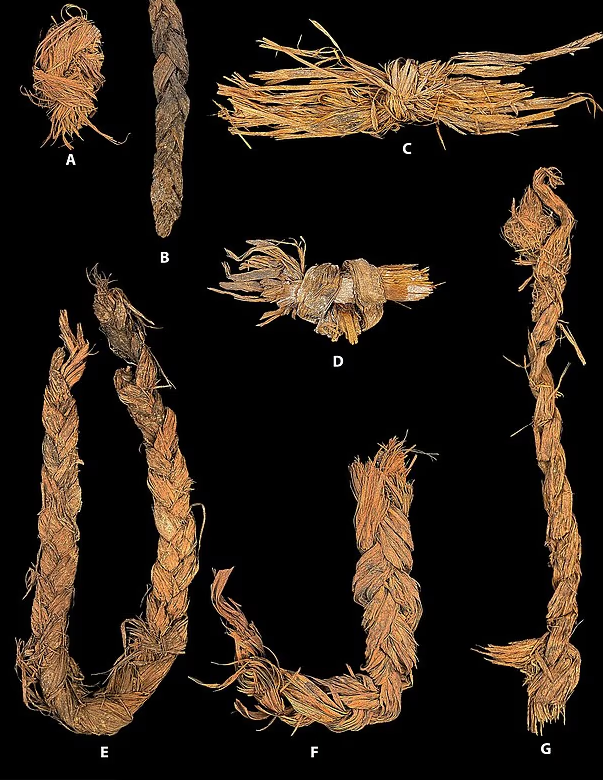
The artifacts previously unearthed in the two Oregon caves included 37 fiber cords, baskets and knots; 15 wooden implements; and three sewn hides.
The cords were braided using three strands and were made using sagebrush, dogbane, juniper, and bitterbrush fibers. Because the cords varied from 0.13 to 1 inch (0.33 to 2.5 centimeters) wide, they were probably used for a range of purposes.
A bundle of fibers that were twined – an early form of weaving – into a rough textile may have been used to make a bag, basket, or mat.
At Paisley Caves, researchers found additional evidence pointing toward a well-developed fur tradition. The team recovered a strip of rabbit fur with hair still attached. The piece resembles rabbit skin garments documented among Northern Paiute communities in recent centuries, where many pelts were woven together with plant fiber to form warm robes or skirts. This detail implies a cultural continuity of textile practice spanning thousands of years.
Researchers also looked at four potential ornamental items uncovered in the Connley Caves, including a porcupine tooth with a hole drilled into the top and lines scratched onto the surface. Items like that tooth push the story further, from pure survival technology into the domain of identity and self-expression.
The Bone Needles: Tools of Precision
The study also examined 14 eyed and three eyeless bone needles that had previously been discovered at Cougar Mountain Cave and the Paisley Caves, as well as the nearby Connley Caves and Tule Lake Rockshelter.
Researchers determined that the needles had been carved from the bones of both bison and mountain sheep. “In all of North America, there are only 17 sites with bone needles in Pleistocene-aged [Ice Age] contexts, while in South America, there are none,” according to the study.
The bone needles included in these collections are some of the best-preserved samples of such ancient technologies known, described as being “among the finest bone needles made in the Pleistocene.” You don’t need a fine eyed needle to drape a raw pelt over your shoulders. You need one to stitch a seam – to close gaps, create fitted layers, and produce garments that trap body heat efficiently.
The authors of the study noted: “The abundance of bone needles and the presence of adornment items and very fine-eyed needles suggest that clothing was more than a utilitarian survival strategy but also an avenue of expression and identity.”
The Younger Dryas: Why Sewn Clothing Was a Matter of Survival
The sewn hide piece dated to around 12,600 to 12,050 years ago. These dates coincide with the Younger Dryas. That timing is not coincidental.
The Younger Dryas was a cool period between roughly 12,900 and 11,600 years ago that disrupted the prevailing warming trend occurring in the Northern Hemisphere at the end of the Pleistocene Epoch. It was characterized by cooler average temperatures that returned parts of Europe and North America to ice age conditions. The onset took less than 100 years, and the period persisted for roughly 1,300 years.
According to Britannica, isotope data suggests that central Greenland was nearly 14°C (24.5°F) colder during the Younger Dryas than it is today, and that the sudden warming that ended the period took about 40 to 50 years. While Oregon’s high desert would not have experienced cooling as severe as Greenland, the climate shift was pronounced enough to demand a different approach to warmth.
The appearance of sewn materials around the Younger Dryas hints at some of the ways humans began to adapt to their environments in difficult times. When loose hides or woven materials were not enough to stop hypothermia from setting in, ingenuity was required, which seems to have led to tighter sewn clothing.
The timing also tells a story in reverse. Eyed bone needles disappeared from the archaeological record in Oregon after around 11,700 years ago, Rosencrance said, which suggests that tight-fitting clothing became less important as the climate warmed. After about 11,000 years ago, as climate grew warmer and drier, the archaeological record in the region shows more plant-based textiles and fewer bone needles. Lighter woven materials replaced heavy hide clothing for much of the year.
Implications for Understanding Early Americans
The Oregon discoveries do not exist in isolation. They fit into a larger and rapidly evolving picture of how technically accomplished the first Americans were.
There are only four sites – all in Oregon and Nevada – where non-bone animal and plant technology from the Late Pleistocene has been discovered in the Western Hemisphere. The Late Pleistocene spanned 126,000 to 11,700 years ago and includes the last ice age.
All four North American sites are in the Great Basin: Paisley Caves and Cougar Mountain Cave in Oregon, and Smith Creek Cave and Bonneville Estates Rockshelter in Nevada. In South America, only Monte Verde in Chile and Guitarrero Cave in Peru contain examples of Late Pleistocene perishables.
The rarity of the evidence is not because these technologies were rare in practice – it is because organic materials decay. Structurally and functionally complex technologies were a defining element of Late Pleistocene societies, but physical examples of them remain extremely rare in the archaeological record because most were made from perishable raw materials. The sparse material record limits the ability to formulate detailed models about this critical period in human history.
The Oregon sites are extraordinary precisely because their arid conditions bucked that trend. Artifacts made of biological material typically don’t survive as long as these ones have. The region’s ultradry air was crucial to their preservation.
There is also a thread of cultural continuity woven through these findings. When asked whether these paleo-Americans were ancestors of Native American tribes in the Great Northern Basin, Rosencrance said: “Absolutely.” “This looks like a tradition going back at least 10,000 years and at Paisley, at least 12,000 years,” Rosencrance said.
For Rosencrance, the artifacts carry a significance that reaches beyond archaeology. “This is kind of chronicling almost 12,000 years of shared technological knowledge,” Rosencrance says to Oregon Public Broadcasting’s Erik Neumann.
The study concluded: “The abundance of bone needles and the presence of adornment items and very fine-eyed needles suggest that clothing was more than a utilitarian survival strategy but also an avenue of expression and identity. This evidence pushes beyond conventional assumptions to confirm that Pleistocene peoples in the Americas used clothing as both survival technology and social practice.”
For more on what ancient discoveries are revealing about the deep human past, read about a 90,000-year-old human hybrid found in an ancient cave.
Read More: Scientists Discover Ancient Species of ‘Big-Headed Humans’ in Asia
What This Means for the Historical Record
The February 2026 findings from Cougar Mountain Cave and Paisley Caves accomplish something rare in archaeology: they replace inference with physical evidence. For decades, researchers assumed that Ice Age Americans made fitted clothing because the needles and the climate demanded it. Now, for the first time, there is the actual sewn hide to go with that reasoning.
Richard Rosencrance, the study’s lead author, captured the significance plainly: “We already knew they did, we just had to assume and guess what they were like. They were accomplished and serious sewists during the Ice Age.”
The research team also noted that there may be further insights available within other museum collections that have not yet been properly analyzed. Further research can refine existing models of early human adaptation and technology. The Cowles collection spent more than six decades in relative obscurity. Other collections may hold equally significant material, waiting for the right analytical techniques and the right moment of attention.
While it is rare to find items made from plants, wood, and hide that have been preserved for so long, this research also illustrates the deep ties that Indigenous people in Oregon have to their home, Rosencrance said. The rabbit-fur textile tradition, the elk-hide sewing, the braided cordage techniques – these are not just prehistoric artifacts. They are the roots of a living cultural inheritance.
The sewn hide from Cougar Mountain Cave predates the Great Pyramid of Giza by more than 7,500 years. It predates the invention of writing. It was made before almost everything we conventionally associate with “civilization.” And yet it required specialized knowledge of animal biology, hide processing, plant fiber identification, cordage construction, and precision sewing with a needle small enough to close a tight seam. That combination of skills tells a different story than the one we long assumed – one in which the first Americans arrived not as desperate wanderers, but as technically accomplished people carrying a full toolkit for survival and self-expression.
AI Disclaimer: This article was created with the assistance of AI tools and reviewed by a human editor.
Read More: Ancient Cave Discovery Challenges Long-Held Beliefs About Australia’s First Inhabitants