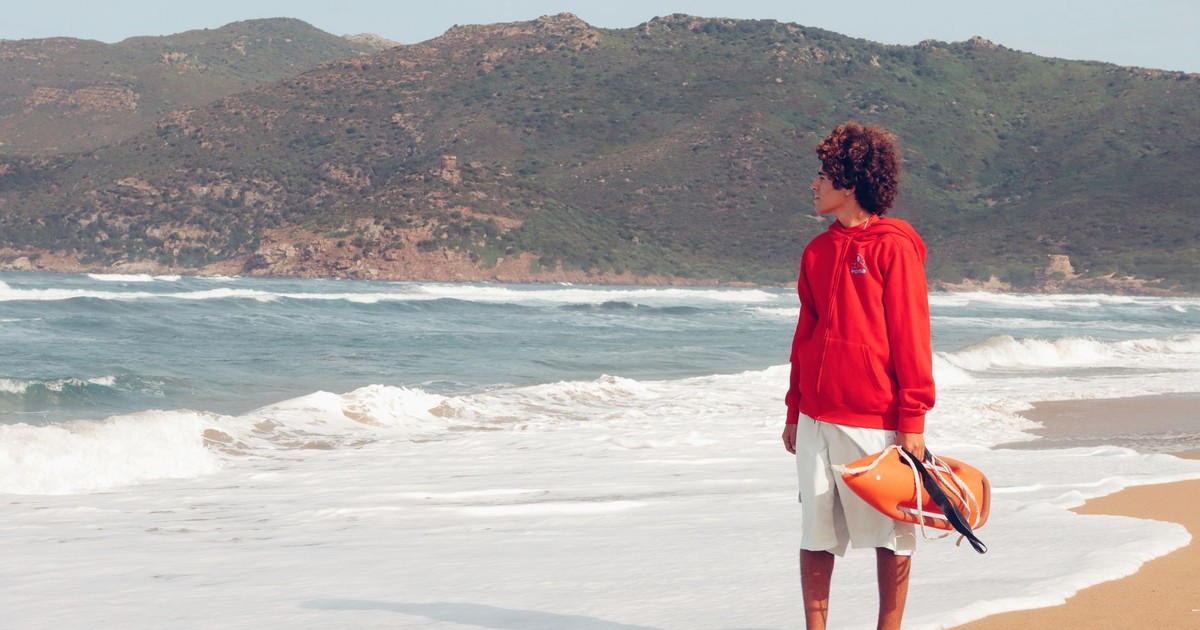

On July 25, 2026, Ryder Williams – a 16-year-old in his first season as a California State Parks lifeguard – ran into 8- to 10-foot Pacific surf at Seabright Beach in Santa Cruz and refused to release a 10-year-old boy swept offshore by a sneaker wave and rip current. That was also his very first rescue.
Shane Williams, Ryder’s father and a retired firefighter, spoke about his son’s rescue three days later – not reaching for the right words, but genuinely trying to make sense of what he had witnessed. He said Ryder didn’t believe the rescue was anything extraordinary. Any lifeguard on duty, his son told him, would have done exactly the same thing. Shane acknowledged he wasn’t certain he could have held on the way Ryder did.
The rescue began when a wave knocked a 10-year-old boy off his feet and swept him roughly 15 yards offshore into surf that included 8- to 10-foot pounding waves, sneaker waves, and rip currents. Ryder spotted the boy in distress, ran to help, and grabbed hold of him.
When the First Teen Lifeguard Rescue Is Your Hardest
Ryder Williams was 16 years old, and this was his first season as a lifeguard – and his very first rescue.
He grabbed the boy and never let go, even as both were slammed repeatedly by unrelenting waves. Bystanders waded in to try to help, but the surf rebuffed them and they retreated. A fellow lifeguard eventually joined Ryder and helped pull both of them safely to shore.
The moment Ryder reached the boy, he found him limp and unresponsive. The boy’s father, Sumit Rai, told ABC7 San Francisco that his son lost consciousness during the incident, and that “another two or three seconds, I don’t think my son would have made it.”
The boy was evaluated by paramedics on the beach and reunited with his family.
A Life Built for the Water
Shane Williams described a childhood spent almost entirely in and around the ocean. Ryder learned to swim young, took to surfing and boogie boarding alongside his father and grandfather, and was swimming independently by around age six.
Ryder played water polo and came up through the junior lifeguard program before joining the California State Parks lifeguard service. Water polo requires players to tread water or swim for the entirety of a match – no breaks, no standing, no resting. Ryder played hole set, a position that involves constant physical battling with opposing defenders in deep water, building the water endurance and upper-body strength that matter in a rescue.
He eventually enrolled in the California State Parks lifeguard academy, pushing through four days of fever to complete the program. That training includes certification in CPR, AED, Public Safety First Aid, and open water search and rescue.
Ryder’s path to beach patrol traces back to the Junior Guards program, a pipeline that trains young swimmers in ocean safety and rescue skills years before they are eligible for paid lifeguard positions. His mother publicly encouraged well-wishers to support that program rather than accept personal donations, pointing to it as the foundation that makes rescues like Ryder’s possible.
The Conditions That Day Were Not Random
The swell that hit the Santa Cruz coastline on July 25 came off a Pacific hurricane system, pushing wave faces to 8 to 10 feet – well above typical summer surf for the area. The National Weather Service had issued warnings for life-threatening rip currents and hazardous ocean conditions along the West Coast that week.
Sneaker waves are sudden, powerful waves that surge much farther up the beach than nearby waves. Unlike rip currents, which pull swimmers offshore gradually, a sneaker wave can knock a person off their feet in seconds. Combined with a rip current, the effect is immediate and overwhelming.
Rip currents account for approximately 80% of all lifeguard rescues, and an estimated 60,000 people are pulled from the water annually because of them. About 100 people drown from rip currents each year in the United States – far more than those killed annually by sharks.
Why the Numbers Behind Drowning Matter
CDC Vital Signs data shows that over 4,500 people drowned each year in the United States from 2020 to 2022 – roughly 500 more each year than in 2019. Among children ages 1 to 4, drowning is the leading cause of death, and drowning rates in that age group increased by 28% in 2022 compared to 2019.
Research consistently identifies formal swimming lessons and water safety training as effective drowning prevention strategies for children. Ryder began swimming lessons as a very young child – that foundation, built over years into junior lifeguard training and competitive water polo, is what made the rescue on July 25 possible.
The CDC’s drowning prevention guidance is consistent: supervise young children within arm’s reach near any water, enroll children in formal swimming lessons, fence home pools with self-latching gates, and choose lifeguard-protected beaches. None of these measures are complicated, and all of them reduce drowning risk.
Read More: What Do Beach Flag Colors Mean? A Quick Safety Guide
What Happened After the Rescue
The video of Ryder’s rescue spread across social media within hours of photographer Scott Vander Dussen posting it to the Santa Cruz Now Instagram account. President Donald Trump announced plans to bring Ryder and his family to the White House to receive a High Civilian Honor, posting on X: “We’re going to bring this heroic young man, and his family, into the White House with, perhaps, the boy he saved, to give him a High Civilian Honor.” Shane Williams told reporters that his son’s first day of high school was August 6, and that the family’s priority was letting Ryder settle into the school year and play water polo.
Ryder declined personal interviews outside those arranged through California State Parks and has no social media presence. His father confirmed that Ryder found the national response genuinely puzzling – in his view, he had simply done what lifeguards are trained to do. Ryder’s own public statement was brief: “This is my job and I love what I do.”
The rescue on July 25 wasn’t Ryder’s last of the day. He made four additional rescues later in his shift, in conditions he described as more challenging than those captured on video. Those rescues were not filmed.
A Real-Life Baywatch Moment
Ryder Williams’ rescue eventually caught the attention of Baywatch, the television franchise built around fictional lifeguard heroes. Stephen Amell, star of the upcoming Baywatch reboot, surprised Williams with an iconic red lifeguard jacket in recognition of his actions at Seabright Beach. The gesture added a Hollywood twist to a story that had already spread far beyond Santa Cruz.
But Williams has remained notably modest about the attention. Rather than seeing himself as a hero, he has repeatedly described the rescue as simply doing his job. That attitude is consistent with his preparation: years of swimming, surfing, water polo and junior lifeguard training had prepared him for the moment when a swimmer needed help.
The recognition also underscored something important about the rescue. What looked extraordinary to people watching from shore was, to Williams, the culmination of years of training—and exactly what a lifeguard is supposed to do when someone is in danger.
Beach Safety Steps That Reduce Drowning Risk
Choosing a lifeguard-protected beach is one of the most direct steps families can take. Staying within arm’s reach of young children near any water, keeping children facing the ocean – turning your back to the surf is how sneaker waves catch people off guard – and paying attention to warning flags are all practical measures. Rip current and high surf warnings issued by the National Weather Service carry real weight, and conditions at Seabright on July 25 demonstrated why.
The Junior Guards program that trained Ryder accepts children as young as nine in many California districts. Enrolling children in formal swim lessons early and consistently is one of the most direct ways to reduce drowning risk, according to CDC guidance. Ryder Williams ran into the ocean at Seabright Beach because he was trained and prepared. The gap between that preparation and the absence of it is measured in seconds.
AI Disclaimer: This article was created with the assistance of AI tools and reviewed by a human editor.
Read More: Suicidal Man Saved After 3 School Boys Grabbed Him and didn’t Let Go