

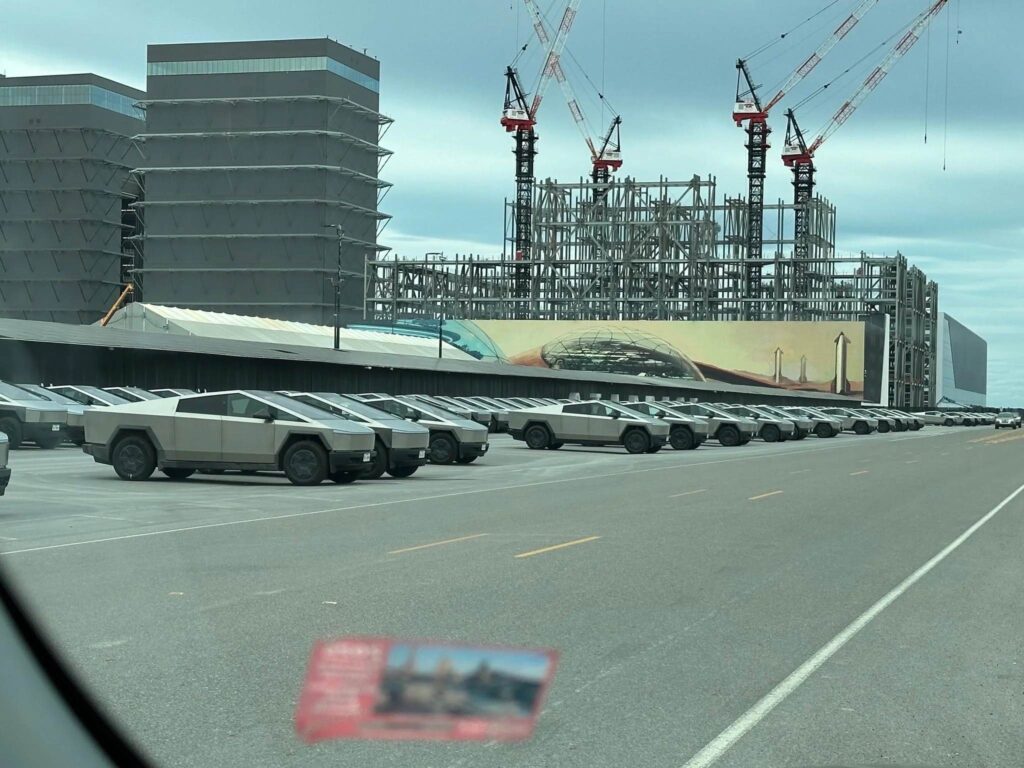
A man passing through Brownsville, Texas, spotted something in a parking lot that stopped him in his tracks: hundreds upon hundreds of Cybertrucks, packed tightly together near the SpaceX Starbase facility in Boca Chica. Fred Jones, visiting from Omaha, quickly snapped a photo and shared it to a Tesla Facebook group with a simple caption noting he’d seen “thousands or hundreds of Tesla trucks” at SpaceX parking lots. The post racked up more than 610 likes and nearly 240 comments, because Jones had accidentally put a face to a question the auto industry had been quietly asking for months.
Where did all those Tesla Cybertruck SpaceX purchases actually go? Registration data tells part of the story. According to Electrek, of the 7,071 Cybertrucks registered in the US during Q4 2025, 1,279 went to SpaceX. That’s not a rounding error. Another 60 units were registered to Musk’s other ventures – xAI, The Boring Company, and Neuralink – bringing the Musk-entity total to roughly 1,339 vehicles, or approximately 19% of all Q4 2025 Cybertruck registrations.
Jones’ photo, and the explanation that followed in the comments, revealed the practical reality behind those numbers. These aren’t trucks sitting in a storage lot gathering dust. SpaceX has worked Cybertrucks into everything from technician transport to chase vehicles for rocket recoveries, and the trucks are a common sight throughout the massive Starbase campus. But there’s a second reason for the sheer density of Cybertrucks in the area – one that surprised even some Tesla fans.
What SpaceX Is Actually Doing With 1,000+ Cybertrucks
Employees of Elon Musk’s companies are reportedly able to lease the Cybertrucks for a highly subsidized rate – some say it’s only $400 a month – and they also get free Supercharging as long as they charge at the base. That context changes the picture considerably. Many of the trucks Jones photographed parked together weren’t SpaceX fleet vehicles sitting idle; they were employee vehicles that simply hadn’t left the lot yet that day. Multiple Facebook commenters on Jones’ post described workers using the trucks for daily transport within the facility.
SpaceX’s transition to a fully electric fleet of work trucks is officially underway, led by the Cybertruck. Multiple deliveries were spotted at SpaceX’s Starbase facility in Boca Chica, Texas, as well as the company’s Starlink factory in Bastrop. The fleet isn’t limited to one site. Vehicles purchased by SpaceX and xAI are being deployed in locations such as Starbase in Boca Chica, the Starlink factory in Bastrop, and xAI facilities.
Wes Morrill, the Cybertruck’s lead engineer at Tesla, celebrated the milestone publicly. “Love to see the ICE support fleets from Tesla and SpaceX get replaced with Cybertruck,” he wrote on X, adding: “When we were engineering it, this was always part of the dream.” The deployment marks the fulfillment of something the truck’s designers had envisioned from early in the development process – a vehicle durable enough to operate in and around one of the world’s most demanding industrial environments.
Love to see the ICE support fleets from Tesla and SpaceX get replaced with Cybertruck. When we were engineering it, this was always part of the dream. Never imagined how hard the fleet photos at starbase would go. Looking forward to more of this https://t.co/M69ImCpamk pic.twitter.com/p1lf4FytY9
— Wes (@wmorrill3) October 7, 2025
Why SpaceX Ended Up With 19% of the Quarter’s Tesla Cybertruck SpaceX Sales
The SpaceX Tesla Cybertruck purchases didn’t happen in a vacuum. They arrived at a moment when the truck’s sales figures were in serious trouble. CBS News reported that Tesla sold 20,237 Cybertrucks in 2025, down from 38,965 the previous year – a 48.1% decline in a single year. Autoblog noted that the Cybertruck suffered the steepest sales decline of any EV nameplate in the US during 2025.
The sales peak feels distant now. Monthly Cybertruck sales peaked at just 5,308 units in September 2024, then fell sharply. By early 2025, there were 4,322 unsold Cybertrucks already manufactured and waiting to be sold to buyers. Price cuts hadn’t delivered a sustained recovery. The elimination of the federal $7,500 EV tax credit in 2025 added further pressure – the tax and spending bill passed by Congress also eliminated credits for both new and used EVs, reducing the purchasing incentive for all electric vehicles across the market.
Against that backdrop, the SpaceX purchases were significant. Ground News reported that without the SpaceX purchases, Cybertruck registrations would have fallen around 51% year-over-year in that quarter – rather than the already-steep decline that was recorded with those purchases included. Whether that constitutes a lifeline for the model or a temporary patch on a larger problem is a question the industry hasn’t finished debating.
A Truck With a Complicated Record
The Cybertruck’s sales struggles have coincided with a string of quality issues that gave some buyers pause. KTTC reported that the Cybertruck had been recalled eight times in roughly 15 months since deliveries began in late 2023. The recalls have covered a wide range of issues. A November 2024 recall involved a fault in an electric inverter that can cause the drive wheels to lose power, while an April 2024 recall addressed accelerator pedals that could get stuck in the floor trim.
One of the more visible recalls involved an exterior panel issue that affected a large portion of the fleet. CBS News also reported that Tesla recalled 46,096 Cybertruck vehicles because of a cosmetic issue – a detachable exterior trim panel known as the cant rail – that could become a road hazard. The recall affected all 2024 and 2025 Cybertruck vehicles manufactured between November 13, 2023, and February 27, 2025.
None of this appears to have deterred SpaceX from its purchasing plans. At an industrial facility where rocket components and high-voltage equipment are the daily backdrop, the Cybertruck’s all-electric drivetrain, towing capacity, and stainless steel durability make it a practical fit, whatever the vehicle’s consumer market struggles. If you’re curious about the broader ownership experience with these trucks, our coverage of Tesla’s EV charging costs breaks down what real-world running costs look like for Tesla owners day to day.
The Used Market Question Nobody Wants to Answer
One Facebook commenter named Paul Packer cut to the financial issue directly when Jones’ photo went viral. “Wait till the corporate lease on these ends and the market is flooded with used inventory,” he wrote. “Why do you think we’re starting to see CTs appear in the preowned section on the Tesla site.”
It’s a fair point backed by hard data. Data from Recharged found that first-year depreciation on high-spec Cybertruck models averaged roughly 35 to 45% in 2025 – brutal numbers for a truck that originally stickered as high as $100,000 for the Foundation Series. Early buyers who paid auction premiums of $150,000 to flip them have seen those same trucks now selling for $58,000 to $70,000 on the secondary market, according to Autoblog’s analysis.
The corporate lease angle amplifies this concern. Hundreds of thousands of electric vehicles leased between 2022 and 2024 are locked in to return between 2025 and 2027, setting up a surge in late-model, low-mileage EV supply just as incentives change and new-car demand cools. When a fleet of 1,279 Cybertrucks finishes its corporate lease cycle and hits auction – potentially all within a similar timeframe – that concentration of nearly identical supply could push prices further. The broader off-lease EV trend is already turning late-model electric vehicles from rare auction prizes into mainstream used-car inventory, with prices on many models falling faster than the wider used market.
Tesla had previously tried to prevent this kind of secondary market pressure. According to TechEdt, Tesla initially prohibited Cybertruck owners from reselling vehicles, but later allowed trade-ins starting May 2025 – with owners facing losses of up to 45%. The trade-in policy change opened a valve that had been held shut for more than a year.
Read More: Tesla Cybertrucks Are Rusting Despite Being Stainless Steel: Here’s Why
What This Means
If you’re watching the Cybertruck market – whether as a potential buyer, a current owner, or just someone curious about where this vehicle ends up – the SpaceX purchases tell two different stories at once. For SpaceX, they represent a genuine operational choice: replacing internal combustion engine work trucks with an all-electric fleet that serves engineering teams, logistical staff, and operations workers across multiple Texas facilities. The $400-a-month subsidized employee lease is a real employee benefit, and the trucks are doing actual daily work at one of the world’s most active rocket development sites.
For the broader Cybertruck market, the numbers are harder to spin. In 2025, Cybertruck sales fell faster than any other EV, plummeting 48.1% compared to 2024. To offload excess inventory, Tesla sold a substantial chunk of vehicles to other Musk-owned companies – and when those fleet vehicles eventually hit the used market, they flood supply and drag prices down further. If you’re considering buying a used Cybertruck in the next two to three years, that supply wave is worth tracking. If you own one already, watching Tesla’s certified pre-owned section for signs of fleet returns hitting the market is the most practical indicator of where prices are headed.
AI Disclaimer: This article was created with the assistance of AI tools and reviewed by a human editor.
Read More: Elon Musk Claims SpaceX Could Match the Entire U.S. Economy — Here’s the Math