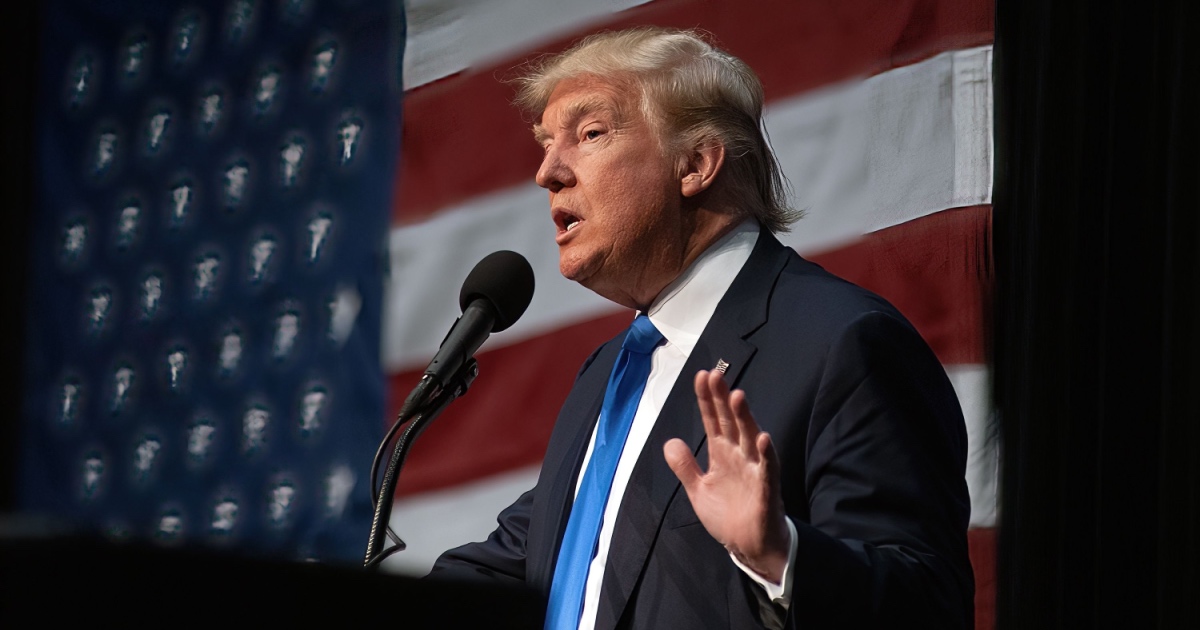

Standing at the EPA’s Washington headquarters on July 23, 2026, to announce an expansion of the White House’s AI data center energy pledge, President Donald Trump veered briefly but unmistakably off-script. “All I know is I’d like to be the next president, because I’m going to make somebody look very good,” he said – a remark that ricocheted across social media within minutes and landed with a thud among constitutional scholars who have spent the past year fielding this exact question.
The context for the speech was mundane enough: Trump was at the EPA headquarters to outline plans to expand a voluntary ratepayer protection pledge aimed at shielding consumers from electricity cost increases tied to AI data center growth. His administration announced it would expand that voluntary pledge to include state governors and electricity companies, having first announced the agreement with tech and AI firms in March. But it was the aside about being “the next president” that dominated the headlines.
Trump has repeatedly expressed his desire to circumvent the 22nd Amendment, which bars U.S. presidents from serving more than two terms in office, throughout his second presidential term. His remark at the EPA was far from an isolated moment – it was the latest in a long and escalating series of signals that have unsettled constitutional experts and energized his critics in roughly equal measure.
A Pattern, Not a Slip
Speaking to reporters in October 2025 aboard Air Force One during a trip to Asia, Trump said it was “too bad” the U.S. Constitution doesn’t permit him to serve a third term. In that same exchange, Trump again refused to rule out running for an unprecedented third term, saying he would “love to do it” and pointing to what he described as his “best numbers ever.”
The Asia trip comments followed closely on remarks from one of Trump’s most visible allies. Steve Bannon told The Economist that “he’s going to get a third term” and that a “plan” to accomplish a third Trump term was in the works and would be unveiled “at the appropriate time.” Republican Sen. Lindsey Graham also hinted at a potential workaround to the 22nd Amendment, while Bannon said he was in discussions with “one of the top constitutional lawyers” in the U.S. about potential paths to a third Trump term.
Trump’s own messaging has been characteristically inconsistent. He has at times cited the 22nd Amendment directly, acknowledging: “Based on what I read, I guess I’m not allowed to run. So we’ll see what happens.” Yet in a March 2025 interview with NBC News, Trump said “there are methods” for him to serve a third term in the White House.
Earlier in his second term, the president’s official merchandise store began selling “Trump 2028” hats in April 2025, and Trump posted a video to Truth Social that showed him ruling for thousands of years, ending with a sign that read “TRUMP 4EVA.”
What the Constitution Actually Says
The U.S. Constitution’s 22nd Amendment states clearly: “No person shall be elected to the office of the President more than twice.” That restriction was ratified in 1951 following Franklin D. Roosevelt’s unprecedented four-term presidency.
According to a Politifact analysis, the supposed loophole circulating in legal circles centers on the word “elected” in the amendment’s text. The use of “elected” – rather than “serve” – leaves open the theoretical question of whether a person can occupy the presidency without being elected a third time. However, Politifact found that whatever constitutional interpretation might be invoked, it would still violate the 22nd Amendment’s clear intent. Michael Gerhardt, a Burton Craige Distinguished Professor of Jurisprudence at the University of North Carolina School of Law, said that simply refusing to leave office past January 20, 2029, “would effectively be an overthrow of our government.”
One scenario that has circulated in legal and political circles involves Trump running as vice president on another candidate’s ticket. Under this scenario, another candidate would win the Republican nomination in 2028 and choose Trump as their vice presidential running mate; if they won the election, the person at the top of the ticket could then immediately resign after being inaugurated, making Trump president again. Trump himself publicly dismissed this approach. He ruled out the possibility of running on a ticket as vice president with the aim of his running mate standing down, saying it would be “too cute” and “wouldn’t be right” – adding, “I’d be allowed to do that, but I wouldn’t do that.”
The Congressional Push
Republican Rep. Andy Ogles of Tennessee has introduced a resolution to amend the 22nd Amendment itself to allow Trump an easier path to seeking a third term. Formally repealing the amendment would require overwhelming majorities in Congress and support from state legislatures, which Trump is unlikely to obtain.
A broader analysis published by researchers at the London School of Economics in November 2025 examined historical cases of leaders attempting to remain in power beyond constitutional limits. That LSE research drew on an earlier study that identified five distinct strategies employed by would-be presidential overstayers: constitutional amendment, implementing a new constitution in a way that gives the incumbent a “blank slate,” appealing to the courts, using a “faithful agent” placeholder president, or delaying elections. The LSE researchers noted that presidential overstay is “remarkably commonplace across the world” and that no attempt to circumvent term limits has involved ignoring the constitution outright – incumbents instead use constitutional procedures to work around it.
Some observers have raised questions about whether Trump-aligned courts would intervene if he attempted to circumvent term limits. Writing in The Hill in November 2025, legal analysts noted that members of the Supreme Court had already shown willingness to interpret constitutional provisions creatively on Trump’s behalf, the most notable example being their 2024 decision that allowed Trump to stay on the 2024 ballot despite the 14th Amendment’s insurrectionist prohibition.
Read More: Trump’s “Big Beautiful Bill” Is Now Law. Here’s What It Actually Does to Your Wallet
The Public Reaction
The social media response to Trump’s “next president” comment at the EPA was swift and largely negative. Critics on multiple platforms rejected the premise outright, with many pointing to his age – Trump is 80 years old – and noting he has not let up on the third-term claim since reclaiming the White House in January 2025.
Within the judiciary, concerns have been raised about whether Trump loyalists would go against the president on constitutional questions. Earlier this year, a Trump-appointed Texas judge, John George Edward Marck, refused to confirm during his Senate Judiciary Committee confirmation hearing whether the U.S. Constitution prohibits a commander-in-chief from serving a third term.
Internationally, the comments have reinforced a narrative that has been building for over a year. Democratic politicians have moved to get ahead of any future legal challenges. New York Democratic Rep. Dan Goldman introduced a resolution affirming the 22nd Amendment, while California state senator Tom Umberg introduced a bill as a preemptive measure to prevent Trump from potentially running for president again in 2028.
What This Means for American Democracy
“Anyone who says that obviously the 22nd Amendment will deter Trump from trying for a third term has been living on a different planet,” said Ian Bassin, executive director of Protect Democracy, a nonprofit focused on defending democratic institutions. Trump’s allies have spent months building the groundwork for exactly the scenario his EPA aside gestured at, and the remark on July 23 landed in that context – not as an isolated quip, but as the latest entry in a sustained pattern.
The weight of constitutional scholarship is firmly on the side of the amendment’s enforcement. Michael Gerhardt has said that any attempt to defy the 22nd Amendment openly would be “completely unprecedented” and that “there is no constitutional basis for the current president to try to serve as president after two elected terms.” The 22nd Amendment’s ratifiers in 1951 were not anticipating a specific president – they were anticipating the possibility that any president might accumulate enough power, popularity, and institutional loyalty to make leaving office feel optional. The LSE analysis of global term-limit evasion found that roughly one-third of leaders who attempted to overstay ultimately failed, and that failure came most reliably when attempts encountered widespread popular resistance – not from the clarity of constitutional text alone.
AI Disclaimer: This article was created with the assistance of AI tools and reviewed by a human editor.