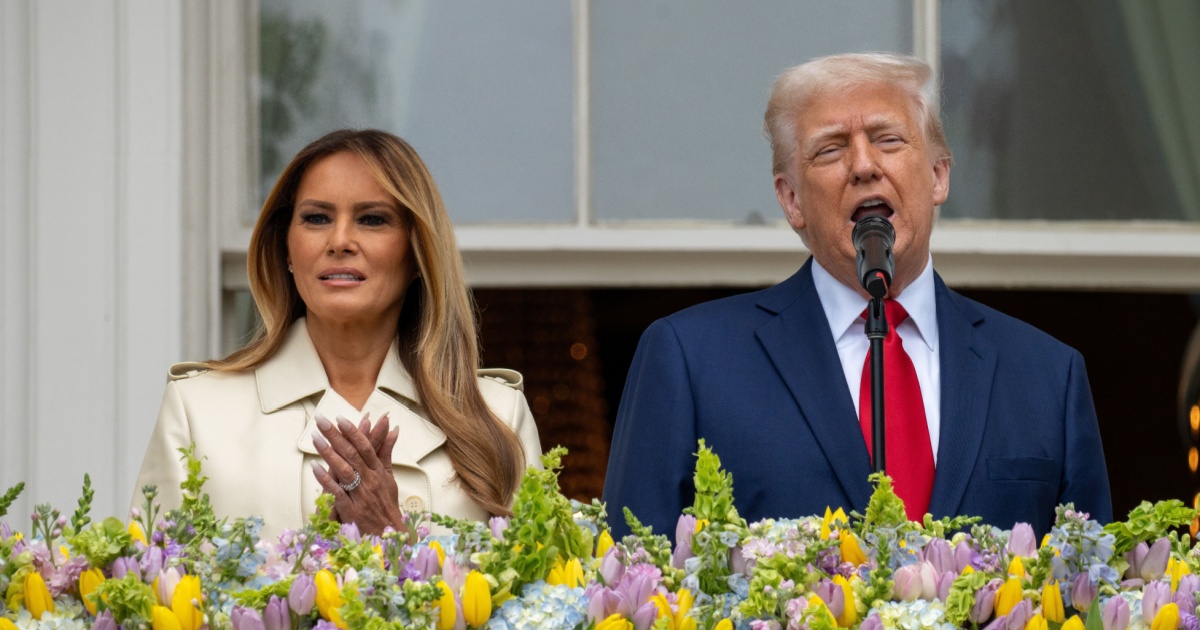

Some people get so used to their phone outsmarting them that a name-swap autocorrect barely registers as a story. But when it involves the oldest sitting president in American history, even a tech glitch becomes a flashpoint. On May 6, 2026, Donald Trump stood in the East Room of the White House and told a crowd gathered for a Military Mother’s Day event that his phone had been quietly, repeatedly replacing “Melania” with “Melody” – and that he had caught serious grief for it online every single time.
Trump delivered the anecdote with full theatrical flair, describing a recurring domestic tech disaster that, he said, caused his critics to claim he didn’t know his own wife’s name. The room laughed. By evening, so did most of social media. But under the jokes, another conversation was already picking up speed.
That conversation isn’t really about autocorrect. It never was. Trump is 79 years old, the oldest person ever to hold the presidency, and questions about his cognitive fitness have been building for months in ways that go well beyond a viral moment. The autocorrect story just gave people one more peg to hang those questions on.
The Mother’s Day Event: What Actually Happened
The moment unfolded during Trump’s introduction of a guest speaker: the mother of National Guard member Andrew Wolfe, who had been shot in Washington D.C. the previous year. Her name was Melody. Trump seized on the coincidence and told the crowd that his autocorrect had a habit of changing “Melania” to “Melody” in his posts, leaving him repeatedly exposed to accusations that he had forgotten his wife’s name.
According to the Washington Examiner, Trump told the audience he would “get absolutely decimated” when the wrong name appeared. He noted that in the 1980s he had been “quite articulate,” speaking in “polished paragraphs” – though the self-reference was meant humorously, not clinically.
Trump added that he had eventually enlisted military personnel to fix the autocorrect issue entirely. He told the crowd, “I said, ‘Come here, you gotta correct this, you’re killing me. I took more abuse. She’s been called Melody a lot.'”
The Online Reaction: From Laughter to Something Else
The crowd in the East Room laughed. Social media did not stay in quite the same mood for long.
Some users took a lighter route, sharing their own autocorrect disasters and poking fun at the technology. Others went further. One comment that circulated quickly read: “He does know autocorrect learns from your typing history, right? So… who is Melody?” Another asked how the military had time to fix a presidential autocorrect problem while presumably having other priorities.
The word “dementia” entered the trending conversation fast. Some observers used the episode to revive the question of whether Trump’s unfiltered moments represent a personality style or something more medically significant. That framing spread rapidly, with the word appearing in trending commentary across platforms.
To be clear: an autocorrect error proves nothing about a person’s cognition. It happens to everyone. The incident gained traction not because of its own weight, but because it became a vessel for a much larger pre-existing debate – one that involves credentialed physicians, official medical records, and a constitutional amendment.
The Broader Medical Debate
The autocorrect story arrived in the middle of a serious and escalating dispute between medical professionals and the White House over the president’s fitness to serve.
On April 30, 2026, a group of 36 leading physicians and other doctors with expertise in mental health issued a statement calling for President Donald J. Trump’s immediate, lawful removal from office for medical reasons, declaring that his mental instability, “coupled with his sole, unchecked authority to launch nuclear weapons, makes him a clear and present danger.” The statement was released by the International Physicians for the Prevention of Nuclear War. The U.S. Senate offices of Sheldon Whitehouse (D-RI) and Jack Reed (D-RI) entered the experts’ statement into the Congressional Record, Vol. 172, No. 76.
In the formal statement, the group, composed of individuals “holding both conservative and liberal ideologies, identifying as both Republicans and Democrats, from different backgrounds, races, ethnicities, and religions,” stopped short of diagnosing Trump. Instead, they documented a pattern of behavior: impulsive decision-making, factual confusion, erratic strategic reversals, and extreme rage that they argued constituted a clear and present danger to public safety.
The group included clinicians from institutions such as Harvard, Columbia, and Tufts University, as well as Nobel Peace Prize recipient Eric Chivian.
Dr. Bandy X. Lee, a forensic psychiatrist and former Yale School of Medicine faculty member, stated Trump needs “immediate, even hospital-level, care,” making the comment to The Independent after joining the group of physicians.
Earlier, psychologist Dr. John Gartner had made similar claims in an interview covered by LGBTQ Nation. “The main way to diagnose dementia is that we see a deterioration from someone’s own baseline in these four areas: language, memory, behavior, and psychomotor performance,” Gartner argued. He claimed the rate of deterioration was accelerating and that a high-pressure job could further worsen cognitive dysfunction. Gartner has not examined Trump personally.
What the Official Medical Record Shows
Against this backdrop, the White House has consistently pointed to Trump’s official medical results – and those results tell a different story.
On April 11, 2025, President Trump underwent his annual physical examination at Walter Reed National Military Medical Center. The exam was supervised by White House Physician Dr. Sean Barbabella and included diagnostic and laboratory testing along with consultations with fourteen specialty consultants.
According to the official American Presidency Project record of the examination, Trump has undergone the Montreal Cognitive Assessment (MoCA) at least twice during his presidencies: in January 2018 and again in April 2025. According to White House physicians on both occasions, he scored a perfect 30 out of 30.
The summary from the 2025 physical concluded that “President Trump remains in excellent health, exhibiting robust cardiac, pulmonary, neurological, and general physical function.”
What the MoCA Test Can and Cannot Tell You
The Montreal Cognitive Assessment, or MoCA, was developed by Dr. Ziad Nasreddine, a Canadian neurologist, as a first-line screening tool for cognitive impairment. In 1992, during his residency, Nasreddine recognized the need for a more comprehensive cognitive screening tool that could better serve clinical settings. He finished validation of the test in 2005. You can read more about how MoCA Cognition describes the test’s development directly on their website.
The MoCA is a brief, 30-question test that helps healthcare professionals detect cognitive impairments early, and is considered the most sensitive test available for detecting Alzheimer’s disease, measuring executive functions and multiple cognitive domains. Crucially, the test is not designed to assess intelligence. Doctors use it as a tool to help diagnose brain conditions, such as mild cognitive impairment (MCI), which often – but not always – progresses into dementia.
Trump says he earned a perfect 30 points, which is uncommon. Usually only about eight out of 90 people with an average age of 73 score that highly, according to Dr. Nasreddine himself.
Medical analysts have also pointed out that those who take the MoCA with high frequency are often individuals whose doctors are monitoring for potential impairment. Dr. John Gartner noted that Trump’s doctors may be “past the point of trying to figure out whether he is suffering from dementia” and are now monitoring decline, given how many times Trump has undergone the MoCA assessment.
In other words, passing the MoCA is reassuring, but it is a first-line screen, not a complete neuropsychological evaluation. A normal result reduces immediate concern but does not address all cognitive domains or real-world performance.
The Ethical Problem With Remote Diagnosis
Medical ethicists and clinicians have been equally pointed in cautioning against the kind of diagnosis-from-a-distance that has dominated online discussion.
Since 1973, the American Psychiatric Association and its members have abided by a principle commonly known as the Goldwater Rule, which prohibits psychiatrists from offering opinions on someone they have not personally evaluated. The rule was created after an incident in the 1964 presidential election, when a magazine polled thousands of psychiatrists about a candidate’s fitness for office and published the results, almost all based on nothing more than watching the man on television.
An article published in the The Conversation argued that diagnosing someone from afar is not only irresponsible, it is clinically impossible. They also raised a secondary concern: that casual public speculation about a politician’s dementia may inadvertently create stigma for the millions of people who actually live with the condition, while simultaneously offering Trump a potential excuse for behavior that may simply be intentional.
There is currently no publicly released medical record indicating that Trump has been diagnosed with dementia or any related neurocognitive disorder. A diagnosis requires a personal examination and a full medical history, neither of which any of the 36 physicians conducted.
Read More: Before Dementia Sets in, Your Body Will Give You These 12 Early Warning Signs
What the Law Would Allow
The physicians’ statement was not just a medical opinion. It was a constitutional call to action.
The physicians’ statement did more than raise clinical concerns. It called for the use of a specific constitutional mechanism. The group questioned whether Trump’s top officials, including Defense Secretary Pete Hegseth and Secretary of State Marco Rubio, would be willing to remove the nuclear codes from Trump’s control, and called for the 25th Amendment to be invoked.
Section 4 of the 25th Amendment outlines the process: the vice president and a majority of Cabinet secretaries could declare that the president is unable to discharge the powers and duties of the office. If the president disputes the declaration, Congress would have a set time frame to decide the issue, triggering a politically charged and legally complex fight. The Congressional Record entry itself does not compel any immediate action and does not trigger this constitutional process on its own.
Trump and his allies have generally dismissed questions about his mental fitness as partisan attacks. White House spokesperson Davis Ingle stated that “President Trump is the sharpest and most accessible President in American history who is working nonstop to solve problems and deliver on his promises, and he remains in excellent health.”
Supporters also argue that political opponents have unfairly pathologized Trump’s personality for years simply because he is unconventional, outspoken, and combative. Mental health advocates warn against casually diagnosing public figures from a distance, noting that confidence, narcissism, anger, or controversial political views alone are not evidence of mental illness.
What This Means for You
The autocorrect story was funny, relatable, and inherently trivial. But it arrived in the middle of something that is none of those things.
What we know for certain: at 79 years old, Donald Trump is the oldest person in American history to serve as president. His official White House physician declared him in excellent health, with a perfect score on a standard cognitive screening. A group of 36 physicians from Harvard, Columbia, Tufts, and other institutions disagrees, and has said so formally in the Congressional Record. None of those physicians has examined Trump personally. The White House has rejected their claims entirely.
The cognitive test Trump passed screens for obvious impairment in about 10 minutes. It is a useful tool, but it is not a substitute for a full neuropsychological evaluation. And the frequency with which it appears to have been administered is itself something clinicians note is more typical of active monitoring than routine preventive care.
What none of us can do from the outside is render a clinical verdict. The public conversation about this topic matters, but it has to stay anchored to what is actually known. An autocorrect glitch is not a symptom. A viral moment is not a diagnosis. What does matter is whether the oldest president in American history is receiving, and whether the public is receiving, a full and transparent accounting of his cognitive health. That question is not partisan. It’s one that medicine and journalism are both right to keep asking, and one that the official record has not yet fully answered.
Disclaimer: The information provided here is for educational and informational purposes only and is not a substitute for professional psychological, psychiatric, or mental health advice, diagnosis, or treatment. Always seek the guidance of a licensed mental health professional, therapist, psychologist, or psychiatrist with any questions or concerns about your emotional well-being or mental health conditions. Never ignore professional advice or delay seeking support because of something you have read here.
AI Disclaimer: This article was created with the assistance of AI tools and reviewed by a human editor.
Read More: Trump Dementia: What’s Behind the Health Concerns in 2026