
Something has shifted in how the world’s most powerful government talks about its neighbors. It’s not the usual chest-thumping about trade deficits or border security. This is bigger, more explicit, and more unsettling to the countries that share a hemisphere with the United States. The language coming out of Washington in 2026 isn’t the language of partnership. It reads more like a landlord informing the tenants of new house rules.
At the center of it all is a phrase that has set off alarms from Ottawa to Bogotá: “Greater North America.” Two words that, depending on who you ask, either describe a rational security framework for a dangerous world, or something much closer to an imperial blueprint dressed up in the language of defense policy.
To understand what’s actually being proposed, and why so many governments are scrambling to respond, you need to look carefully at what American officials have said, what they’ve already done, and what history tells us about what usually comes next when a great power starts redrawing maps.
What “Greater North America” Actually Means
Defense Secretary Pete Hegseth laid out the vision in a speech at the Americas Counter Cartel Conference, hosted at U.S. Southern Command in Doral, Florida on March 5, 2026. The speech was blunt. Hegseth outlined a new geopolitical framework called the “Greater North America” strategy, describing it as a redefinition of regional security under President Donald Trump’s leadership, with the administration’s strategic vision stretching “from Greenland to the Gulf of America to the Panama Canal,” encompassing all sovereign countries and territories north of the equator within what he called an “immediate security perimeter.”
The geographic scope is striking. Hegseth was explicit: “Every sovereign nation and territory north of the Equator, from Greenland to Ecuador and from Alaska to Guyana, is not part of the ‘Global South.'” He argued that each of these countries borders either the North Atlantic or the North Pacific, and each sits north of the two basic geographic barriers in the region, the Amazon and the Andes mountains.
At the same time, Hegseth signaled a shift in expectations for countries south of the equator, calling for increased “burden sharing” in the South Atlantic and South Pacific, and for those nations to “take a greater role in defending” those regions and securing “critical infrastructure and resources in partnership with us and other Western nations.”
Put plainly: the U.S. intends to run the northern half of the hemisphere as its security domain. Countries to the south are asked to help carry the costs. By defining these nations as a single strategic neighborhood, the administration is treating them less as separate regions and more as extensions of the U.S. front line.
Pete Hegseth: "Trump has drawn a new strategic map from Greenland to the Gulf of America – we call this map the Greater North America.
— ᗰᗩƳᖇᗩ (@LePapillonBlu2) March 6, 2026
Every sovereign nation north of the equator is not part of the global south, it is part of the security perimeter in this great neighborhood… pic.twitter.com/WsyrJLjPZF
The “Donroe Doctrine” Behind It All
The “Greater North America” framing didn’t appear out of nowhere. It was built on a broader ideological structure the Trump administration has been constructing since it returned to power, one that deliberately invokes American history while updating it for 2026.
In the wake of the U.S. operation to depose Venezuelan President Nicolás Maduro, President Donald Trump coined a new term to describe his approach to foreign policy: the “Donroe Doctrine,” casting the operation as a revival of the Monroe Doctrine, a policy vision first articulated in 1823 by then-President James Monroe to oppose European interference in the Western Hemisphere.
Trump’s November 2025 national security strategy made the intent explicit: “After years of neglect, the United States will reassert and enforce the Monroe Doctrine to restore American preeminence in the Western Hemisphere, and to protect our homeland and our access to key geographies throughout the region.”
The 2026 National Defense Strategy emphasized securing the Northern Hemisphere and defending it from narco-traffickers, terrorists, and external powers such as China, treating Beijing’s expanding influence in Latin America as a direct U.S. national security issue. The strategy asserts a U.S. security blanket over the entire continent, a posture formally dubbed the “Trump Corollary to the Monroe Doctrine.”
Within that framework, the strategy formally reclassifies drug cartels as narco-terrorists, a designation that permits the use of military assets previously reserved for conventional warfare. This shift has already translated into action, including drone strikes in the Caribbean and expanded operations targeting cartel networks.
That has already meant putting the 101st Airborne Division in “operational control” of the southern border, and Hegseth has boasted of “Operation Southern Spear” sinking cartel boats and a January raid in Caracas to seize Maduro.
The Territories in Play
Trump’s hemispheric vision becomes clearest when you look at the specific places his administration has targeted, some through rhetoric, others through direct action.
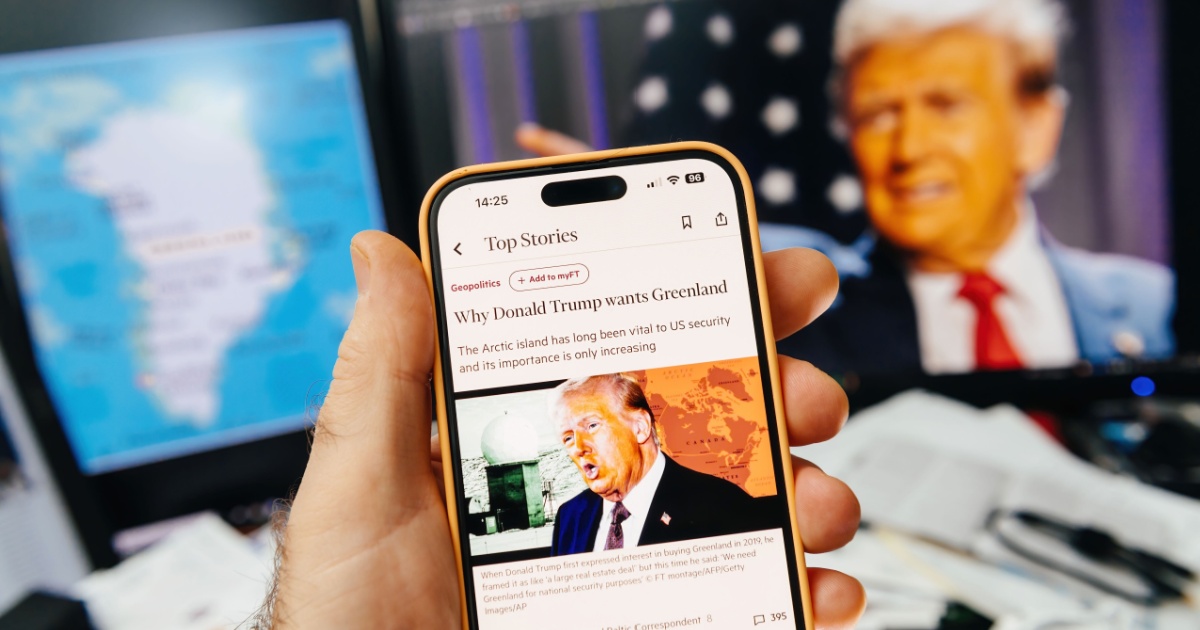
Greenland is the longest-running flashpoint. Trump first stated his desire to annex Greenland during his first presidency. In his second term, he has pursued a campaign to actually acquire it. The strategic rationale is partly about Arctic shipping lanes opening up as ice melts, and partly about resources. Trump likely wants to maintain and deepen U.S. military presence there and ensure “better access for the United States to critical minerals.” The Arctic territory was an important Cold War outpost and still hosts Pituffik Space Base, while China has increasingly sought joint ventures to tap into Greenland’s rich rare-earth minerals.
Trump threatened tariffs on countries that participated in a joint military exercise, with a 10% import tariff to be imposed on Denmark, Norway, Sweden, France, Germany, the United Kingdom, the Netherlands, and Finland starting February 2026, rising to 25% in June unless Denmark agreed to sell Greenland to the United States.
Canada has been subjected to a relentless pressure campaign. Trump has repeatedly called for Canada to join the United States as “a state,” with these “51st state” calls forming a backdrop against the ongoing Canada-US trade dispute. The economic dimension is real. The trade pact binding North America is under the most strain since its inception, and a war of words between U.S. and Canadian officials is pushing the deal to a potential breaking point.
Cuba has been directly named. During a crisis and American blockade of the island, Trump stated, “I do believe I will have the honor of taking Cuba,” then clarified “in some form,” adding, “whether I free it, take it, I think I can do anything I want with it.”
Venezuela moved from rhetoric to action in January 2026. On January 3, 2026, U.S. military and federal law enforcement apprehended the President of Venezuela, Nicolás Maduro, in a mission codenamed Operation Absolute Resolve. Following the arrest, the official State Department account wrote, “This is OUR Hemisphere and President Trump will not allow our security to be threatened.”
And the ambitions appear to have no fixed boundary. In March 2026, following Venezuela’s victory in the World Baseball Classic, Trump on two occasions called for the eventual inclusion of Venezuela as the 51st state.
How Neighbors Are Responding
The reaction from affected countries has been a mix of defiance, alarm, and quiet accommodation in some corners.
Danish Prime Minister Mette Frederiksen has stressed that Greenland “is not for sale and will not be in the future either,” while Greenland Prime Minister Múte B. Egede has declared that the Arctic territory “is for Greenlandic people.” The foreign minister of Panama has similarly insisted that “the only hands operating the canal are Panamanian and that is how it’s going to stay.”
Canada’s response has been perhaps the most significant given the depth of the bilateral relationship. Prime Minister Mark Carney declared during the 2025 election campaign that the old relationship between Canada and the United States is over, ended by the Trump administration’s tariffs. Public opinion in Canada has shifted dramatically. In early 2026, a polling firm found that 57.9% of Canadians believed that an American invasion of Canada was likely.
Latin America’s response has been more divided. There has been a marked increase in U.S. naval and military action against suspected drug-linked vessels in the Caribbean and Eastern Pacific. According to reporting by the World Socialist Web Site, more than 163 people have been killed in controversial strikes that Pentagon sources describe as “preemptive.” Latin American political leaders have responded unevenly, with some right-wing governments expressing support for closer security cooperation, while others, especially from major drug-producing nations, have pushed back.
On January 4, 2026, Brazil, Spain, Chile, Colombia, Mexico, and Uruguay issued a joint statement expressing “profound concern and firm rejection of the military actions carried out unilaterally in Venezuelan territory.” China also condemned the raid. “China is deeply shocked and strongly condemns the use of force by the U.S. against a sovereign country and the use of force against the president of a country,” the Chinese foreign ministry said.
Some right-leaning governments have positioned themselves closer to Washington. The Trump administration arranged a deal unlocking up to $20 billion in a currency swap with Argentina’s central bank in October 2025, a move analysts have cited as an example of the Donroe Doctrine in financial form.
The Comparisons Critics Are Making
The “Greater North America” announcement drew comparisons that alarmed a broad range of observers. Numerous commentators compared Trump’s “Greater North America” with the “Greater Israel” movement, whose most zealous proponents want to conquer territory between the Nile and Euphrates rivers.
University of Lausanne professor Julia Steinberger said on social media that Hegseth’s “Greater North America” “should be taken VERY seriously as a real threat.” She warned that the U.S. and Israel were “realizing ‘Greater Israel'” and that “Hegseth is saying it’s Greenland, Cuba, Canada, and Mexico next.”
Graeme Garrard, a Canadian professor at Cardiff University in Wales, was more blunt, saying on social media: “By ‘Greater North America’ he means ‘Greater United States.'”
Critics in the foreign policy world point to a broader danger beyond the immediate flashpoints. Even if Trump’s comments about Canada, Greenland, and Panama are passing whimsies, they will exact a cost. They help legitimize Russia’s ongoing aggression against Ukraine and China’s claims over Taiwan. Many have compared Trump’s posture toward these territories to Putin’s comments about Ukraine and Xi’s comments about Taiwan. Former U.S. ambassador to NATO Ivo Daalder, now a senior fellow at Harvard’s Belfer Center, has argued that Trump’s approach effectively signals to allies and adversaries alike that the rules-based international order can no longer be taken for granted, asking publicly whether the U.S. will “adapt the same behavior as the Russians and decide that because we are powerful, we can do what we want.”
Read More: Trump’s Actions in 2026 Are Igniting Anger at Home and Across the World
What This Means
If you live outside the United States, especially in Canada, Mexico, or any country the Trump administration has named as part of its “security perimeter,” these aren’t abstract geopolitical debates. They carry direct consequences for trade, energy prices, travel, and the basic assumption that your country’s government makes its own decisions.
The USMCA, the trade agreement governing North American commerce, is now up for review. Trade experts and lawyers can’t rule out the possibility that the trilateral agreement implodes, which would affect companies that have spent decades investing in North American supply chains that help produce more affordable cars, supply crude oil, and equip homes with natural gas.
The stakes extend well beyond trade. Analysts have argued that the “Greater North America” approach is “shortsighted and runs the risk of creating long-term backlash that could ultimately undermine U.S. interests and cooperation across the Americas.” Senior fellows with the European Council on Foreign Relations have warned that the administration’s “willingness to violate another state’s sovereignty reinforces fears that Washington is increasingly open to reordering the international system along great-power lines,” adding that European leaders must prepare for a strategic environment where “US actions are less predictable, more unilateral and increasingly shaped by domestic politics.”
What’s already happened, in Venezuela, on the Canadian border, in the waters off Colombia, suggests this administration means more of what it says than many would like to believe. Whether “Greater North America” turns out to be a genuine long-term strategic project or the world’s most aggressive negotiating tactic is a question that no one can answer with certainty right now. What is certain is that the countries on that map are right to take it seriously and to plan accordingly.
AI Disclaimer: This article was created with the assistance of AI tools and reviewed by a human editor.
Read More: Trump, Iran War, and Epstein Files: An Unexpected Political Triangle