
Fifty years from now, the grandchildren of today’s 40-year-olds will wake up in a world that looks almost nothing like ours. The changes already underway – in energy, medicine, food, technology, and climate – are moving fast enough that many people alive today will live to see them unfold. Most of us feel it already: a low hum of anticipation, or unease, depending on the day.
The honest answer is that no one knows exactly what 2050 will look like. The future doesn’t arrive in a single form. What researchers, climate scientists, economists, and technologists can tell us, though, is where the trajectories are pointing. And some of those trajectories are extraordinary. Others are sobering. Most are both at once.
What follows isn’t science fiction. These are projections grounded in current data, research, and the choices being made right now by governments, companies, and individuals. The world of 2050 is being built today – one policy, one technology, one degree of warming at a time.
1. The Planet Will Be Hotter – and the Consequences Will Be Visible Everywhere
Climate change is the thread running through almost every other prediction for 2050. Without dramatic action, climate models predict that Earth’s global average temperature will rise an additional 4°C (7.2°F) during the 21st century if greenhouse gas levels continue to rise at present levels. Even the more optimistic scenarios paint a challenging picture.
By the year 2050, models predict sea levels will rise an additional 0.25 to 0.30 meters, and by 2100, without immediate reductions in greenhouse gas emissions, global sea level rise is expected to be on the order of 1.1 meters (3.5 feet). That may sound modest, but for the hundreds of millions of people living in low-lying coastal areas, it represents a direct and permanent threat to their homes.
The ripple effects go beyond flooding. Climate change, left unchecked, will expose about 1.1 billion more people to heavy rains and an additional 900 million people to intense drought by 2050. According to the United Nations Environment Programme, by 2050, 3.3 billion people – one third of the planet – will face water stress. The practical meaning of that number is enormous: strained agriculture, forced migration, and geopolitical tension over resources. Climate action isn’t an abstract future concern. It’s a race that’s already underway.
2. Renewable Energy Will Reshape How We Power Our Lives
Here’s a reason for genuine optimism. The energy picture for 2050 looks dramatically different from today’s, and the shift is already accelerating faster than most experts predicted even a decade ago.
According to the IEA’s Net Zero by 2050 analysis, two-thirds of total energy supply in 2050 could come from wind, solar, bioenergy, geothermal, and hydro energy. Solar alone would become the largest source, accounting for one-fifth of all energy supplies – with solar PV capacity increasing 20-fold from current levels and wind power expanding 11-fold.
In the more ambitious scenario, renewables would meet all additional global energy demand from the 2030s, rising from one-third of electricity generation today to over half by 2035 and two-thirds by 2050, led by solar and wind power with support from batteries. A dramatic shift away from the fossil fuel economy – driven by exponential improvements in the cost and capacity of renewables – could reduce the volatility of energy prices. Cheap and abundant clean energy, near-ubiquitous electrification of transport, and greener industrial processes could become common around the world.
The personal takeaway here is real: your home energy bill, your car, and the products you buy are all likely to be powered differently in 2050. The question is how fast that transition happens, and whether it happens equitably.
3. Artificial Intelligence Will Be Woven Into Daily Life
The AI tools we use today – voice assistants, recommendation engines, fraud detection – will look primitive by 2050 standards. Automation and artificial intelligence will be deeply ingrained in every aspect of daily life. What began as basic digital assistants will evolve into ubiquitous, context-aware systems that manage everything from personal healthcare to urban infrastructure.
In medicine, the transformation may be especially profound. AI tools are already leading to hospital care savings, which could amount to as much as $900 billion by 2050. Beyond cost savings, AI’s role in actual diagnosis is expanding quickly. Researchers at Northwestern Medicine developed a generative AI system that, according to a 2025 study in JAMA Network Open, boosted radiograph report completion efficiency by an average of 15.5% – with some radiologists achieving gains as high as 40% – without compromising accuracy. The same research found that follow-on work showed efficiency gains of up to 80%.
The job market won’t emerge unchanged. A Goldman Sachs report found that AI could expose the equivalent of 300 million full-time jobs to automation globally, with roughly a quarter of work tasks in the US potentially automated – but also notes that AI is likely to help create jobs and could boost labor productivity significantly. Around two-thirds of current roles are expected to undergo task-level change, and workers will need to adjust to new responsibilities that require human decision-making, reasoning, and creativity. What the research consistently shows is that AI will change how most people work far more often than it will simply eliminate their jobs outright.
4. Cities Will Look and Function Differently
By 2050, nearly 70% of humanity will call cities their home – that’s 6.7 billion people concentrated in urban centers that are already struggling to meet the needs of their current populations. Building cities that can absorb that growth while remaining livable is one of the great design challenges of our time.
Autonomous vehicles will glide through streets in orchestrated harmony, communicating with one another to avoid collisions. Shared fleets of self-driving cars will replace private ownership, freeing up vast amounts of urban space currently wasted on parking lots. Above ground, aerial taxis – small electric aircraft – will shorten commutes that once took hours into minutes, while underground hyperloop systems may whisk passengers between cities at near-supersonic speeds.
Smart city technology will optimize everything from street lighting to disaster response. Multi-purpose buildings will serve different functions throughout the day and night. Rather than zones rigidly separated by function – residential here, commercial there – future cities are expected to be fluid and adaptive. Cities of the future will be self-regulating, continuously adapting to demographic shifts, climate patterns, and economic demands, with AI-driven data analytics enabling infrastructure that responds dynamically to human behavior – redirecting traffic flow, optimizing public transport, and adjusting energy consumption in real time.
If you’re concerned about what all of this means for your own health and well-being amid rapid environmental change, climate change and its impact on the human body is worth understanding now, not later.
5. How We Eat Will Change Dramatically
Feeding close to 10 billion people without destroying what remains of the natural world requires a serious rethink of agriculture. By 2050, the world’s environmental, agricultural, and food challenges will pose serious global problems. When the world’s population reaches 9.7 billion, there will be a 50% increase in demand for agricultural products over 2012 levels.
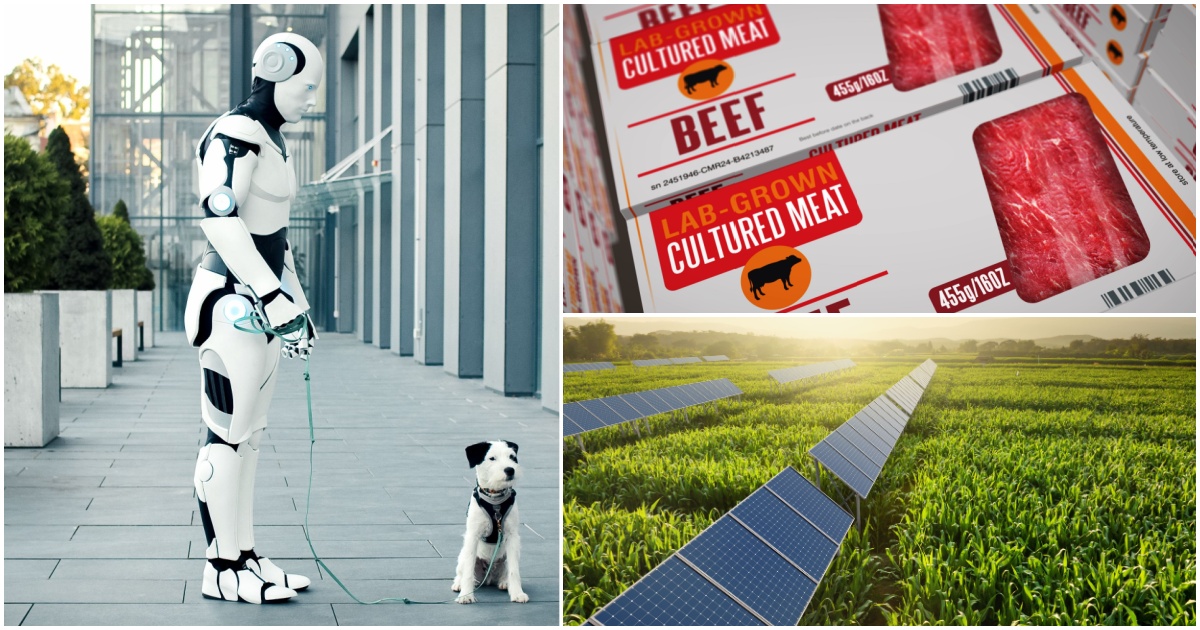
The framework for sustainable food production points to dietary shifts and alternative protein sources, including lab-grown meat, dairy substitutes, and plant-derived foods, while recognizing the ethical considerations of animal husbandry. Ensuring global food security will require advanced agricultural practices such as vertical farming, precision farming, GM crops, cellular agriculture, and sustainable seafood production.
Lab-grown meat, also known as cultivated or cultured meat, involves producing meat directly from animal cells without the need to raise or slaughter animals. The process is still expensive and faces real regulatory and consumer-acceptance hurdles. Economic and regulatory challenges continue to shape its feasibility, and gene editing has the potential to lower costs, improve efficiency, and enhance nutritional profiles. None of this is guaranteed to be on your plate by 2050 at scale, but the direction of investment and research makes it increasingly likely. What you eat in the next 25 years will, in part, reflect choices that food scientists and policymakers are making right now.
6. The World’s Population Will Look Very Different
Under the assumption that the current global fertility rate will continue to decline and reach replacement level by 2050, the United Nations projects the world’s population at 9.7 billion by then. But the growth won’t be evenly spread. Drawing on the UN’s World Population Prospects 2024, the contrast is stark: parts of sub-Saharan Africa are set to nearly double in size, while several of the world’s largest economies are projected to shrink significantly.
Aging populations represent one of the most consequential shifts. According to a UN report on population prospects, by 2050, the number of persons aged 65 years or over worldwide will be more than twice the number of children under the age of five, and average global longevity is expected to reach around 77.2 years.
By 2050, one in four people in Europe and North America will be over the age of 65 – meaning health systems will have to deal with more patients with complex needs. That demographic reality will reshape pension systems, healthcare infrastructure, housing design, and labor markets. For individuals, it means planning for a longer life – and thinking seriously about what quality of life looks like across those added decades.
7. Mental Health and Human Connection Will Be Tested
This one doesn’t come with a neat data point. But experts across sociology, public health, and psychology consistently flag something that often gets lost in the excitement about technology: as the physical world accelerates, human well-being may not keep pace automatically.
One of the most consequential pressures bearing down on 2050 will be climate change itself. Despite mitigation efforts, the effects of rising global temperatures will be undeniable. Sea levels could be up to one meter higher than in 2020, displacing millions from coastal cities and transforming global migration patterns. Climate-driven displacement carries a psychological toll that rarely gets enough attention – severing people from communities, cultures, and the physical places that give life meaning.
At the same time, by 2050, technology will be deeply integrated into daily life, driven by exponential growth in AI, IoT (the network of internet-connected devices around us), and biotechnology. The question researchers are beginning to ask is not whether that integration will happen, but whether it will serve human flourishing or erode it. Ethical debates over AI in warfare, privacy, and genetic modification will intensify. The societies that navigate these tensions best will likely be those that treat mental health, community, and equity as core infrastructure – not afterthoughts.
Read More: The Cities That Could Disappear by 2030 Due to Climate Change and Rising Seas
What This Means for You
No version of the future is locked in. The world of 2050 is being shaped right now – by the decisions of governments, companies, and billions of individuals, including you. Predicting the future with precision is impossible, but research is clear that choices made in the next five years will determine a great deal about what the next 25 look like. The same logic applies at the individual level. The food you choose, the energy you use, the communities you support – these aren’t trivial.
What the data makes clear is that both the best and worst versions of 2050 are scientifically plausible. The Global Environment Outlook offers a stark vision of the decades ahead, but its authors are explicit that the worst forecasts can still be avoided if countries take meaningful steps now to address climate change, biodiversity loss, and pollution. That window is still open. The version of 2050 where clean energy is abundant, food systems are more sustainable, cities are livable, and medicine is dramatically more effective is genuinely within reach – not as a fantasy, but as an outcome that follows logically from choices being made today. The most useful thing any of us can do is stay informed, stay engaged, and not mistake uncertainty for inevitability.
AI Disclaimer: This article was created with the assistance of AI tools and reviewed by a human editor.
Read More: This Year’s ‘Super El Niño’ Could Rewrite Climate Records – What Scientists Are Saying