
Otto Aerospace has designed a nine-passenger business jet. It has no traditional windows for passengers. Private-jet company Flexjet has signed a contract to buy 300 of them. The order is worth roughly $5.85 billion at market pricing. Both companies declined to comment on the negotiated value. The Phantom 3500 is still in development, and no passengers have flown on it yet.
The jet’s first flight is targeted for 2027. Otto Aerospace aims to begin deliveries by 2030. The company has built a full-size mock-up cabin, 22 feet long and 7.5 feet wide, to show what the interior would look like.
The Phantom 3500’s teardrop-shaped fuselage looks nothing like a conventional jet.
What Windowless Aircraft Technology Actually Does to the Plane
Aircraft windows are structural weak points. Each window needs extra support, adds weight, and breaks up the smooth outer surface of the fuselage. The fuselage is the main body of the plane. Otto Aerospace removed all passenger windows to keep the outer surface smooth. A smooth surface helps the company achieve what it calls full laminar flow.
The Fox News piece from June 5, 2025 refers to the company as Otto Aviation. The company’s own site uses the name Otto Aerospace. The Phantom 3500 flies at speeds between Mach 0.8 and Mach 1.2. That range is near the speed of sound and is called transonic. Fox also reports a cruising altitude of 51,000 feet, which is higher than most commercial airliners. Fox reports the jet can take off from runways as short as 3,500 feet.
Fuel efficiency figures for the Phantom 3500 vary by source. They should not be treated as one settled number. The Fox News piece from June 5, 2025 says the aircraft aims to cut fuel use by 35%. Fox links that figure to the aircraft’s laminar flow aerodynamics. The same piece also states the plane “burns 50% less fuel than conventional business jets.” The Sept. 30, 2025 Wall Street Journal report reprinted by Otto Aerospace quotes CEO Paul Touw. He says the design cuts fuel burn by 60% compared with other jets of similar size. These figures use different baselines and come from different sources. The final number will depend on what flight testing confirms.
Read More: Flight Attendant Reveals Why Cabin Says Hello As You Board, and It’s Not What You Think
The Cabin: Six-Foot Screens Instead of Portholes
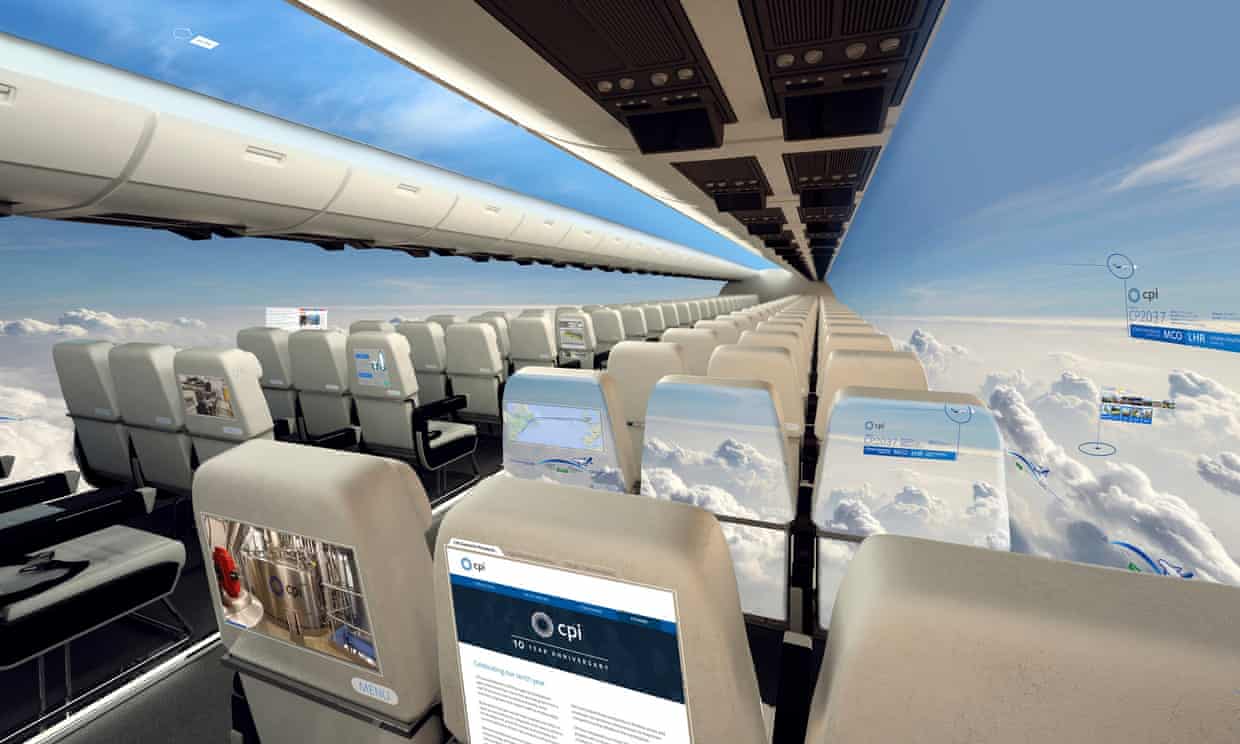
The inside of the Phantom 3500 replaces every passenger window with digital display panels. The smooth exterior lets air flow with very little turbulence. Otto Aerospace calls this “full laminar flow characteristics.” That smooth outer surface also changes how the cabin walls look. Instead of oval portholes, passengers see something very different on the cabin walls.
The Phantom 3500 has no traditional porthole windows. Instead, it uses high-definition digital displays. The June 5, 2025 Fox News piece calls the system “Super Natural Vision,” while CEO Paul Touw uses the term “supernatural vision” when describing the feature. Cameras on the outside of the aircraft send live footage to the screens inside. The cameras are high resolution. Otto Aerospace says the panels will be 6 feet wide. They will show a color-enhanced, wide-angle image.
The June 5, 2025 Fox News piece describes the cabin volume at 800 cubic feet with a 6-foot-5-inch ceiling. The mock-up dimensions from Otto’s own site are 22 feet long by 7.5 feet wide. The jet seats nine passengers.
Otto and Flexjet say the digital windows will appeal to buyers. They expect Gen Z travelers, who tend to be more tech savvy, to be drawn to the feature.
The Flexjet Deal and What It Means for the Market
The company has raised $250 million from private investors. It is building the Phantom 3500 in Jacksonville, Florida. The state gave the project a $515 million incentive package.
Flexjet signed a contract to buy 300 Phantom 3500 aircraft, making it Otto’s first fleet customer. The order is worth about $5.85 billion at market pricing. Both companies declined to comment on the actual negotiated price. Flexjet leases and sells fractional ownership of private jets to individuals and Fortune 500 companies. It is coming off an $800 million investment led by private-equity firm L Catterton. It currently operates a fleet of roughly 340 jets and is valued above $4 billion.
Flexjet’s order is a commitment to a jet that is not yet built or certified. Demand for private flying among wealthy Americans is growing. Flexjet is placing a large bet on a new design to meet that demand.
Touw is focused on the business-jet segment, which he values at $43 billion a year. Touw said in the Wall Street Journal: “Everybody’s running around all excited about Firefly and SpaceX and Rocket Lab,” adding that the market for moving wealthy people around the world every day is actually much bigger than the market for moving stuff into space.
The Engineering Bet Behind the Tear-Drop Shape
The Phantom 3500’s teardrop fuselage is not purely for looks. It is the shape that makes laminar flow possible. Most jets have a rounded body with rows of oval windows. Each window interrupts the surface and forces the airflow to break apart. The Phantom 3500 uses carbon fiber composite materials. It has smaller fuel tanks and engines than a typical jet. This keeps production and upkeep costs lower.
The design needs less space for fuel storage. That lets the aircraft be built smaller. A smaller build cuts manufacturing costs further. Otto plans to use revenue from Phantom 3500 sales to fund a larger regional aircraft. That aircraft would use the same aerodynamic design.
The Phantom 3500 is not certified, not in production, and not yet airborne. The 2027 first-flight target and 2030 delivery window are projections. Otto Aerospace has demonstrated a full-size mock-up and has a signed purchase contract from Flexjet. Flight testing will show whether the efficiency claims hold up. Those results will decide whether this windowless design changes private aviation or stays a concept.
What This Means for Private Aviation
The Phantom 3500 cannot be booked yet. The first flight is set for 2027. Deliveries are planned for 2030. That means real passengers are still several years away. If you hold a Flexjet fractional ownership share, ask your rep about the new aircraft. Find out how the company plans to add it to its fleet as testing moves forward.
Flexjet ordered 300 aircraft at roughly $5.85 billion. That is a full fleet commitment. Flexjet already operates 340 jets. Open questions remain. One is whether laminar flow can be achieved at transonic speeds. Another is whether the FAA will certify a cabin with no windows. Those are the key data points to watch as 2027 approaches.
Disclaimer: The author is not a licensed medical professional. The information provided is for general informational and educational purposes only and is based on research from publicly available, reputable sources. It is not intended to constitute, and should not be relied upon as, medical advice, diagnosis, or treatment. Always consult a licensed physician or other qualified healthcare provider regarding any medical condition, symptoms, or medications. Do not disregard, avoid, or delay seeking professional medical advice or treatment because of information contained herein.
AI Disclaimer: This article was created with the assistance of AI tools and reviewed by a human editor.