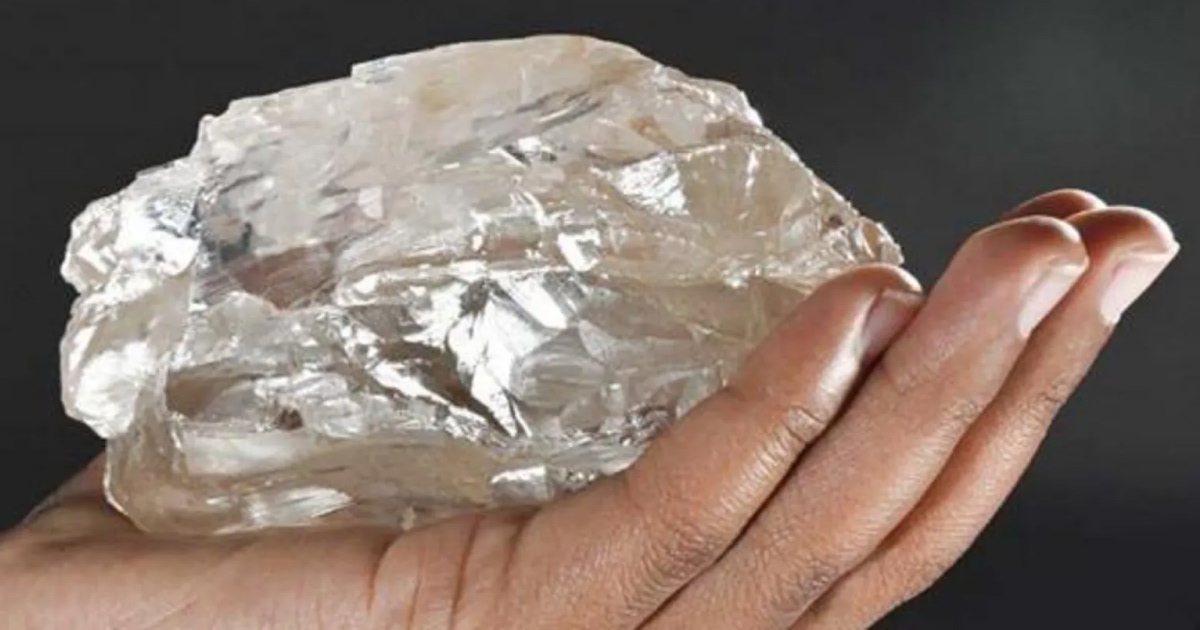

A rough diamond weighing 2,492 carats at recovery, found at Karowe Mine in northeastern Botswana in August 2024, is the second-largest diamond ever found. Workers at the Karowe Diamond Mine pulled the stone from the earth intact – an outcome that would have been nearly impossible under older mining methods. The stone, named Motswedi, emerged without fracture because of X-ray scanning technology Lucara Diamond Corp. installed at the mine in 2017.
For most of diamond mining history, enormous stones were routinely shattered during ore processing, their scale lost before anyone knew it existed. Surviving intact was the direct result of a deliberate technological investment that changed how Lucara Diamond Corp., the Vancouver-based company that owns the mine, finds and handles its largest recoveries.
Lucara president and CEO William Lamb called the recovery “extraordinary” and described the company as “ecstatic.” Within hours of the announcement, the stone was presented to Botswana’s then-President Mokgweetsi Masisi in the capital Gaborone.
The World’s Second-Largest Diamond – and What Came Before It
The 3,106-carat Cullinan Diamond holds the top spot, discovered on January 26, 1905, at the Premier Mine in South Africa – the largest diamond ever found in gem-quality rough form. In its uncut state, it measured 10.1 by 6.35 by 5.9 centimeters. Named for Sir Thomas Cullinan, who had discovered the mine three years earlier, the colourless stone was purchased by the Transvaal government and presented in 1907 to King Edward VII.
Starting in 1908, I.J. Asscher and Company of Amsterdam cut the Cullinan into nine large stones and about 100 smaller ones. The largest piece, the 530-carat Cullinan I – also known as the Star of Africa – now sits in the royal sceptre of the British Crown Jewels and is the largest colourless cut diamond in the world. The second-largest piece, Cullinan II, a 317-carat stone called the Second Star of Africa, was set into the Imperial State Crown.
The 2024 Botswana find now sits at number two on that all-time list, the biggest discovery in more than a century. Lucara announced the recovery in August 2024 and named the stone Motswedi – a word in Setswana meaning a water spring or the flow of underground water that emerges to the surface.
The Mine That Keeps Rewriting the Record Books
The Karowe diamond mine, located approximately 500 kilometers north of Gaborone, was fully commissioned in Q2 2012. Karowe, which means “precious stone” in the local language, is one of the world’s foremost producers of large, high-quality Type IIA diamonds – stones that are chemically pure, containing virtually no nitrogen impurities, which gives them exceptional optical clarity.
In 2015, Lucara recovered the 1,109-carat Lesedi La Rona from Karowe – at the time the second-largest diamond ever found. That stone was sold for $53 million to London jeweler Laurence Graff in 2017. In 2019, Lucara recovered a 1,758-carat diamond from the same mine, naming it Sewelô, which became the subject of a collaboration agreement with Louis Vuitton. The 2,492-carat Motswedi now sits above both on the all-time list.
Karowe has produced multiple record-setting rough diamonds since beginning production in 2012. Lucara has 100% ownership of the Karowe mine.
The X-Ray Technology That Changed Everything
The stone’s survival intact traces directly to equipment installed at Karowe in 2017. Lucara’s Mega Diamond Recovery X-ray Transmission (XRT) technology identifies large diamonds during ore processing and routes them away from crushing equipment before they can be fractured.
Before this technology was in place, large diamonds faced a significant hazard during ore crushing. Without a way to detect what is inside a rock before it is crushed, stones of extraordinary size were routinely fractured. The XRT system, in use at Karowe since 2017, was specifically designed to identify and preserve high-value diamonds during processing.
William Lamb noted that the Motswedi was the largest diamond found in 120 years and the second-largest ever recovered after the Cullinan. The stone’s colour and clarity drew comparisons to the Cullinan, though full gemological evaluation takes weeks after initial recovery. HB Antwerp, which handles processing and marketing of Karowe stones exceeding 10.8 carats, is currently analyzing the Motswedi. HB Antwerp’s public affairs director Margaux Donckier told AFP that pricing the stone was difficult at that stage, and noted that some potential buyers include museums.
Botswana’s Diamond Economy
Botswana accounts for approximately 20% of global diamond production and is one of the world’s largest producers by value. Diamonds account for a significant share of the country’s exports, fiscal revenues, and GDP. The country’s relationship with diamond mining stretches back to the late 1960s, and successive governments have used revenue from the sector to fund public infrastructure, education, and healthcare.
Lucara holds 100% ownership of the Karowe mine. Botswana’s government collects royalties and taxes on production and has proposed legislation that would require mining companies to sell a 24% stake in mines to local investors once a license is granted, unless the government elects to take that shareholding itself.
What Comes Next for the Motswedi
A stone of the Motswedi’s size presents no straightforward path. The Cullinan was cut into nine major gems, each destined for royal collections. The Sewelô became the subject of a collaboration with Louis Vuitton. The Lesedi La Rona went to Graff Diamonds. Rough diamonds are graded by color, clarity, size, and shape before any cutting decision is made, and a stone grading as gem-quality throughout could be cut into multiple world-class gems – or sold to a single buyer who wants to make that decision themselves.
Donckier said the Motswedi had received interest from buyers around the world, including museums. “The size of these stones is so exceptionally rare that they also perfectly could end up in a museum,” she said. The ground beneath Karowe continues to yield stones without historical precedent, making it one of the most consequential diamond-producing sites in the world.
AI Disclaimer: This article was created with the assistance of AI tools and reviewed by a human editor.