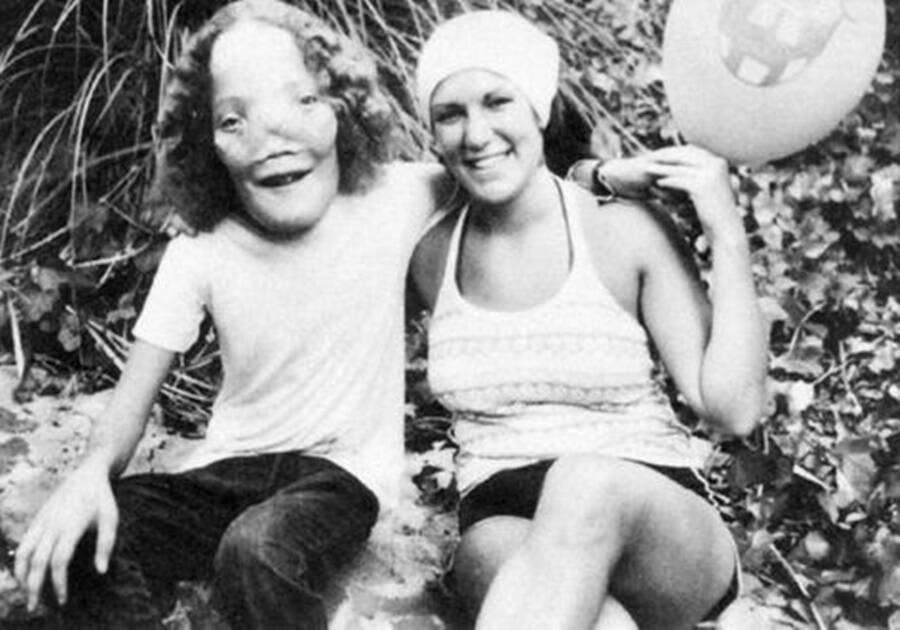
There are stories that make you stop mid-scroll and just sit for a moment. Rocky Dennis is one of them. Born in California in the early 1960s, he faced a medical reality so rare that most doctors had never encountered it, and a physical appearance so striking that strangers would sometimes cross the street to avoid him. Yet the people who actually knew Rocky describe someone who was sharp, funny, warm, and deeply present in his own life. He tutored classmates, cracked jokes about his own face on Halloween, and turned down surgery that might have made him look more “normal.”
He died at 16. Somehow, that feels like both a tragedy and something more.
Rocky’s story went on to inspire a celebrated Hollywood film and has never really faded from public consciousness. But the version most people know, the movie version, leaves out a lot. The real story is messier, more tender, and more instructive than the one that won awards at Cannes. Here is a fuller picture of who Rocky Dennis actually was, what the condition that shaped his life really does to the human body, and why his story still resonates more than four decades after his death.
The Condition Almost No One Has Heard Of
Roy Lee “Rocky” Dennis was born on December 4, 1961, and he had craniodiaphyseal dysplasia, an extremely rare sclerotic bone disorder. The name is a mouthful, but the mechanics of the disease are, in a grim way, straightforward. Often abbreviated as CDD and sometimes called “lionitis,” this condition is an autosomal recessive bone disorder, meaning both parents must carry the responsible gene. It causes calcium to build up excessively in the skull, which gradually distorts the facial features and significantly reduces life expectancy.
What that means in practical terms: the bones of the skull don’t grow normally and stop. They keep accumulating calcium and thickening, slowly reshaping the face. As the bones press inward and intracranial pressure (the pressure inside the skull) rises, additional complications develop. These include blurry vision, eye pain, severe headaches, seizures, sinus pressure, and difficulty breathing and hearing. The brain, nerves, and sensory organs are all steadily compressed by the encroaching bone.
CDD is so rare that it affects roughly one in every 220 million births, and there are fewer than 20 recorded cases in medical history. Even conditions considered exceptionally uncommon, such as some forms of childhood leukemia, occur far more frequently. There is no cure. The condition gets worse over time, and according to the Cleveland Clinic, most children born with CDD live for around 20 years.
Rocky was born in Glendora, California, to Florence “Rusty” Tullis and Roy Dennis. For the first couple of years, nothing seemed out of the ordinary. He was a healthy baby with an older half-brother named Joshua. Then, during a routine childhood procedure, everything changed.
While undergoing a tonsillectomy at age two, doctors detected abnormalities in his X-rays. Over the following year, his family made multiple visits per week to UCLA’s medical center. Those tests confirmed that Rocky had CDD. The calcium deposits in his skull would distort his face and cause it to grow to twice its normal size. His eyesight and hearing would fail. The pressure building inside his skull would likely destroy his brain before he turned seven.
Think about what it means to be told your child probably won’t see their seventh birthday. Rocky’s mother, Rusty, a fierce and unconventional woman who rode motorcycles and surrounded herself with biker friends, refused to organize her family’s life around that prognosis. She insisted that her son lead as normal a life as possible. That decision would define Rocky’s entire childhood.
Learning to Live Without Apology
Getting Rocky into school required his mother to fight. When Rusty attempted to enroll him, she was met with significant pushback. School staff worried about his appearance and what other parents might think. She campaigned on his behalf successfully, and Rocky enrolled in public school. He was initially behind academically, but quickly caught up and graduated from Sandburg Junior High as an honor student.
His condition caused immense pressure on his brain, resulting in frequent and intense headaches. By the time he was seven, Rocky had made 42 visits to eye doctors alone, as medical professionals monitored the progression of his vision loss. Despite this, he kept showing up. He kept learning. He was known for his sharp intellect, compassionate nature, and keen sense of humor, and he tutored other students while excelling academically.
One of the most telling moments of Rocky’s character came on Halloween. He would approach neighbors’ doors pretending to pull off a fake costume mask, then act confused when his actual face wouldn’t come off. His mother later recalled, “Rocky always got lots of candy.” Humor was his way through. So was an unshakeable sense of self.
Rocky had the opportunity to undergo plastic surgery that could potentially correct his facial deformities and extend his life, but he decided against it. He asked his mother, “Who will I see in the mirror if I change my face?” That line, spoken by a teenager living with a terminal diagnosis, says more about identity and self-worth than most of us manage to articulate in a lifetime. Rocky’s story connects to a broader conversation that the chronic illness and disability community continues to have about how we treat people who look different.
A Mother Like No Other
Florence “Rusty” Dennis deserves her own focus. She was outspoken, unconventional, and ran with a motorcycle crowd. She also struggled with her own personal difficulties. But her commitment to Rocky was absolute and practical. When a school tried to place him in a special education program on the basis of his appearance rather than his actual ability, she pushed back. When doctors issued grim predictions, she absorbed them and moved straight to the question of how to live.
Rusty described her philosophy as, “I decided early in my life if you could make yourself sick, you could make yourself well,” and she passed that outlook to Rocky. There’s a debate to be had about how useful that mindset is in the face of a terminal genetic condition, but it gave Rocky something important: permission to see himself as more than a patient. He was a kid. A funny, curious, baseball-card-collecting, music-loving kid.
There was also a real sting in the film’s production that Rusty never let go of. Director Peter Bogdanovich had originally intended to use several songs by Bruce Springsteen, who was the real Rocky Dennis’s favorite singer. Due to an impasse between Universal Pictures and Springsteen’s label Columbia Records, those songs were pulled from the film and replaced with tracks by Bob Seger for the original theatrical release. Rusty was reportedly unhappy with that change. Rocky’s love of Springsteen was real, and replacing it felt like erasing a piece of who he actually was.
The Film That Brought His Story to the World
Mask is a 1985 American biographical drama film directed by Peter Bogdanovich and written by Anna Hamilton Phelan, whose screenplay was nominated for a Writers Guild of America Award. It stars Cher, Sam Elliott, and Eric Stoltz, and is based on the life and early death of Rocky Dennis.
The film won the Academy Award for Best Makeup at the 58th ceremony, while Cher and Stoltz received Golden Globe Award nominations for their performances, and Cher won the 1985 Cannes Film Festival award for Best Actress. Film critic Roger Ebert called it “a wonderful movie, a story of high spirits and hope and courage,” with Stoltz’s performance establishing a character that transcended his physical appearance. The makeup used to recreate Rocky’s condition was so convincing that coworkers reportedly didn’t recognize Stoltz without it. He had to show his ID to security to enter the film’s post-production party and reintroduce himself to cast and crew members who had never seen his real face.
Rusty Dennis sold the film rights to Rocky’s life story for $15,000, most of which went to pay medical bills for her son Joshua, who was undergoing treatment for AIDS. The film was not a perfect retelling. Rusty later told a reporter that the story unfolded across 10 to 12 years rather than the single year depicted in the film, and that Rocky’s older half-brother Joshua does not appear in the movie at all.
As Rocky entered his teenage years, his health began to deteriorate more rapidly. The intense headaches became more frequent. His energy dropped. His physique weakened, and the signs of his declining health became more apparent to everyone around him.
By September 1978, he was using a wheelchair for the final weeks of his life. About three weeks before he died, his headaches had intensified significantly, and his mother alerted the hospital that the end was probably near. Rocky had made his wishes clear. He wanted to die at home.
He passed away peacefully in his sleep on October 4, 1978, at the age of 16, from complications of craniodiaphyseal dysplasia. He had outlived his original prognosis by almost a decade. His body was donated to the UCLA medical center for genetics research, to help scientists better understand his rare condition. Florence “Rusty” Tullis lived until November 11, 2006. After Rocky’s death, she worked as a counselor helping people struggling with addiction and later took up Buddhism in San Francisco. She never stopped talking about her son.
What Rocky Dennis Actually Teaches Us
Rocky’s story is often framed as one of suffering and resilience, but that framing misses something. He didn’t just endure his condition. He genuinely seemed to enjoy being alive. He loved music, baseball cards, his biker family, and making people laugh. He chose his own face over the possibility of a different one. He graduated junior high with honors. He fell in love. He tutored classmates.
The medical reality of CDD is unsparing. As the skull bones continue to expand and harden, internal space for the brain and nerves shrinks, leading to a cascade of life-threatening events. Treatments today focus on managing symptoms and relieving pressure on the nerves. There is still no cure. For families navigating this diagnosis, the Cleveland Clinic’s resource on CDD offers one of the clearest current overviews of what to expect and how care is managed.
What His Story Leaves Behind
Rocky Dennis didn’t get a long life. He got a full one. He packed more self-awareness, humor, and genuine connection into 16 years than most people manage across a much longer span. And the question he asked his mother, “Who will I see in the mirror if I change my face?”, is one that goes far beyond his specific diagnosis.
Most of us will never face his circumstances. But the question underneath it, about who we are when the world pressures us to be someone else, is one we all encounter. Rocky answered it without hesitation. He saw himself clearly, liked what he saw, and refused to let a prognosis, a surgeon, or a stranger’s stare define him. That’s not a lesson about illness. It’s a lesson about being a person. And more than four decades after his death, it still holds.
AI Disclaimer: This article was created with the assistance of AI tools and reviewed by a human editor.