
Most people trying to lose significant weight eventually hit a wall. They’ve made the dietary changes, added the exercise, maybe even tried one of the new GLP-1 medications their doctor recommended. And yet, for many, the scale moves only so far. The conversation around what’s medically possible for weight loss has been shifting rapidly over the past few years, but this week, it shifted again in a way that’s hard to ignore.
A drug that isn’t even available yet has just produced results that have the medical world talking. The numbers coming out of its clinical trials don’t fit the usual mold – they belong in a conversation that, until very recently, was reserved almost exclusively for the operating room.
What researchers found, and what it could mean for millions of people who struggle with obesity, is the kind of story worth reading slowly. Because the details matter.
What Retatrutide Is – and Why It’s Different
To understand why these results are significant, it helps to know where retatrutide fits in the broader world of weight loss medicine. Drugs like Wegovy and Zepbound belong to a class called GLP-1 receptor agonists – medications that mimic a hormone called GLP-1 (glucagon-like peptide-1) to reduce appetite and slow digestion. GLP-1 is a naturally occurring hormone that plays a key role in regulating blood sugar, appetite, and digestion. Medications called GLP-1 receptor agonists are designed to mimic this hormone, helping to manage insulin and blood sugar levels, which results in weight loss and blood sugar regulation.
Zepbound (tirzepatide) took things a step further by targeting two hormones instead of one. It is a dual glucose-dependent insulinotropic polypeptide (GIP)/GLP-1 receptor agonist, representing a newer generation of this therapeutic class. Retatrutide goes one step further still. It is an investigational once-weekly triple hormone receptor agonist – a single molecule that activates the body’s receptors for glucose-dependent insulinotropic polypeptide (GIP), glucagon-like peptide-1 (GLP-1), and glucagon.
That third target – the glucagon receptor – is what sets retatrutide apart from everything already on the market. Glucagon is a hormone involved in regulating how much energy the body burns at rest. By adding glucagon receptor activation to the GIP and GLP-1 effects, retatrutide aims to address metabolic adaptation through combined satiety signaling and increased energy expenditure and lipid breakdown. In plain terms: it doesn’t just reduce your appetite. It may also push your body to burn more energy on its own.
The Trial Results That Stopped People in Their Tracks
Retatrutide produced positive topline results in the Phase 3 TRIUMPH-1 clinical trial, an 80-week trial that evaluated the once-weekly medication in adults with obesity or overweight and at least one weight-related condition, but without diabetes.
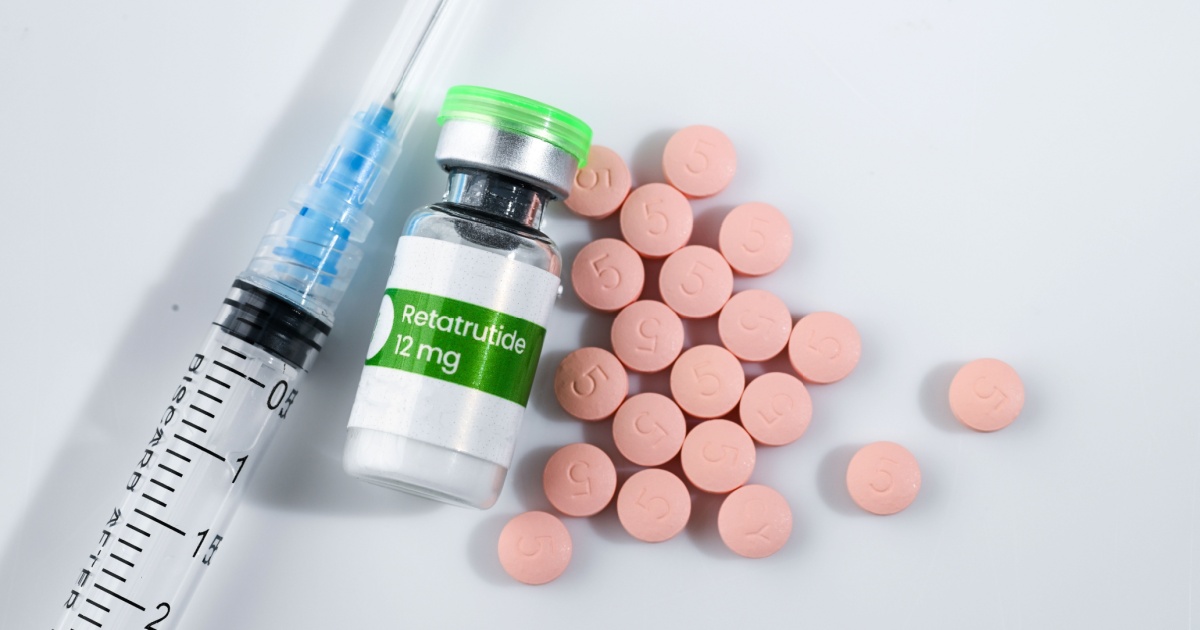
The study randomized 2,339 participants in a 1:1:1:1 ratio to receive either retatrutide 4 mg, 9 mg, 12 mg, or placebo. The results from Eli Lilly’s TRIUMPH-1 announcement showed something researchers rarely see from a medication trial. Participants on the 12 mg dose of retatrutide lost an average of 70.3 lbs – 28.3% of their body weight – over 80 weeks, with 45.3% of participants achieving 30% or more weight loss, a level long associated with bariatric surgery.
Even at the lowest tested dose, the results were striking. Those taking the 4 mg dose, reached with just a single escalation step, lost an average of 47.2 lbs (19.0%) at 80 weeks, with a lower observed discontinuation rate due to adverse events compared to higher doses.
For patients with more severe obesity who continued into an extended follow-up period, the numbers climbed further still. A prespecified extension for participants with a BMI of 35 or higher showed further weight reduction, reaching 85.0 lbs (30.3%) by week 104 among those initially assigned to the 12 mg dose. By week 104, individuals initially randomized to the 12 mg arm had a starting average weight of 268.3 lbs (BMI 42.8), and the weight loss continued without apparent plateau throughout the extension period.
The question of whether the weight loss had leveled off matters enormously. Earlier phase 2 data, published in the New England Journal of Medicine, had already hinted at this. In that earlier phase 2 trial, the 12 mg dose produced a mean weight reduction of 24.2% after 48 weeks, and participants continued to lose weight until treatment was stopped – with the weight-reduction trajectory indicating that a plateau had not yet been reached. The phase 3 data now confirms that pattern holds at larger scale and over longer periods.
How It Compares to Surgery – and to Other Drugs
This is where the conversation gets genuinely unusual for a medication. For most people, bariatric surgery has long been the gold standard for serious, sustained weight loss. On average, people lose 25 to 35% of their total body weight within the first one to two years after surgery. According to the American Society for Metabolic and Bariatric Surgery, patients may lose as much as 60% of their excess weight six months after surgery and 77% of excess weight within 12 months, though on average five years after surgery, patients maintain about 50% of their excess weight loss.
Those are big numbers, but they come with the risks and recovery demands of a major surgical procedure. Retatrutide’s ability to produce 28% or 30% average total body weight loss in a pill-and-injection format – particularly that 45% of participants clearing the 30% threshold – means it’s now entering territory that belonged only to surgeons before.
The comparison to currently approved weight loss medications is notable too, though it needs to be read carefully since these were separate trials with different designs and patient populations. As of early 2026, the most effective FDA-approved GLP-1 drug for weight loss is tirzepatide (Zepbound), with average losses of up to 22.5% of body weight. Wegovy (semaglutide) produces on average around 15% total body weight loss in its pivotal trials. Retatrutide’s 28.3% average at the highest dose in TRIUMPH-1 is meaningfully higher – though again, any direct comparison would require a head-to-head trial.
Beyond the Scale: Other Findings from the Trial
The weight loss numbers are the headline, but they’re not the only noteworthy finding. Cardiometabolic improvements accompanied the weight loss, including a 24.1 cm reduction in waist circumference and favorable changes in non-HDL cholesterol, triglycerides, systolic blood pressure, and a marker of inflammation called hs-CRP.
Earlier Phase 3 data from TRIUMPH-4 – a trial focused on people with obesity and knee osteoarthritis – added another layer. That trial showed a 75.8% reduction in osteoarthritis pain scores, roughly a 20% drop in LDL cholesterol, and a 72% reversal rate of prediabetes to normal blood sugar in the affected subpopulation.
Lilly is also studying retatrutide in Phase 3 trials across a range of additional conditions, including type 2 diabetes, moderate-to-severe obstructive sleep apnea, chronic low back pain, cardiovascular and renal outcomes, and metabolic dysfunction-associated steatotic liver disease (a form of fatty liver disease not caused by alcohol). These are conditions that frequently travel together with obesity, and the hope is that a single weekly injection might address multiple problems simultaneously.
Who Could Benefit Most – and What the Side Effects Look Like
No drug works for everyone, and retatrutide is no exception. Analysts expect retatrutide to primarily serve patients who do not achieve sufficient weight loss with current GLP-1-based therapies, particularly those with high cardiometabolic risk. Even with tirzepatide, a substantial proportion of patients remain underserved, including those at the higher end of the BMI spectrum and patients with type 2 diabetes and obesity who tend to be more metabolically resistant to weight loss.
Research shows that at the highest approved dose of semaglutide, between 10% and 30% of participants achieved less than 5% total body weight loss – essentially no meaningful response – over long-term follow-up. For this group of non-responders, a drug that activates a third metabolic pathway could potentially offer a meaningful next step.
On side effects: the profile looks broadly similar to what’s already seen with GLP-1 medications. Safety was broadly consistent with existing incretin therapies; gastrointestinal side effects were the most common, and discontinuations increased with dose – 4.1% at 4 mg, 6.9% at 9 mg, and 11.3% at 12 mg, compared to 4.9% in the placebo group. Nausea, constipation, and diarrhea were among the most frequently reported complaints. One notable observation from earlier Phase 3 data was that some participants actually discontinued the drug because they felt they were losing too much weight – an unusual side effect in obesity medicine and a signal of just how potent the drug can be.
One area worth watching is lean mass. Retatrutide appears to cause a similar proportion of lean mass loss relative to total weight lost compared with current GLP-1 drugs – about 38% of total weight lost was lean mass, which falls within the 20 – 40% range reported for semaglutide and tirzepatide. These findings suggest retatrutide’s greater weight loss efficacy doesn’t come at the cost of a higher lean mass percentage. However, because the absolute amount of weight lost is larger, the absolute amount of muscle lost may also be greater – something clinicians will need to factor into patient monitoring.
When Might Retatrutide Actually Be Available?
This is the part that requires a reality check. Impressive trial results are not the same as an approved drug on pharmacy shelves. As of April 2026, the FDA hasn’t received an application for retatrutide yet – no submission, no review, no PDUFA date. Eli Lilly is still running seven Phase 3 trials under the TRIUMPH program.
A new drug application to the FDA is likely in late 2026, followed by an approximately 10-month review period, with potential approval coming around a year after that. That puts the realistic window for commercial availability somewhere in 2027 or 2028 at the earliest, depending on how quickly the remaining trial data comes in and whether the FDA grants any kind of expedited review.
Retatrutide is not available at pharmacies, is not covered by insurance, and cannot be legally prescribed in the United States outside of clinical trial protocols. The FDA has also warned against obtaining retatrutide from unofficial sources, a concern that has grown as demand for GLP-1 class medications continues to outpace official supply.
Read More: Fat Cells ‘Remember’ Obesity, Offering Clues to Why Weight Loss is So Challenging
What This Means for You
If you’re currently managing obesity or overweight – or supporting someone who is – the most useful thing to take from these results is this: the treatment landscape is genuinely changing, and changing fast. What was once considered surgery-level weight loss is now, at least in clinical trials, achievable with a weekly injection.
That doesn’t mean you should wait for retatrutide. Doing nothing for 18 to 24 months while waiting for a drug that isn’t yet approved is not a health strategy. As of early 2026, the most effective FDA-approved GLP-1 drug for weight loss remains tirzepatide, and semaglutide (Wegovy) continues to be widely available and clinically supported. If you’re already on one of these medications and responding well, there’s no reason to pause treatment waiting for the next thing.
If you haven’t responded well to current GLP-1 medications or haven’t been able to reach your weight goals with available options, now is a good time to revisit the conversation with your doctor. The TRIUMPH trials are still enrolling participants in some locations, and eligibility through ClinicalTrials.gov is worth checking if you want earlier access. What these results tell us, plainly, is that the ceiling for what medication can do is higher than most people assumed – and that ceiling may rise further still as the remaining trial data comes in through 2026.
Disclaimer: This information is not intended to be a substitute for professional medical advice, diagnosis, or treatment and is for information only. Always seek the advice of your physician or another qualified health provider with any questions about your medical condition and/or current medication. Do not disregard professional medical advice or delay seeking advice or treatment because of something you have read here.
AI Disclaimer: This article was created with the assistance of AI tools and reviewed by a human editor.
Read More: Ozempic for Weight Loss and Diabetes: How It Works, and What Can Go Wrong