
Public opinion doesn’t usually move fast. Political divides run deep. And yet, on one of the most hotly debated social issues of the past half-century, something unusual has happened: Americans across party lines have quietly arrived at a broad and durable consensus. The question isn’t whether most Americans support marijuana legalization. New polling makes clear that they do. The more interesting question is why – and what that means for federal policy that still hasn’t caught up.
Marijuana legalization support has now crossed a threshold that would have seemed implausible to anyone surveying the American public in the late 1960s. Today, that support runs deep enough to shape policy, shift federal drug schedules, and alter the political calculus in ways few anticipated even a decade ago.
So where does the country actually stand? And what’s driving opinions on both sides? The numbers tell a more layered story than any single headline captures.
Where the Numbers Stand in 2026
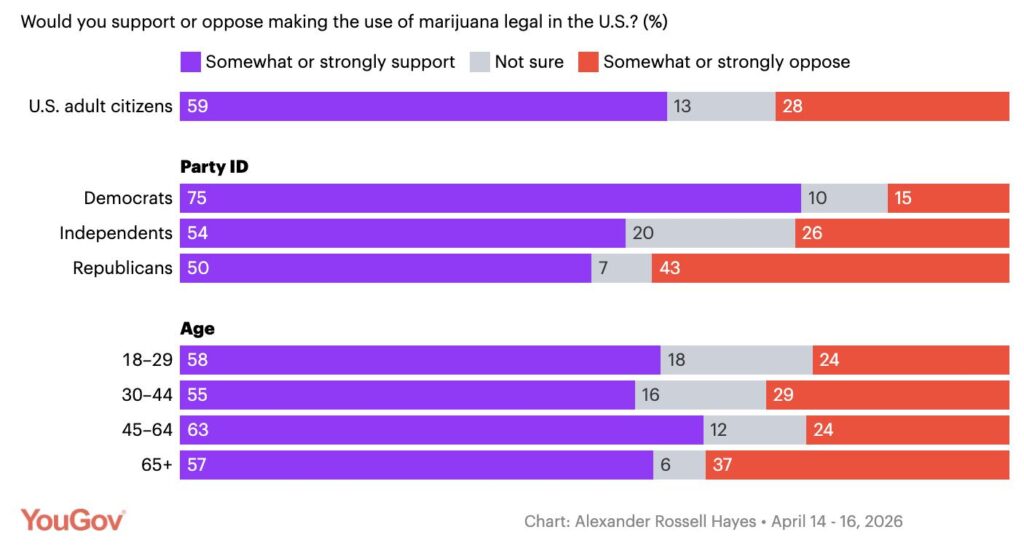
A majority – 59% – of Americans somewhat or strongly support making the use of marijuana legal in the U.S., according to an April 2026 Economist/YouGov poll. About half as many (28%) oppose legalization, and support holds across party lines. That figure is consistent with a separate November 2025 survey from Gallup, which found 64% of U.S. adults think marijuana use should be legal.
The gap between those two polls reflects something real: how a question is framed affects how people answer it. But either way, majority support is not in dispute. What’s striking is how far public opinion has traveled to get here. When Gallup first asked the question in 1969, only 12% of Americans thought marijuana use should be legal. By the late 1970s, support had increased to roughly 25%, and it held there through the mid-1990s. It finally passed 30% by 2000 and exceeded 40% by 2009.
The real inflection point came in 2013. Support cracked the 50% threshold that year, jumping 10 percentage points to 58% after Colorado and Washington became the first states to legalize recreational use of marijuana. Since then, it has never fallen back below a majority – a level of sustained public consensus that’s rare on any contested policy issue.
The Medical vs. Recreational Divide
The strongest numbers in any recent poll don’t come from recreational legalization at all. They come from medical use. An overwhelming 84% of Americans support making the use of marijuana for medical purposes legal, according to the same YouGov survey. That figure holds across party lines in a way recreational support does not.
In 2024, Pew Research Center found only 11% of Americans think cannabis should not be legal at all, according to data compiled by the Pew Research Center. Over 80% of Republicans, independents, and Democrats say cannabis should be available for medical purposes. That 88% figure has remained remarkably stable across subsequent Pew surveys, suggesting the medical consensus is not a soft one.
What this split reveals is that the debate over marijuana legalization is no longer really a debate about whether cannabis has medical value. The political argument, where it still exists, centers almost entirely on recreational access – and even there, opposition has been shrinking.
The Personal Experience Factor
One finding that holds across multiple polls is how powerfully personal familiarity shapes opinion. Public support for legalization is largely influenced by whether respondents had either first-hand or second-hand experience with cannabis. “The overwhelming majority (83%) of Americans who say they currently use marijuana recreationally or have used it in the past somewhat or strongly support making the use of marijuana legal,” pollsters reported, according to NORML.
That pattern makes intuitive sense. Lived experience with something tends to reduce its perceived threat. Americans who have used marijuana or who know someone who has used it are more likely to say marijuana makes people’s lives better, not worse. The practical implication is significant: as the pool of people with direct or secondhand experience grows, the political climate around legalization shifts with it.
The survey found that 13% of respondents currently use marijuana recreationally and another 28% say they’ve done so in the past, according to The Marijuana Herald. Twenty percent of respondents said they currently or have in the past used marijuana for medical purposes, and 45% know someone who has. With roughly 4 in 10 Americans reporting personal recreational use, the “never tried it” demographic is no longer the majority.
According to the 2024 National Survey on Drug Use and Health, the most commonly used illicit drug in the past year was marijuana, used by 64.2 million people. That’s not a fringe behavior – it’s a baseline reality of American life that public policy is still working to fully acknowledge.
A Genuine Political Divide, But Not the One You’d Expect
Marijuana legalization support isn’t uniform across party lines, but the partisan picture is more complicated than many assume.
Support is strongest among Democrats (75%) and those between the ages of 45 and 64 (63%), while support was weakest among Republicans at 50%. The April 2026 YouGov poll put Republican support at that same 50% mark – meaning even within the party historically most resistant to legalization, half now back it.
Among Democrats, support runs at 75% versus 15% who oppose legalization, while independents and Republicans are also more likely to support than oppose: 54% vs. 26% among independents and 50% vs. 43% among Republicans.
Age tells a less expected story. Conventional wisdom holds that younger adults are the core constituency for legalization – but recent data complicates that. Nearly two-thirds (63%) of Americans between the ages of 45 and 64 support legalization, while about one-quarter (24%) oppose it – a higher level of support than among adults under 30 (58%), those between 30 and 44 (55%), or those 65 and older (57%). That finding reflects the shifting generational composition of the debate: baby boomers and Gen X, many of whom came of age during the early rise of cannabis culture, are now among the most consistent supporters of reform.
For a closer look at what the science actually says about cannabis and health, this piece on marijuana research covers the latest findings from researchers.
The State-by-State Reality
The gap between public opinion and federal law has been papered over, in practice, by a sweeping set of state-level changes. As of March 1, 2026, 24 states, DC, Guam, and the Northern Mariana Islands have enacted laws allowing for the recreational use of marijuana. As of the same date, 40 states, DC, Puerto Rico, Guam, and the U.S. Virgin Islands have comprehensive laws and policies allowing for the medicinal use of marijuana.
That means the majority of Americans now live under state laws that the federal government still considers illegal. It’s an unusual inversion – a situation where the gap between popular opinion, state law, and federal policy has grown so wide that the federal government has been largely forced to look the other way.
Thus far, the federal response to states legalizing marijuana has largely been to allow states to implement their own laws, though the DEA has reaffirmed that marijuana growth, possession, and trafficking remain crimes under federal law irrespective of state laws.
A Federal Shift – But Not Legalization
April 2026 brought the most significant federal marijuana policy change in decades. The U.S. Department of Justice issued a final order reclassifying state-legal medical cannabis – along with cannabis included in an FDA-approved drug product – to Schedule III. Although the change signals a major shift in federal policy, its practical effects are more subtle.
Like heroin, ecstasy, and LSD, marijuana was formerly classified as a Schedule I drug with no accepted medical use and high potential for abuse. It will now be regulated alongside drugs considered to have legitimate medical applications, such as Tylenol with codeine and anabolic steroids.
What this doesn’t mean is legalization. Rescheduling marijuana from Schedule I to Schedule III, without other reforms, may not significantly change things for people who purchase and use marijuana. It would still be a federally controlled substance, meaning its manufacture, distribution, and possession would still be illegal under the Controlled Substances Act. The practical wins are significant for medical marijuana businesses – particularly around federal tax deductions they were previously denied – and for researchers who have long faced regulatory barriers to studying cannabis. The Justice Department has called for a June 29, 2026, hearing to consider rescheduling all marijuana products, both medical and otherwise.
Read More: Trump Just Reclassified Marijuana – What It Means For You
What This Means for You
The polling data here tells a consistent story across multiple organizations and methodologies: marijuana legalization support in the United States is broad, durable, and no longer closely tied to party or age in the way it once was. Medical support is near-universal. Recreational support has crossed the majority mark and held it for over a decade. That kind of sustained consensus is rare in American politics – and it’s beginning to move federal policy, even if slowly.
That said, majority support doesn’t resolve every question worth asking. There are legitimate concerns about public health, youth access, impaired driving, and the long-term effects of higher-potency products that continue to deserve serious research attention. The rescheduling of medical marijuana to Schedule III may finally allow more of that research to happen – removing regulatory barriers that have kept cannabis understudied for decades – which should ultimately inform better policy on all sides.
For anyone tracking this issue, the practical takeaway is this: what Americans think about marijuana has outpaced what federal law reflects, and that gap is now narrowing through regulatory action rather than legislation. Whether that momentum continues toward full federal descheduling remains an open question, one that will be shaped in part by the ongoing hearing process beginning in late June 2026. Staying informed about those developments matters, both for understanding your rights and for making sense of how drug policy shapes access to care.
AI Disclaimer: This article was created with the assistance of AI tools and reviewed by a human editor.
Read More: New Analyses Suggest Cannabis Offers No Proven Relief for Anxiety, Depression