Pope Leo XIV Just Issued His Biggest Warning About AI — Here Are 5 Reasons It Matters
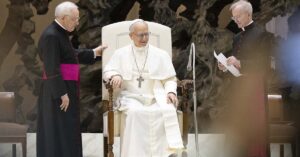
Something remarkable happened on May 25, 2026, inside the Vatican’s Synod Hall. For the first time in Catholic history, a sitting pope stood before the world to present his own encyclical – one of the most weighty teaching documents a pontiff can produce. Pope Leo XIV didn’t hand the moment off to a spokesperson or let the document quietly appear on the Vatican website. He walked to the podium himself, alongside cardinals and theologians, and next to him stood a co-founder of one of Silicon Valley’s most prominent AI companies. That combination alone told you something unusual was happening.
The document is called Magnifica Humanitas, which translates as “Magnificent Humanity.” Its subject is artificial intelligence: where it’s heading, who it serves, and what it could take from us if we let it run unchecked. The timing was deliberate. The pope chose to sign it on May 15, exactly 135 years after his predecessor Pope Leo XIII published Rerum Novarum, the 1891 letter that shaped Catholic thinking on workers’ rights and the social costs of industrialization. That parallel was intentional – and pointed.
Pope Leo XIV has described AI as a “new industrial revolution,” a civilizational moment as significant as the steam engine and the factory floor. The question his encyclical poses is not whether AI is useful. He says clearly that it can be. The harder question is whether humanity will shape AI around its own values, or allow AI to quietly reshape humanity instead. Here are the five ways he says that warping could happen.
1. AI Is Never Neutral – It Carries the Values of Its Makers
The most foundational argument in Magnifica Humanitas is one that tends to get lost in conversations about regulation and governance. Most people assume that software is simply a tool, like a hammer or a calculator. Pope Leo XIV rejects that framing completely.
According to the encyclical, “technology is never neutral, because it takes on the characteristics of those who devise, finance, regulate, and use it.” That sentence has major implications. It means that every AI system deciding who gets a job offer, who qualifies for a loan, or who sees which political ad is doing so through a lens shaped by whoever built and trained it.
The encyclical calls for democratic oversight of AI systems, protection of workers displaced by automation, and international governance of AI on a scale comparable to nuclear arms control. That’s not the language of a minor policy suggestion. It reflects the pope’s belief that the values baked into AI are already reshaping access to opportunity at a systemic level.
At the Vatican presentation, Anthropic co-founder Chris Olah acknowledged that computer scientists alone cannot determine the ethical boundaries of AI because developers themselves are influenced by “incentives” such as ambition, competition and financial pressure. His admission was striking: even those building the systems recognize that they are not objective. “We need informed critics who will tell the labs when we are failing,” Olah said.
The practical takeaway here is simple: when an algorithm makes a decision about your life, it’s worth asking whose priorities went into building it.
2. AI Is Making War Easier and Moral Accountability Harder
Pope Leo condemns lethal autonomous weapons as morally impermissible, and theologians have described his effective declaration that the traditional Catholic just-war framework is inadequate for an era of AI-guided warfare as historically significant.
The core problem, as the encyclical frames it, is one of distance and diffusion. The encyclical states that “any technology that facilitates attacks without seeing the face of human beings lowers the moral threshold of conflict.” When a machine pulls the trigger, the human chain of responsibility becomes blurred. Who is accountable? The programmer? The general who authorized deployment? The company that sold the system?
The document explicitly warns that some autonomous weapons systems have advanced “practically beyond any human reach to govern them.” That phrase landed with particular weight at the Vatican event given the company represented on the stage. Pope Leo XIV personally presented his encyclical alongside the co-founder of Anthropic, the AI research company recently thrust into a public clash with the Trump administration over the use of its models in military and surveillance contexts.
The encyclical states that “it is not permissible to entrust lethal or otherwise irreversible decisions to artificial systems” and that no algorithm can make war morally acceptable.
The pope urges strict ethical limits, shared at the international level and based on personal responsibility and the protection of civilians. For anyone thinking about the practical meaning of that: if a weapons system cannot identify who gave the order, trace who is responsible, or be stopped once launched, the pope’s position is that it should not exist at all.
3. AI Is Eroding How We Think – and How We Trust Each Other
In the encyclical, Pope Leo writes that AI systems are “driving profound changes in public and political communication,” that “tools that could foster dialogue and participation are often used to construct distorted narratives and blur the boundaries between truth and falsehood,” and that “indifference to the truth leads, slowly but surely, to a descent into totalitarianism.”
That’s a striking escalation from a document concerned with digital ethics. The pope isn’t just worried about fake news. He’s worried about what a permanent fog of AI-generated disinformation does to a society’s ability to reason collectively and govern itself.
The encyclical notes that while disinformation and fake news are not new, AI can amplify them dramatically, and its concern is to call for the shared pursuit of honest communication and social trust. The problem isn’t that people are gullible. It’s that the volume and quality of false content is now industrialized.
This concern is well-grounded. Deepfakes have crossed a critical threshold in 2026, with improved quality accessible via smartphone, and a 2025 study published in the peer-reviewed Journal of Creative Communications found that people struggle to identify deepfake videos and are influenced by AI-generated political misinformation. Meanwhile, there is no federal regulation constraining the use of AI in political messaging, leaving only a patchwork of largely unenforced state laws.
For readers, the encyclical’s call for what it describes as “an ecology of communication” means being genuinely skeptical about political content encountered online, and supporting news environments that have real editorial standards.
4. AI Could Strip Work of Its Dignity – and Leave People Behind
Pope Leo XIV chose his papal name carefully. His focus on AI is reflected in his papal name itself, which he chose in reference to Pope Leo XIII, whose 1891 encyclical Rerum Novarum addressed the social consequences of the Industrial Revolution and established the foundation of modern Catholic social teaching on labor and technology.
The labor concerns in Magnifica Humanitas are among its most grounded. Echoing the worker-centered concerns of Rerum Novarum, the encyclical warns that rapid automation could displace workers and reshape labor markets in ways that would risk leaving many in “forced inactivity,” and states that “the pursuit of greater profits cannot justify choices that systematically sacrifice jobs.”
This isn’t hypothetical. Research from Northwestern University’s law journal found that algorithmic tools can prevent capable candidates from even seeing job postings, and that over 70% of companies are now using AI in hiring. The filtering happens before a human ever looks at a resume. Researchers have found that despite claims of neutrality, AI hiring tools can discriminate by reproducing and amplifying human bias when training data reflects historical inequities.
Algorithmic bias in hiring sits at the intersection of technology, economic justice, and human dignity – exactly the territory the encyclical maps. The pope’s argument isn’t that automation is inherently wrong. It’s that when a person loses access to work, credit, or public services because of an opaque algorithm with no accountability, something genuinely human has been violated.
Whether Magnifica Humanitas translates into policy influence in the next year or the next decade remains an open question. But for workers navigating AI-screened job applications right now, the encyclical’s demand for transparency in algorithmic decision-making is immediately relevant.
5. AI Can Simulate Care – and Make Us Mistake It for Connection
This fifth warning may be the most personal – and the least discussed. While the earlier concerns about warfare and disinformation are easy to grasp, the encyclical also raises a quieter danger: that AI can mimic the texture of human relationship closely enough to fool people who are lonely, grieving, or vulnerable.
Pope Leo warned that artificial intelligence must be “disarmed,” urging governments, tech leaders and society to confront the rapidly growing technology before it weakens human relationships, critical thinking and peace itself. The weakening of human relationships is worth pausing on. The encyclical flags the risk that people in need of genuine care – elderly people, isolated teenagers, individuals in mental health crises – may increasingly turn to AI systems that simulate empathy without possessing any.
Cardinal Fernández, presenting alongside the pope, emphasized one of the encyclical’s central arguments: that artificial intelligence cannot replicate humanity’s capacity to suffer, grow and love. That’s not a theological abstraction. It’s a direct comment on chatbots and AI companions that are already being marketed to older adults and young people as substitutes for human contact.
Among the passages drawing attention from AI researchers was a section describing AI systems as being more “cultivated” than “built,” with developers not directly designing every detail but instead creating a framework within which intelligence “grows,” leaving fundamental aspects of behavior poorly understood even by their creators. When you combine that opacity with emotionally resonant design, the concern becomes concrete: people may form genuine attachment to a system that doesn’t understand them and cannot truly be accountable to them.
The encyclical also links this to the broader erosion of critical thinking. The encyclical warns that unmanned weapons systems lower the psychological threshold for conflict by distancing societies from the human cost of violence. The same logic applies to personal relationships: distance from genuine friction, genuine effort, and genuine accountability makes everything feel easier – and less real.
What This Means for You
Pope Leo made history by becoming the first pope to personally present his own encyclical – a signal that this document was not routine. The 42,300-word document calls for democratic oversight of AI systems, a categorical ban on lethal autonomous weapons, protection of workers displaced by automation, and international governance of AI on a scale comparable to nuclear arms control. That agenda is enormous, and the pope is not a policymaker. But encyclicals have historically moved institutions, shaped laws, and reframed public conversations in ways that took decades to fully register.
For those of us who aren’t heads of state or AI executives, the five concerns raised in Magnifica Humanitas translate into daily choices. Who benefits when you use an AI hiring tool? Who built the chatbot offering you emotional support, and what incentives shaped its design? When you share a political video, have you considered whether it’s real? The encyclical calls for “robust legal frameworks, independent oversight, informed users and a political system that does not abdicate its responsibility,” adding that “calling for prudence, rigorous evaluation and even, at times, a slower pace in adopting AI does not mean opposing progress; instead, it is an exercise of responsible care for the human family.” That last sentence is worth carrying with you. Skepticism about AI is not technophobia. According to the pope leo ai ethics framework laid out in Magnifica Humanitas, it’s one of the most human things you can practice right now.
AI Disclaimer: This article was created with the assistance of AI tools and reviewed by a human editor.