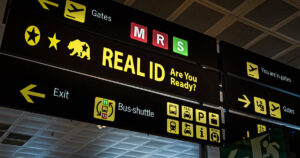
Don’t Have Real ID Yet? This TSA Rule Could Hit Your Bank Account
Imagine packing your bag, booking a ride to the airport, and then finding out at the security line that your wallet is about to take a hit – not from a flight fee or a checked bag charge, but because of the ID card sitting in your pocket. That scenario is now playing out at airports across the country, and millions of Americans may not realize they’re at risk until they’re already standing at the checkpoint.
The real ID TSA requirements have officially moved from background noise to a real-money issue. A federal rule that’s been two decades in the making has changed what showing up to a domestic flight actually looks like. And for anyone who hasn’t gotten around to updating their driver’s license – or who simply lost their wallet the week before a trip – the consequences now have a dollar amount attached.
This isn’t about hassle anymore. It’s about cash.
Why This Law Exists in the First Place
The story starts in 2005, in the aftermath of the September 11 attacks. The REAL ID Act, passed by Congress in 2005, enacted the 9/11 Commission’s recommendation that the federal government set standards for the issuance of identification such as driver’s licenses and identification cards. The motivation wasn’t abstract. Before 9/11, standards for issuing driver’s licenses and other IDs varied widely among states, with little coordination or verification of critical documents. Several of the 9/11 hijackers were able to obtain legitimate state IDs using fraudulent documents, enabling them to move freely and board planes without detection.
The original statute gave states three years to comply, setting a deadline of May 11, 2008, for federal agencies to stop accepting non-compliant IDs. That deadline was never enforced, and what followed was one of the longest implementation sagas in modern federal law. The REAL ID law was signed more than 20 years ago, but previous presidential administrations failed to properly implement it. Under President Trump’s leadership, the law was finally implemented and enforced by Secretary Kristi Noem as of May 7, 2025.
The Federal Register’s final rule, published by TSA, confirmed that the May 7, 2025 enforcement deadline ensured that federal agencies had the framework to implement the card-based enforcement provisions of the REAL ID regulations. For everyday travelers, what it means in practice is simpler: if your driver’s license doesn’t meet these standards, your airport experience just got more complicated and more expensive.
The $45 Fee That Changed Everything
For years, a traveler who showed up at a checkpoint without compliant ID could go through a manual verification process at no charge. That option has now been replaced. The Transportation Security Administration announced that it would refer all passengers who do not present an acceptable form of ID and still want to fly an option to pay a $45 fee to use a modernized alternative identity verification system, TSA ConfirmID, to establish identity at security checkpoints beginning on February 1, 2026.
The fee didn’t land at $45 by accident. An earlier Federal Register notice, published November 20, 2025, proposed a fee of $18.00 per person at the time an individual registers and requests alternative identity verification. To address the government-incurred costs of operating the new program, including an updated review and revision of relevant population estimates, TSA set the TSA Confirm.ID program fee to $45.00, effective December 3, 2025. TSA frames this not as a penalty but as a cost-recovery measure. As Adam Stahl, the senior official performing the duties of deputy administrator for TSA, stated: “This fee ensures the cost to cover verification of an insufficient ID will come from the traveler, not the taxpayer.” The fees are structured to cover what the agency spends on the program: according to TSA, ConfirmID includes biometric screening, photo matching against government databases, information technology infrastructure, software development, data integration, and program management costs.
The TSA estimates around 94% of travelers in the U.S. already have a REAL ID or another form of acceptable ID, such as a passport. That leaves around 6% of travelers non-compliant. That sounds small, but across the volume of passengers moving through U.S. airports every day, it adds up to a significant number of people potentially facing a fee they weren’t expecting.
How TSA ConfirmID Actually Works
Under the system, travelers can go online to pay the $45 fee and provide basic information to receive a digital or printed receipt. Travelers can complete the process online before arriving at the airport by submitting their legal name, address, and date of birth, then paying the $45 fee using a debit card, credit card, Venmo, or PayPal. Travelers will be able to pay $45 to use TSA ConfirmID for a 10-day travel period. That 10-day window matters for anyone taking a round-trip or connecting through multiple airports – one payment covers the full travel period.
Timing is critical. TSA urges all travelers who do not have a REAL ID to pay the fee online before traveling. For passengers who arrive at the airport without paying the fee, information about how to pay will be available at marked locations at or near the checkpoint in most airports. Passengers who wait to complete the process at the airport may face delays of 30 minutes or more and could miss their flight. Missing a flight because you waited until you got to the checkpoint is a very real possibility.
And there’s one more catch that many travelers overlook. If you are unable to provide the required acceptable ID, such as a passport or REAL ID, you can pay a $45 fee to use TSA ConfirmID. TSA will then attempt to verify your identity so you can go through security; however, there is no guarantee TSA can do so. TSA will not refund the fee, in whole or in part, to individuals whose identities are not verified or who are unable to enter the sterile area based upon the results of the identity verification process. Pay the fee, fail the verification, and you could be turned away with nothing to show for it.
Using TSA ConfirmID is optional. If you choose not to use it and don’t have an acceptable ID, you may not be allowed through security and may miss your flight.
Who Actually Needs to Worry
Not everyone flying domestically is in trouble. Some examples of alternate forms of acceptable identification are a U.S. passport or passport card; any government-issued passport; Department of Homeland Security Trusted Traveler cards including a Global Entry or SENTRI card; active duty and retired military ID including IDs issued to dependents; an ID card issued by any federally-recognized tribe; and the Transportation Worker Identification Credential.
What won’t work is a temporary paper license. TSA will not accept the temporary paper card given at the DMV. This catches people by surprise – someone who just moved, recently renewed their license, or had their wallet stolen might be holding a piece of paper they assume is valid. It isn’t.
The good news is that getting compliant has never been more accessible. All states are issuing REAL ID-compliant driver’s licenses and identification cards. You can spot a compliant ID by looking for a star marking in the upper corner. Look for the gold star in the upper righthand corner of your driver’s license or identification card – the presence of this star indicates the credential is REAL ID-compliant. If that star isn’t there, and your ID says “Not for Federal Identification,” you’ll want to visit your state DMV before your next flight.
The announcement of the fee – even before it went live – appears to have pushed many people to finally update their IDs. Based on early data reports from the TSA, 95-99% of travelers are presenting REAL IDs or other acceptable forms of identification at airport security checkpoints, an encouraging improvement in compliance since TSA ConfirmID was announced in December 2025.
That’s a meaningful shift. The threat of paying $45 on the spot, combined with the potential to miss a flight, proved to be a more effective motivator than years of public awareness campaigns. The new system is designed to strengthen identity verification and further enhance aviation security by closing long-standing gaps in ID standards. “TSA ConfirmID has been a huge success due to the ongoing collaboration with our airline, airport and industry partners and effective public outreach and communications efforts,” said Steve Lorincz, TSA’s Acting Executive Assistant Administrator for Security Operations. For the small percentage still arriving without proper ID, the system is now firmly in place – and fully enforced.
Check your wallet right now. Look at your driver’s license and find the star in the upper corner. No star, or a note saying “Not for Federal Identification”? You have two options: get a REAL ID-compliant license from your state DMV, or make sure you travel with an acceptable alternative like a valid U.S. passport.
If your next trip is soon and there’s no time for a DMV visit, don’t wait until you’re at the airport to deal with this. Visit TSA.gov/ConfirmID to pay the $45 fee before your trip. You’ll receive a payment receipt by email from Pay.gov. At the airport, show that receipt – printed or screenshot – along with any government-issued ID to the TSA officer. Doing this before you leave home saves you from the worst-case scenario of scrambling at the checkpoint while your boarding time ticks away.
One thing to plan for: the $45 fee buys you a 10-day travel window, not a permanent pass. If TSA successfully verifies the traveler’s identity, it issues temporary clearance valid for up to 10 days, covering multiple flights within that window. If you travel after the 10-day expiration date, you must pay the fee again. For frequent travelers or anyone with back-to-back trips, that cost adds up fast. The math strongly favors a one-time DMV visit over repeated $45 payments.
The bottom line is practical: the days of breezing through airport security on an outdated state ID are over. The requirement is enforced, the fee is real, and the process at the checkpoint takes time that most people don’t have to spare. A REAL ID-compliant license costs nothing extra to get if you’re due for a renewal, and every state in the country now offers them. For most people, the fix is a single DMV appointment – far cheaper than finding out the hard way.
Disclaimer: This information is not intended to be a substitute for professional financial advice, investment advice, tax advice, or legal advice, and is provided for informational purposes only. Always seek the guidance of a qualified financial advisor, accountant, or other licensed professional regarding your personal financial situation or investment decisions. Do not make financial, investment, or tax decisions based solely on information presented here. Past performance is not indicative of future results, and all investments carry risk, including the potential loss of principal.
AI Disclaimer: This article was created with the assistance of AI tools and reviewed by a human editor.