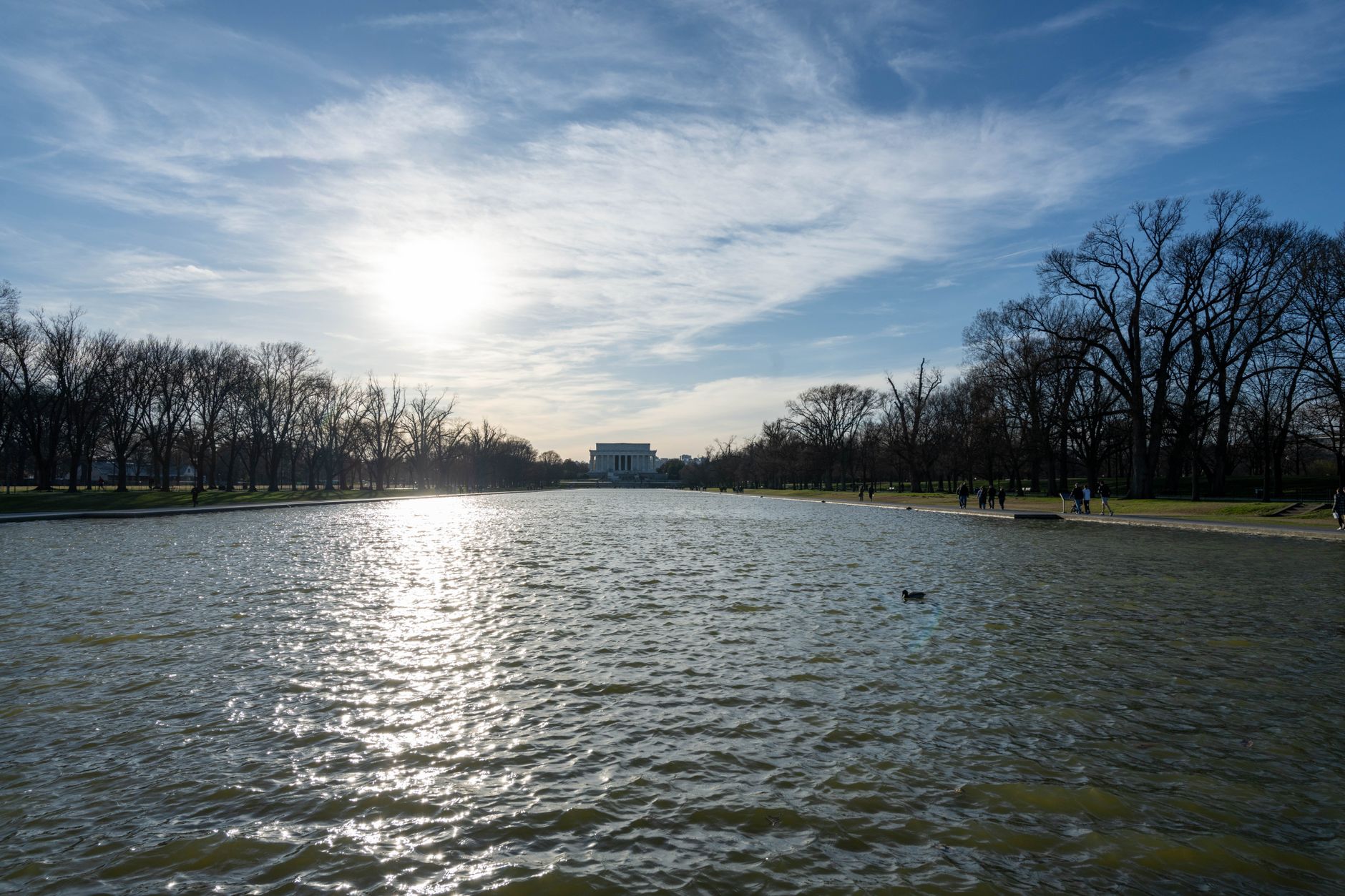

Trump told reporters on June 4, 2026, that the Lincoln Memorial’s front was always supposed to face the Potomac River, not the Reflecting Pool. Two roadways cut that off after the memorial was built, he said, and he’s now going to fix it. This Trump memorial overhaul claim – that the entire orientation of the memorial was a historical mistake – is not a view shared by architectural historians. But that hasn’t slowed anything down.
Trump announced that a new promenade will be built connecting the Lincoln Memorial to the Potomac River, saying the project would restore what he described as the memorial’s original intended design before roadways cut off its access to the water. He floated a name for it from the Oval Office, saying “It’s called the promenade, will be the promenade,” and added that “they want to call it the ‘Trump Promenade’ but I don’t know if I want to do that.”
The promenade announcement arrived the same day Trump showcased another project: the Lincoln Memorial Reflecting Pool refilling with water after he ordered it painted a new color. Trump said the pool’s new shade would be “American Flag Blue,” a color he chose himself. The combination of these two announcements – a new walkway over active roadways and a repainted historic pool – gives a fairly clear picture of how aggressively the administration is reshaping Washington’s most iconic civic spaces ahead of the nation’s 250th birthday.
The Cultural Landscape Foundation, a nonprofit advocacy organization, had already asked a federal judge to halt Trump’s plans to resurface the Reflecting Pool. That lawsuit was filed nearly a month before the promenade announcement, and the legal fight is still ongoing. The bigger story is what’s happened at the Reflecting Pool – and what it reveals about how this administration is operating across Washington’s monumental core.
The Reflecting Pool and the Trump Memorial Overhaul
The Reflecting Pool is more than 2,000 feet long, sits between the Lincoln Memorial and the Washington Monument, and is one of the most iconic sites in Washington. Martin Luther King Jr. delivered his “I Have a Dream” speech at the Lincoln Memorial on August 28, 1963.
According to a 1999 National Park Service cultural landscape report cited in the lawsuit, the pool’s basin color was selected because it “created the illusion of greater depth and a more profound reflection,” fundamental to the visual connection between the Washington Monument and the Lincoln Memorial. For preservationists, that detail isn’t incidental – it’s central to the design intent.
Trump ordered that dark gray basin replaced with a blue coating. The pool is listed on the National Register of Historic Places, meaning any proposed changes are subject to Section 106 of the National Historic Preservation Act, which, as the Advisory Council on Historic Preservation explains, requires federal agencies to consider the effects on historic properties of projects they carry out and gives the public the chance to weigh in before a final decision is made. The Cultural Landscape Foundation’s lawsuit argues the project violates federal laws requiring the Interior Department to complete a consultation process – including notifying the public and getting input from other federal agencies – before beginning the work. The group also says the project runs afoul of a federal law requiring an environmental impact assessment.
Changing the Reflecting Pool’s color, a key character-defining feature of the site listed in the National Register of Historic Places, should be subject to reviews pursuant to Section 106 of the National Historic Preservation Act of 1966 and other laws. The administration proceeded without those reviews.
A $1.8 Million Project That Cost $13 Million
The cost question is where things get particularly pointed. The federal government paid $13.1 million to Atlantic Industrial Coatings through a no-bid contract, awarded in two payments: $6.8 million on April 3 and an additional $6.2 million on May 8, 2026. Atlantic Industrial Coatings, LLC, is a Virginia-based woman-owned coatings company.
Trump initially said the project could be done for $1.5 million. The company previously performed work on swimming pools at Trump’s National Golf Club in Sterling, Virginia, and had no prior federal contracts before this award.
The Reflecting Pool and its surrounding landscape are listed on the National Register of Historic Places as part of the National Mall Historic District. That protected status is the basis for the Section 106 consultation requirement the lawsuit says the Trump administration skipped entirely.
For context, the Obama administration spent $34 million on a major overhaul of the pool, which included the installation of a new circulation and filtration system, during his presidency. That figure makes the current claimed price tag of $1.8 million difficult to square with a project of comparable scale. Court filings from the Trump administration itself note the Reflecting Pool holds approximately 6.5 million gallons of water – roughly equivalent to ten Olympic-size swimming pools. Recoating a structure of that size to a permanent new color is not, by any reasonable measure, a $1.8 million job.
A National Park Service analysis found that while the typical profit margin for such a job is 6 to 12 percent, Atlantic Industrial Coatings is receiving a 20 percent profit margin for its work – meaning the company is charging the government at least $850,000 more than average.
What the Lawsuit Actually Says
Charles A. Birnbaum, TCLF’s president and CEO, argued that “The reflecting pool should not be viewed in isolation; it is part of the larger ensemble of designed landscapes that comprise the National Mall,” and that “The design intent, to create a reflective surface that is subordinate, is fundamental to the solemn and hallowed visual and spatial connection between the Washington Monument and the Lincoln Memorial. A blue-tinted basin is more appropriate to a resort or theme park.”
Lawyers for the foundation wrote in court papers that “Defendants’ failure to follow the law before inserting a permanent blemish on the National Mall is causing serious and irreparable harm to the Plaintiffs and the public generally,” and that “Without immediate judicial intervention, defendants will deface an iconic American landmark, in open violation of Congressionally mandated procedures.”
The lawsuit notes that previous interventions involving the Reflecting Pool, Lincoln Memorial grounds, and adjacent National Mall landscapes were all subject to Section 106 review as well as oversight by the U.S. Commission of Fine Arts. This time, neither happened.
The Cultural Landscape Foundation also has another open lawsuit against the federal administration – it is one of eight cultural and architecture groups suing Trump and the Kennedy Center board over planned renovations of that complex.
The Promenade Claim: History or Revisionism?
Trump’s stated justification for the new promenade rests on a specific historical claim. According to CNN, he told reporters in the Oval Office that “The Lincoln Memorial – the front was supposed to be the back. The back was supposed to be the front. It never got built, because they built two roadways behind it after it was built, and it shut off the gateway to the water,” adding that “we have a way of beautifully going over those two roads.”
The Lincoln Memorial was dedicated in 1922, designed by New York architect Henry Bacon, with construction beginning in 1914. The memorial’s relationship with the Potomac has always been complicated by the development of the George Washington Memorial Parkway, which runs along the river’s edge. But the claim that the memorial’s orientation was essentially a historical mistake is not a view shared by architectural historians. The White House, when asked for additional details about the promenade plan, referred reporters to Trump’s own comments.
Trump has also proposed building a 250-foot arch and constructing a 90,000-square-foot ballroom on the site of the former East Wing of the White House, which he plans to demolish. The promenade fits that broader pattern: a series of large-scale construction projects around the National Mall framed as restorations of original intent or improvements to neglected infrastructure.
Work was still actively underway on the Reflecting Pool as of May 12, 2026, with National Guard soldiers visible on the National Mall as contractors applied the blue coating. Trump’s stated goal is to finish the job before July 4.
The Kennedy Center Parallel
The Reflecting Pool fight isn’t happening in isolation. Trump’s name was added to the Kennedy Center in December 2025. U.S. District Judge Christopher Cooper ruled that Trump’s handpicked board did not have the authority to rename the facility on its own, writing that “The Kennedy Center’s organic statute makes crystal clear that the Center is to be named for President Kennedy, and it cannot bear any other formal name or public memorial based on the Board’s unilateral say-so.” “Congress gave the Kennedy Center its name, and only Congress can change it.”
As part of his ruling, Judge Cooper ordered that all signage and online materials referring to the “Donald J. Trump and John F. Kennedy Memorial Center for the Performing Arts,” the “Trump Kennedy Center,” or anything similar must be removed within 14 days.
The Kennedy Center ordered staff to erase Trump’s name from official materials less than a week after the federal judge ruled it had been illegally added to the institution.
The Reflecting Pool lawsuit and the Kennedy Center ruling follow the same basic legal pattern: the administration makes a unilateral change to a federally protected landmark, skips the legally required review processes, and then faces a court challenge. Other groups have asked federal courts to stop the president from moving ahead with work on a massive new ballroom at the White House, construction of an arch similar to Paris’ Arc de Triomphe, and the painting of historic federal office buildings – including the Wilbur J. Cohen Federal Building, the Eisenhower Executive Office Building, and the Robert C. Weaver Federal Building – adjacent to the White House.
Read More: Trump Wants to Paint This Historic Landmark White – Experts Say It Can’t Be Undone
Where This Ends Up
The Lincoln Memorial steps have served as the setting for major historic moments – most famously Marian Anderson’s 1939 open-air concert, performed there after she was denied a segregated venue, and Martin Luther King Jr.’s 1963 “I Have a Dream” speech during the March on Washington. Permanently changing the color of the Reflecting Pool – the reflective surface those events literally looked out across – without public notice or environmental review is a legal question, and courts are increasingly treating it that way.
A no-bid contract worth $13.1 million was awarded to a company with prior ties to Trump properties, while the public price claim stood at $1.8 million – less than a seventh of what federal records show. Preservationists filed suit. A separate court has already ruled against the administration on the Kennedy Center renaming. Now a new promenade announcement adds yet another unreviewed construction project to the National Mall.
America’s 250th anniversary celebrations are set for July 4, 2026, and the administration has tied every one of these projects to that deadline. Trump claimed to have driven the Reflecting Pool overhaul by asking contractors he knew for “a good price” and said he chose the shade of blue himself after being dissuaded from another option. Whether the courts move faster than the construction crews will determine how much of Washington’s historically protected landscape gets permanently altered before any legal review takes place. If the Kennedy Center ruling is any guide, that question may already be in the hands of federal judges.
AI Disclaimer: This article was created with the assistance of AI tools and reviewed by a human editor.
Read More: Trump Bought Dell Stock Months Before Pentagon Handed It a $9.7B Contract