
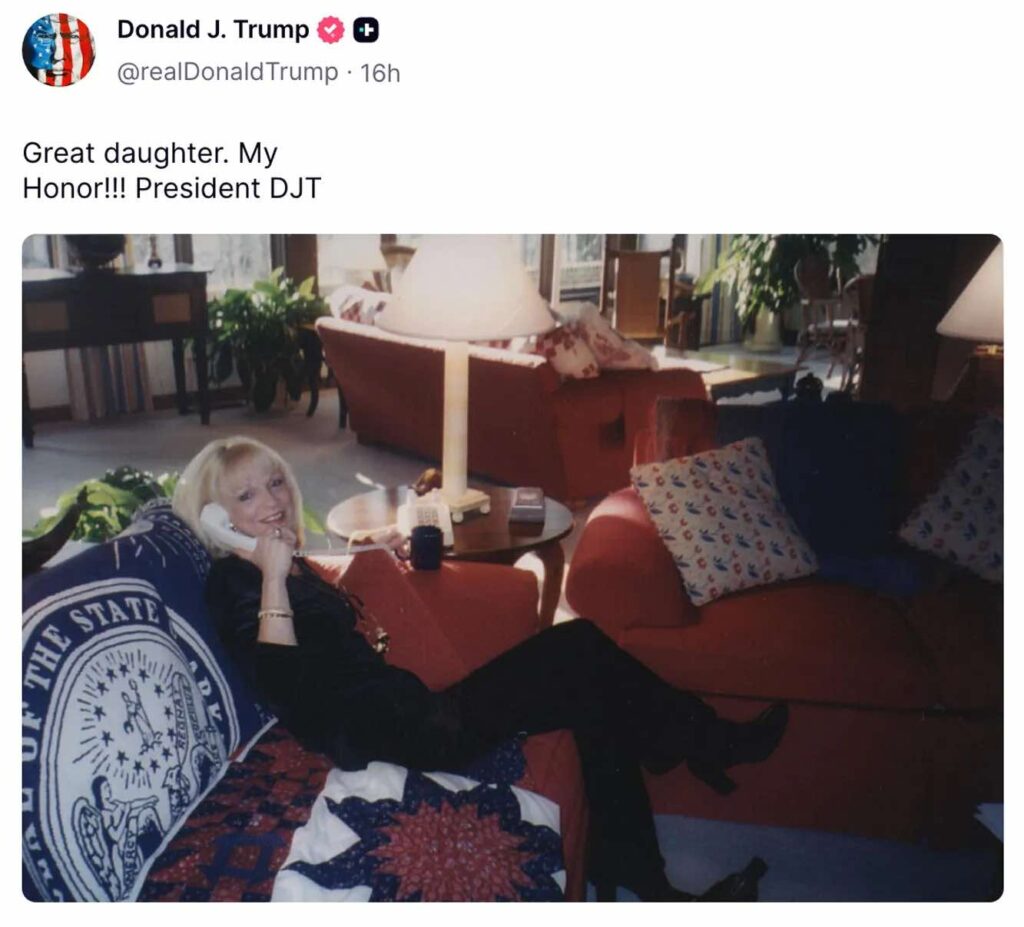
On the eve of Father’s Day this year, President Donald Trump posted a photo to Truth Social of a blonde woman reclining on a red sofa, talking on a phone. The caption read: “Great daughter. My Honor!!! President DJT.” The woman in the photo was not his daughter.
Trump posted the shout-out to a “great daughter” using a photo of a woman who was definitely not his daughter, neither Ivanka, 44, nor Tiffany, 32, setting off immediate and fresh concerns about the 80-year-old president’s mental state. The post spread quickly across social media, and within hours, online sleuths were working to figure out who she actually was.
Online sleuths identified the woman as Margo Catsimatidis, 74, the wife of billionaire retail mogul and Trump ally John Catsimatidis, and suggested the photo had likely been taken at Camp David at some time during the Clinton administration. The state seal of Arkansas, Clinton’s home state, is visible on the couch she is sitting on. The photo appears to be decades old, sourced from a private archive, and was posted alongside a caption referring to a “great daughter.” The reason for the pairing remains unclear.
Who Is Margo Catsimatidis, and Why Does It Matter?
The couple’s daughter, Andrea Catsimatidis, is the chairwoman of the Manhattan Republican Party. One theory that gained traction online suggested the photo shows Margo Catsimatidis at Camp David during Bill Clinton’s term and that the “great daughter” Trump meant was actually her daughter Andrea, meaning the president posted a decades-old picture of the mother while praising the daughter. Andrea Catsimatidis, who attended Trump’s 80th birthday celebration at a UFC event, responded to the post on X, thanking the president for the birthday invitation but not directly addressing the confusion.
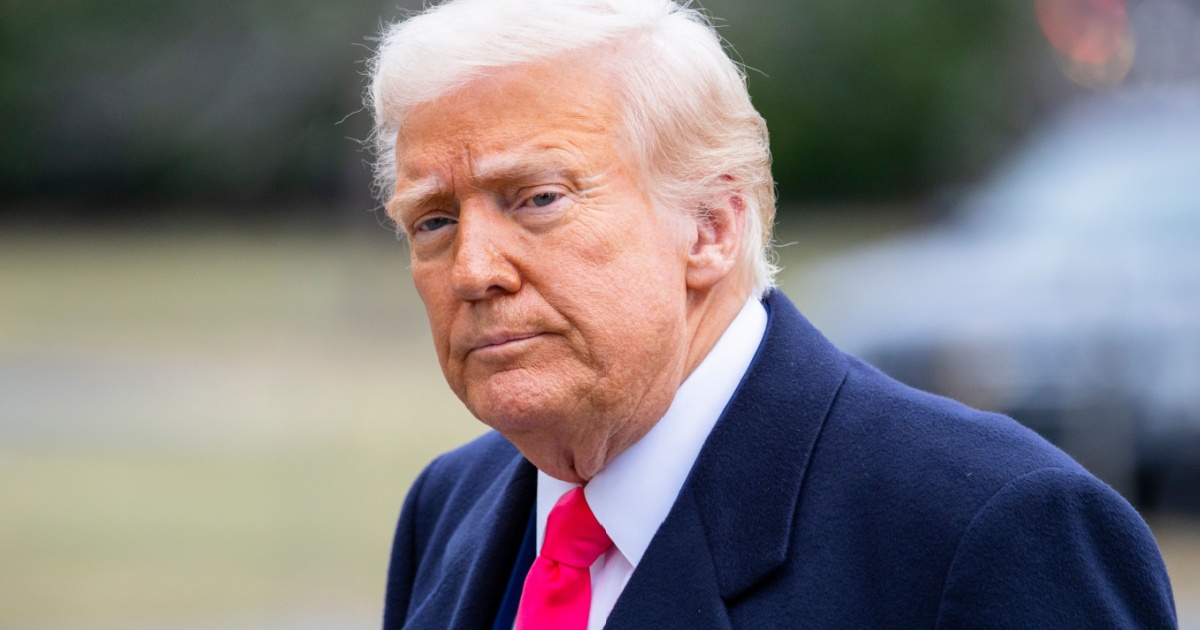
The episode quickly became a referendum on the 80-year-old president’s grip on his own social media account. Social media commentator Arieh Kovler doubted Trump was personally sorting through 1990s Camp David photographs, writing that the president “must have told some staffer to post this and nobody queried it or told him ‘that’s not your daughter.'” Whether Trump was actually referring to Andrea Catsimatidis in the Truth Social post remains unconfirmed, as does the true identity of the woman pictured. The White House did not respond to multiple requests for comment.
The reaction online was swift and divided along predictable lines. Some observers focused on whether the post reflected a simple staffing mistake. Others pointed directly to the trump daughter health concerns that have circulated around the president for months, arguing that a post like this was not an isolated lapse.
A Pattern of Posts and the Health Scrutiny They’ve Drawn
According to The Daily Beast, Trump posted an astounding 861 times on Truth Social in May 2026, with the president averaging 27 posts per day, the equivalent of just over once every hour of every day. His posting frequency was a sharp increase over April, when the same outlet calculated that he posted an average of 18 times a day. According to a Mediaite analysis, Trump has averaged 19 Truth Social posts a day so far in 2026.
The volume of posting is striking by any measure. The content of specific posts has fed the sharpest concerns. The posts include AI-generated memes, posts criticizing opponents during the Iran conflict, and a picture of Trump lounging shirtless on a pool floatie in the Lincoln Memorial Reflecting Pool with a bikini-clad woman. Political observers have drawn different conclusions about what this pattern signals. Some see a president fully in command of his platform and using it aggressively. Others see something more concerning.
Rep. Jamie Raskin wrote to White House Physician Captain Sean Barbabella, demanding an immediate and comprehensive cognitive and neurological evaluation of President Trump in April 2026, joining a growing chorus of Democratic lawmakers and some right-wing personalities who had expressed concern about the president’s fitness for office. As recently as June 18, 2026, Raskin wrote again to Barbabella, seeking information about Trump’s unexplained symptoms and frequent hospital visits after the Washington Post reported that the president is being seen by 22 medical specialists.
The administration’s response has been consistent and categorical: the White House has stated that Trump “is the sharpest and most accessible President in American history and remains in excellent health.” No formal diagnosis of any cognitive condition has been disclosed.
How Dementia Affects Facial Recognition
Before discussing the medical science, it is important to note that the confusion surrounding this post has led to speculation about President Trump’s cognitive health, but no diagnosis of dementia or any other cognitive disorder has been made public. While some commentators, political opponents, and medical professionals have offered opinions based on Trump’s public appearances, speeches, or social media activity, such observations are not equivalent to a clinical diagnosis. The symptoms described below are provided for general educational context only and should not be interpreted as evidence that Trump has dementia or any specific neurological condition.
The “daughter” post renewed a specific line of concern: could Trump be confusing people he knows? In the later stages of dementia, memory loss becomes far more severe. A person may not recognize family members, may forget relationships, call family members by other names, or become confused about the location of home or the passage of time. The Alzheimer’s Association describes this as one of the most painful experiences for families, and distinguishes it clearly from ordinary forgetfulness.
The World Health Organization lists person misidentification as a recognized symptom of dementia and Alzheimer’s disease, noting that people with the condition may lose the ability to recognize family members or friends. The important clinical distinction is that this failure isn’t simply “forgetting a face.” Recognizing someone actually requires pulling together multiple separate memories: a memory of the person’s face, a memory of their name, their voice, and the nature of your relationship. Pulling all of these together requires multiple parts of the brain and different neural pathways. When those pathways are damaged, a person may see a familiar face and genuinely not be able to place it, or may incorrectly assign a relationship to it.
A related condition, prosopagnosia (face blindness) as it appears in dementia, describes a specific failure of facial recognition in which a person may not recognize even close family members. In dementia, this misidentification process begins as an altered sense of familiarity, a mismatch between what the person sees and what their damaged memory is able to match it to.
None of the symptoms discussed above should be taken as evidence that President Trump has dementia. While some observers have cited incidents such as this post when raising concerns about his cognitive health, determining whether a person has dementia requires a formal medical evaluation. Without such an assessment, any conclusion about Trump’s cognitive status remains speculation rather than an established medical fact.
Researchers Joyce Siette and Paul Strutt, writing in The Conversation for Western Sydney University, argue that diagnosing someone with dementia from afar is “not only irresponsible, it’s impossible,” and may inadvertently give Trump an “out” for offensive but intentional behavior, while increasing stigma for those who actually live with dementia. Proper diagnosis is complex and cannot rely on observation alone. A multidisciplinary clinical team must examine the person’s personal and medical history, followed by neurological examinations, formal cognitive testing, and brain imaging such as MRI or PET scans to identify structural and functional changes in the brain. None of that has been done publicly.
Age, Cognitive Risk, and What the Research Shows
Trump is 80 years old. That number matters clinically regardless of politics. Even outside of dementia, research published in a 2024 study in PMC found that cognitive decline accelerates with advancing age, particularly after 70.
According to the U.S. Preventive Services Task Force, dementia affects an estimated 9.9% of persons aged 75 to 84 years and 29.3% of those 85 years or older. One in ten people between 75 and 84 has dementia, and that proportion triples in the decade that follows. These are population statistics and don’t determine any individual’s status, but they establish why age itself is considered the primary risk factor for cognitive decline.
The 12 early warning signs of cognitive decline that clinicians actually monitor include the difference between benign age-related forgetfulness and the kind of changes that warrant medical attention. Person misidentification belongs in the latter category when it is consistent and unexplained.
The posts Trump makes and the errors he makes in them cannot, on their own, establish a diagnosis. They have prompted formal congressional requests for independent evaluation, multiple hospital visits, and questions about reports that the president has been seen by numerous medical specialists. None of those developments, however, constitute evidence of dementia or any other specific cognitive disorder.
Read More: Trump Dementia: What’s Behind the Health Concerns in 2026
What Does This All Mean?
The specific post, an 80-year-old man publicly labeling a 74-year-old woman as his “great daughter” without apparent awareness of the error, sits in a genuinely ambiguous space. It may reflect a staffing failure. It may reflect a deliberate but confusing tribute to Andrea Catsimatidis through her mother’s photo. Or it may reflect another explanation that remains unknown because the circumstances surrounding the post have not been publicly clarified.
Age-related cognitive change is real, measurable, and accelerating after 70. It does not affect everyone the same way, and a single confusing social media post proves nothing. A formal cognitive assessment would provide a baseline, a documented and verified picture of where the president’s cognitive function actually stands, rather than a political claim from either direction.
If you have an aging parent or loved one and you’ve noticed moments of person misidentification, word substitution, or confusion about relationships, the appropriate step is a conversation with their primary care physician, who can refer to a neurologist for proper evaluation. The tools exist. What they require is access to the person and a willingness to ask the question honestly.
Disclaimer: The information provided here is for educational and informational purposes only and is not a substitute for professional psychological, psychiatric, or mental health advice, diagnosis, or treatment. Always seek the guidance of a licensed mental health professional, therapist, psychologist, or psychiatrist with any questions or concerns about your emotional well-being or mental health conditions. Never ignore professional advice or delay seeking support because of something you have read here.
AI Disclaimer: This article was created with the assistance of AI tools and reviewed by a human editor.
Read More: Melania Trump Skipped Don Jr.’s Wedding — Here’s Why