
A 90-year-old woman was asked to name the happiest time of her life. Her answer had nothing to do with her retirement years, a milestone celebration, or a moment of personal triumph. It pointed straight back to the years that, from the outside, looked the most difficult.
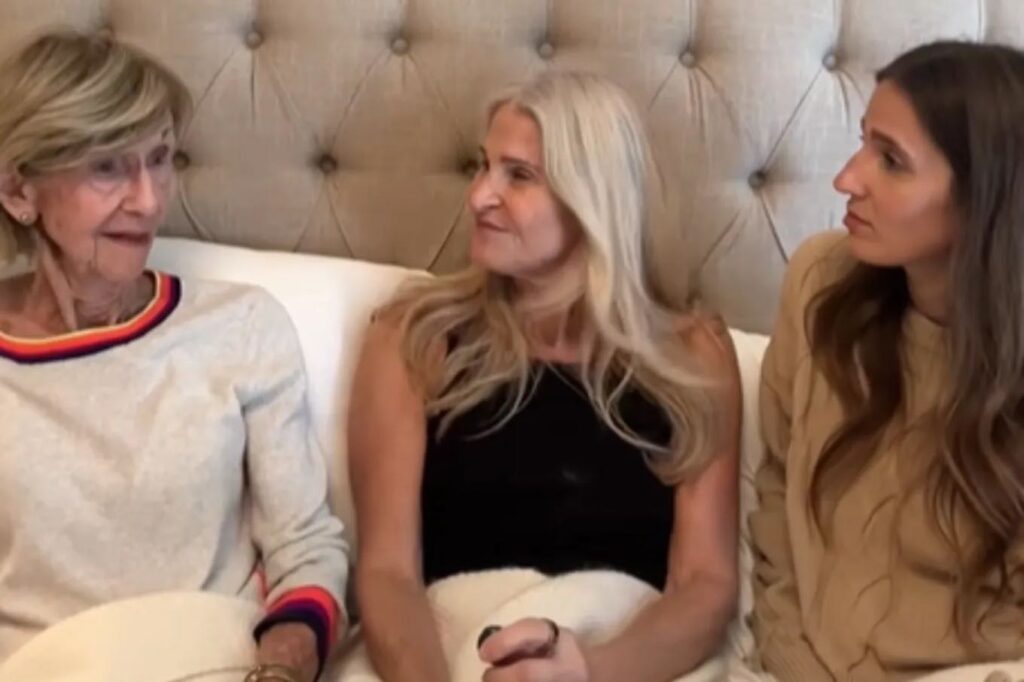
In a TikTok clip that stopped people mid-scroll, three generations sat together: Samantha Krevalin, her mother Deborah, and 90-year-old Ruth H. Kenler. When Samantha asked her grandmother when she had been happiest, Ruth’s answer landed like a quiet thunderclap. “Probably when my life was the most hectic,” she said. Her husband was in medical training. She was raising three children of different ages. Money was tight. Every part of life was difficult – “but it was so full and so happy.”
The clip spread fast. Nearly 700,000 people viewed it on TikTok, with just under another million tuning in via Instagram. The comments filled with people recognizing something they couldn’t quite name – the strange possibility that the years you were most stretched, most tired, most alive with need might also be the ones you’d look back on with the most tenderness.
Deborah Krevalin, a licensed therapist, relationship expert, and business relationship coach, told Newsweek that her grandmother “wasn’t just speaking from her own experience” – she “put language to something a lot of people are living through right now and don’t always have the words for.” That observation cut to something real. Ruth Kenler’s grandma’s happiest memory wasn’t a polished highlight. It was a season of chaos, love, and barely enough.
What Made Ruth’s Answer So Disarming
For Deborah, the sentiment was deeply familiar. “My family has always enjoyed deep, emotional conversations about life and relationships,” she told Newsweek. “We also joke around and have plenty of small talk, but going deep has just always been part of how we connect.”
Deborah, a licensed professional counselor verified in Connecticut, has built her practice around exactly these kinds of conversations – the ones that move past surface pleasantries into something that actually illuminates how people work. Ruth’s answer, it turns out, was the kind of revelation that emerges when a family makes a habit of asking real questions.
Deborah echoed her mother’s sentiment directly: “I still like to be hopeful that the best years are ahead of me, yet I was the happiest when I was just raising my three children and working my ass off, and didn’t have tons of help.”
That parallel – mother and daughter, decades apart in age, pointing to the same chaotic chapter as their peak – is part of what made the video land so hard. One viewer captured the ambivalence perfectly in the comments: “I have a painful hyper awareness every day that I’m in the best years of my life. And I just don’t know if that is a blessing or a curse.”
The Science Behind Why Hard Years Feel Happiest in Retrospect
Ruth’s reflection isn’t just personal sentiment – it tracks closely with what researchers have found about how happiness actually works across a life.
Ruth herself put it best at the end of the video: “There’s something about life… You don’t always know when it’s your happiest moment.” That observation turns out to have substantial psychological backing. Research on nostalgia shows it plays an active role in maintaining emotional stability, not just providing comfort. Nostalgia among older adults provides more than warmth – a 2022 study in the journal Frontiers in Psychology found that among older adults, nostalgia provides a safe haven in the face of adversity, augmenting comfort and security when confronted with limited time horizons.
The same research found something even more striking about the long-term effects of warm memories. Memories of warmth and safeness are associated with better self-rated health and lower depressive symptoms over intervals of 6 to 18 years in middle-aged and older adults – suggesting that how we remember a difficult period matters as much as how difficult it actually was.
Reminiscence therapy, the clinical practice of deliberately recalling positive life experiences, is now used widely in elder care for exactly this reason. Research from Nature shows that reminiscence-based interventions contribute to a measurable reduction in depressive symptoms while promoting self-esteem in older adults. Ruth wasn’t in a therapy session – she was answering a question from her granddaughter. But the mechanism is the same: reaching back into a full, connected, purposeful chapter of life and finding it rich enough to sustain you.
@debkrevalincounseling We asked my 90 year-old mother when she was the happiest in her life. She didn't say retirement. She didn't say when things finally slowed down. She said raising her kids. In the trenches. The chaos, the exhaustion, all of it. We spend so much time waiting for life to get easier before we give ourselves permission to enjoy it. And here is someone who has lived nine decades telling us her peak wasn't the calm. It was the mess! #motherdaughter #family #therapists ♬ original sound – Deborah Krevalin, LPC, LMHC
Why Older Adults Often Report Being Happier Than Younger Ones
One of the more counterintuitive patterns in happiness research is that older adults consistently report higher life satisfaction than people in midlife. According to the AARP Public Policy Institute, 34% of adults aged 80 and older report being “very happy,” compared to just 16% of those in their 40s.
That gap is significant. A 40-year-old in the thick of career pressure, parenting, and financial strain is statistically much less likely to describe themselves as very happy than a 90-year-old like Ruth – who, looking back, names that exact phase of strain as her golden era. Separate findings from the Leyden Academy on Vitality and Ageing, a Dutch research institute dedicated to improving quality of life for older people, show that adults aged 85 report an average life satisfaction score of 8 out of 10, comparable to that of much younger adults.
Physical health, which most people assume would drag satisfaction down, turns out to matter less than expected. The Leiden 85-Plus Study found that older adults with health conditions report almost equivalent life satisfaction as those in good physical health, once mental health is factored in. What actually predicts wellbeing in older age has less to do with the body than with connection, purpose, and how a person relates to their own history.
Psychology Today’s overview of happiness across the lifespan notes that after a dip around age 40, happiness tends to grow with age, with older adults deriving satisfaction from meaningful relationships, volunteer work, and purpose-driven goals rather than material gain.
What Ruth’s Answer Reveals About Connection and Family
The conversation between Ruth, Deborah, and Samantha wasn’t incidental. Three generations sitting together, asking questions that matter, is itself a form of the thing Ruth was describing – a life full enough to look back on.
The Harvard Study of Adult Development, which has tracked participants for more than 85 years, found that people who are more socially connected to family, friends, and community are happier, healthier, and live longer – and that the warmth of those connections had a direct positive impact on health and wellbeing. Ruth’s hectic years were also, almost certainly, her most socially rich: three young children, a husband building a career, a household that demanded constant presence and participation.
The Harvard research also found that satisfaction with relationships at age 50 was a stronger predictor of physical health at age 80 than cholesterol levels or other clinical markers. A 90-year-old who can look back on those years with warmth rather than resentment isn’t just lucky – she may be demonstrating exactly the kind of relational richness that kept her healthy.
Intergenerational connection, the kind on display in that TikTok clip, carries its own documented benefits. Research published by Keiro shows that reciprocal intergenerational transfers – including emotional support from children – may improve older adults’ subjective health status and reduce depression. The video wasn’t just good content. It was, functionally, a form of care.
Read More: Here Are 10 Priceless Quotes That All Grandparents Will Love
What This Means for You
Ruth’s grandma happiest memory was a season most people would label “the hard years.” The lesson isn’t that difficulty equals happiness, but that fullness does. A life crowded with people who need you, with purpose that requires your effort, with connection that runs three generations deep – that’s what she was describing. The hectic was the vehicle. The love was the point.
Research from the Population Reference Bureau finds that older adults report being happiest and most satisfied during social activities – not during leisure or rest, but while actively engaged with other people. Ruth knew this at 90 not from reading studies, but from living it.
The practical takeaway is simpler than it sounds: ask the older people in your life the real questions now, while you can. Ask them when they were happiest. Ask what they’d do differently. Not because their answers will map directly onto your life, but because those conversations are themselves a form of the very thing they’re likely to describe – a life rich with connection, too full to fully appreciate in the moment. A 2025 systematic review in International Psychogeriatrics examining 26 studies of intergenerational programs found that 77% reported positive outcomes for both generations involved. The conversation Samantha started with one question on TikTok may be the most useful thing two generations can do for each other.
AI Disclaimer: This article was created with the assistance of AI tools and reviewed by a human editor.