
A single word, chosen by more than half of all Americans surveyed, says more about the state of Donald Trump’s second term than any approval rating chart. That word isn’t a partisan attack launched by activists or cable news commentators. It came from a nationally representative sample of 1,602 U.S. adults, asked in a structured poll to pick from a list of descriptors. And the word that a majority landed on was “dangerous.”
The finding lands with additional weight when set against the broader polling environment of July 2026. Trump’s approval numbers have not simply drifted downward; they have settled into territory that, by historical measures, typically precedes serious midterm losses. The question polling analysts are now examining is whether the word choices Americans use to describe a president tell us something that job approval numbers alone cannot.
The Economist/YouGov survey, conducted July 17-20, 2026, offered respondents a structured list of descriptors and asked which words they would or would not use to describe the president. The results were not close. At the same time, the findings were not one-sided, either. Alongside the critical language sat a bloc of Americans who chose words that were strikingly favorable – and the partisan divide between those two camps was as sharp as anything the pollsters recorded.
The Word Americans Chose Most: “Dangerous”
The July 17-20, 2026 Economist/YouGov poll found that the most commonly chosen word to describe Trump was “dangerous,” with 86% of Democrats applying that label, compared to only 12% of Republicans. Republicans, in contrast, were far more likely to describe Trump as “strong,” with 76% choosing that word versus just 6% of Democrats.
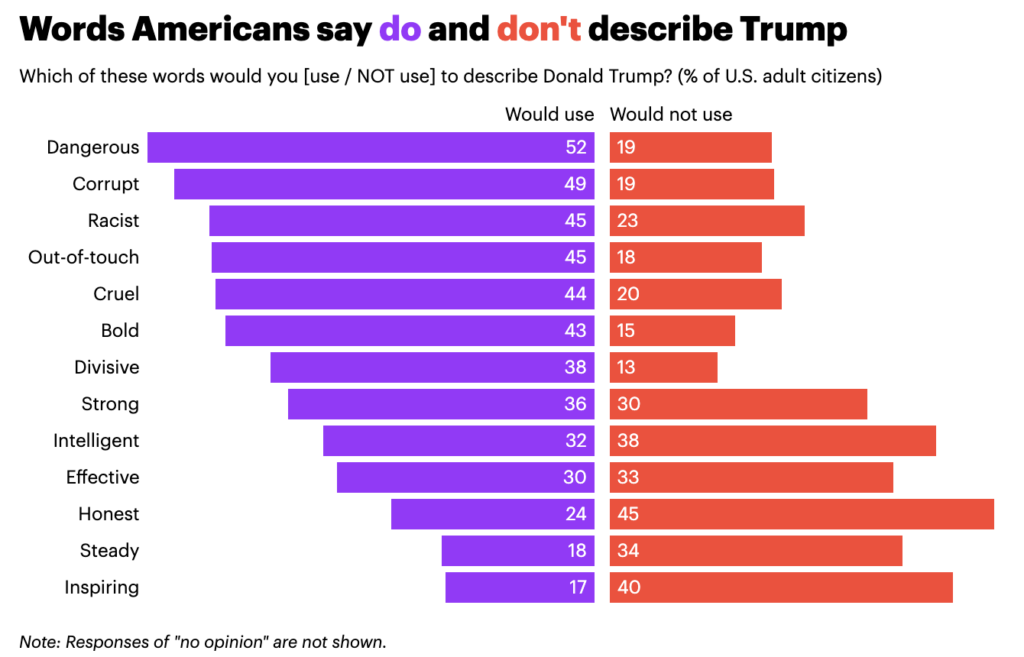
Overall, 52 percent of Americans said “dangerous” when asked which word they would use to describe the president. Forty-nine percent used “corrupt,” and 45 percent used “racist” and “out-of-touch” to describe Trump.
Other negative descriptors also registered strongly: 44 percent chose “cruel,” 43 percent chose “bold,” and 38 percent selected “divisive.”
A word like “dangerous” crossing the 50-percent threshold among all U.S. adults, not just partisan opponents, is a signal that cuts across the normal noise of political polling. The fact that 49 percent simultaneously chose “corrupt” suggests the concern is not limited to perceived temperament. It extends to questions about conduct and institutional integrity.
The Positive Descriptors: A Partisan Floor
The poll’s findings were not uniformly negative. There were also 45 percent of Americans who used the word “honest,” 40 percent who used the word “inspiring,” and 38 percent who used the word “intelligent” to describe Trump.
Generally, it was Republicans who used favorable words and Democrats who used unfavorable words to describe Trump. That pattern explains how a president who draws “dangerous” from 52 percent of the country can simultaneously draw “honest” from 45 percent. Those two groups are largely not the same people. The favorable-word bloc is almost entirely composed of Republican respondents, whose support for Trump has remained durable even as his broader approval slides.
Democrats and Republicans generally use very different words to describe Trump, and the scale of that divergence is notable. A 74-point gap on the word “dangerous” (86% Democrats vs. 12% Republicans) reflects a degree of perceptual polarization that goes beyond ordinary partisan disagreement. Two large segments of the American electorate are looking at the same president and arriving at almost diametrically opposed conclusions about what kind of person he is.
Trump’s Approval Rating: Where It Stands in July 2026
The word-descriptor data sits within a wider approval landscape that, for Trump, is near the worst of his political career. The latest Economist/YouGov poll shows that 36% of Americans strongly or somewhat approve of Trump’s job performance, with 60% disapproving. That net job approval of -24 is near the lowest Trump has recorded in his second term, and below both the lowest net approval of Trump in his first term and the lowest recorded for Joe Biden during his term.
Multiple polls released in the same week corroborate the Economist/YouGov figures, suggesting this is not a methodological outlier. The CNBC All-America Economic Survey, conducted July 8-12 among 1,000 voters, showed a 40% approval rating and 59% disapproval rating, with Trump’s approval rating on the economy at 38% to 60% disapproval – his worst marks on the economy of his political career in CNBC polling.
A Washington Post/Ipsos poll conducted July 8-13 among 2,648 U.S. adults showed a 37% approval rating and 61% disapproval rating, consistent with the April figures.
The CNBC survey also found 61% of respondents are pessimistic about the state of the economy and outlook for the future, the highest percentage since December 2023.
Across three major polling organizations using different methodologies and sample populations, Trump’s approval is tracking in the same narrow and deeply negative band, ranging from 36 to 40 percent approval against disapproval figures consistently above 59 percent.
Historical Context: Lower Than Biden, Lower Than His Own First Term
The depth of Trump’s current unpopularity is made clearer by comparison. His net job approval of -24 is below both the lowest net approval recorded during Trump’s first term and the lowest recorded for Joe Biden. Biden’s approval numbers were widely described as catastrophic during his final years in office. Trump’s second-term numbers, in July 2026, are worse than Biden’s worst recorded figure.
Trump’s net approval among men has fallen to -22, also the lowest in either of his terms. Male voters, particularly non-college men, were a pillar of Trump’s electoral coalition in 2024. Erosion in that group signals something beyond the expected partisan skew of his opposition.
For more on how Trump’s second-term numbers compare to presidential approval patterns, see this analysis at The Hearty Soul on 2026 polling.
Issue-by-Issue Disapproval: Immigration and Race Relations
The word-choice poll included issue-level approval data that sharpens the picture further. Immigration, the issue Trump ran on most aggressively, has not translated into broad public endorsement.
Fifty-four percent of Americans disapprove of Trump’s handling of immigration, while just 39 percent approve. Fifty-four percent of respondents also disapproved of Trump’s handling of race relations, while 32 percent approved.
On crime, Trump fared somewhat better, but 49 percent still disapproved of his handling of the matter while 41 percent approved.
On race relations, the 22-point disapproval gap is especially stark, and it maps directly onto the 45 percent of Americans who chose “racist” as a word to describe the president in the same poll.
The immigration figure deserves separate attention. Trump’s second term began with aggressive enforcement actions, including the expansion of deportation programs and the deployment of federal immigration agents in ways that drew national controversy. Despite the visibility of those actions – or perhaps because of it – only 39 percent of Americans say they approve of how he is handling it.
The Partisan Architecture of Public Perception
A Reuters/Ipsos poll conducted around the same period found 83% of Republicans approving of Trump’s job performance, with just 3% of Democrats approving. About one-third of independents approved.
That partisan ceiling and floor are doing most of the arithmetic work in the aggregate numbers. Trump’s 36 to 40 percent overall approval is essentially a reflection of near-universal Republican support combined with near-zero Democratic support, with independents providing the swing. The independent approval figure, sitting around one-third, is politically decisive. Independent approval of Trump has been tracked by polling analysts at 34 percent, which is below the 36 percent level that preceded Democrats’ 41-seat gain in the 2018 midterms.
Republicans drive the favorable descriptors (“honest,” “inspiring,” “intelligent”), while Democrats overwhelmingly select the negative ones (“dangerous,” “corrupt,” “racist”). The aggregate percentage for each word reflects the combined size of those partisan camps plus however many independents land on each side.
What the Midterm Backdrop Adds
With Trump unpopular, his Republican Party is trailing in Americans’ intended House vote. When choosing between unnamed Democratic and Republican candidates, registered voters prefer the Democrat by 6 points (46% to 41%).
The CNBC survey found that 61 percent of the public is pessimistic about the current state of the economy. Micah Roberts, a partner at Public Opinion Strategies who serves as the Republican pollster for the CNBC All-America Economic Survey, told CNBC that “more voters expect things to get worse by a 41/29% margin, leaving the electorate in a distinctly sour mood heading into the midterm election cycle.”
In response to higher prices, 47 percent of respondents reported cutting back on essential items such as food and medical care, up 6 percentage points from the April survey. Two-thirds said they are reducing purchases of nonessentials, also up 5 points from the prior poll.
Historical patterns in presidential approval suggest that presidents whose net approval falls below -20 for a sustained period face severe headwinds in midterm elections. Trump is now at -24 in Economist/YouGov data and -22 in CNBC polling. The convergence of those figures across pollsters with different methodologies strengthens the case that this is a real signal, not a house-effect artifact.
What This Means for November
The July 2026 polling data presents a cohesive picture across multiple polling organizations. A majority of Americans use the word “dangerous” to describe the president. Nearly half choose “corrupt.” His overall job approval sits between 36 and 40 percent depending on the pollster, with disapproval consistently above 59 percent. His net approval of -24 in Economist/YouGov data is below Biden’s recorded low, below Trump’s own first-term low, and below the threshold that has historically preceded significant midterm losses.
The partisan divide in word choice is extreme: an 86-to-12 split on “dangerous” between Democrats and Republicans, and a 76-to-6 split on “strong” going the other direction. Independents are the population that will determine how this translates into electoral outcomes, and their approval of Trump currently sits around one-third. On immigration, Trump’s signature policy, 54 percent disapprove. On race relations, 54 percent disapprove. On the economy, 60 percent disapprove of his handling in CNBC data. The breadth of that disapproval, sustained across issues, pollsters, and demographic groups, is the defining feature of Trump’s approval standing heading into the second half of 2026.
AI Disclaimer: This article was created with the assistance of AI tools and reviewed by a human editor.