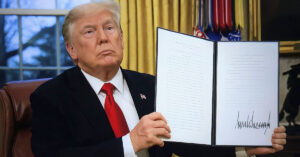

OpenAI CEO Sam Altman first floated the idea of the U.S. government taking an equity stake in his company in a direct conversation with Donald Trump in early 2025. Nobody announced it. No executive order followed. The concept circulated quietly in private conversations between one of Silicon Valley’s most powerful figures and the White House, while the rest of the country had no idea it was on the table. Now, just over a year later, it’s become one of the most politically charged ideas in Washington.
Trump told reporters that the AI industry is generating so much wealth that “there are concepts where pieces could be given to the American public, where the American public essentially becomes a partner.” That framing, populist and deliberately vague, landed at an unusual moment. For the first time since AI went mainstream, politicians on both the left and right are converging on the same question: if artificial intelligence is going to generate historic levels of wealth while disrupting the jobs of millions of Americans, who exactly should own a piece of it?
The answer coming out of Washington right now is “everyone.” The specifics, though, are where things fracture. The version being discussed at the White House looks nothing like the version introduced by Senator Bernie Sanders in the Senate. And both of those look different from what OpenAI itself has put on the table. What they share is a premise, one that has surprising backing from across the political spectrum: AI profit sharing, in some form, is no longer a fringe idea.
The OpenAI Proposal: A 5% Stake Worth $42.6 Billion
OpenAI, the creator of ChatGPT, is reportedly in discussions about handing the Trump administration a 5% stake in the company, with the proposal potentially extending to other U.S. AI companies offering the government similar stakes. The dollar figure attached to that stake is not hypothetical. A 5% share in OpenAI would be worth about $42.6 billion, based on a funding round in March 2026 that valued the company at $852 billion.
Under the proposals discussed with officials, Altman and other OpenAI executives have suggested that America’s leading AI companies allot 5% of their equity to a vehicle similar to the Alaska Permanent Fund, a sovereign fund that invests the state’s oil wealth into stocks and pays dividends to the state government. OpenAI had been building toward this publicly for months. In April 2026, OpenAI argued for a “public wealth fund” that “provides every citizen, including those not invested in financial markets, with a stake in AI-driven economic growth.”
Altman first pitched the concept directly to President Trump in early 2025 and has since discussed it again with senior administration officials as a way to more broadly distribute the economic benefits of AI to the public. The political logic is straightforward. The framing is populist: if artificial intelligence generates enormous wealth and simultaneously eliminates jobs, the government wants a mechanism so the public shares in the upside rather than absorbing only the downside.
The precedent Trump’s team is pointing to isn’t hypothetical either. In August 2025, the U.S. government took a 10% stake in chipmaker Intel, an investment worth $8.9 billion, largely by converting CHIPS Act grants into equity. That deal gave the administration a working template – a passive ownership stake in a major technology company, achieved without legislation, and without nationalizing anything.
Sanders’ Proposal: A $7 Trillion Sovereign Wealth Fund
Where the Trump-OpenAI conversations involve a 5% voluntary stake, Senator Bernie Sanders has proposed something on an entirely different scale. The legislation would give the public a direct ownership stake in the largest AI companies in America through a one-time 50% tax on their stock. Under the bill, firms crossing the $200 million annual AI revenue threshold would be required to hand over half their shares to a new federally managed fund, with Sanders pegging the total value of the resulting fund at approximately $7 trillion.
The distributions would flow directly to Americans. The bill would authorize annual appropriations from the fund of 5% of the stocks’ average market value, with Sanders estimating that initial annual dividends would be about $1,000 per person. Oversight would fall to an independent, seven-person commission whose members would go through presidential nomination and Senate confirmation, wielding the fund’s voting shares to push back against corporate actions seen as harmful to ordinary Americans.
The ideological distance between Sanders’ bill and Trump’s conversations is wide. A 9.9% passive Intel-style stake can plausibly be sold as capitalism with a national-interest twist. A 50% controlling position is, by any conventional definition, partial nationalization of the most dynamic sector of the U.S. economy. The bill is unlikely to become law under Republican control of Congress, but the idea of creating a system for the public to benefit from AI profits has supporters within the industry and on both sides of the political spectrum.
Sanders himself drew a sharp distinction between his proposal and what he sees as the administration’s more accommodating approach. He said that those sympathetic to a softer version are essentially saying: “Okay, look, we’re making zillions of dollars, so we’re going to be nice guys, and maybe we’ll buy off the public.”
Why Americans Are Skeptical of AI Right Now
The political momentum behind AI profit-sharing ideas doesn’t exist in a vacuum. A March 2026 Quinnipiac University poll found that 55% of Americans think AI will do more harm than good in their day-to-day lives, an 11-point increase since April 2025. That skepticism is grounded in something concrete.
According to Challenger, Gray & Christmas, nearly 55,000 job cuts were directly attributed to AI through all of 2025, and the technology sector had already cut over 123,000 jobs in 2026 through late May, with AI cited as the leading reason. Companies including Meta, Cloudflare, and Cisco have explicitly linked workforce reductions to AI investment. A 2025 Stanford Digital Economy Lab study found that software developer employment for workers aged 22 to 25 has fallen roughly 20% from its 2024 peak, with early-career workers in AI-exposed roles showing a 13% relative employment decline since late 2022.
The costs of AI infrastructure are also landing on household electricity bills in a way that wasn’t anticipated even two years ago. Research from the Carnegie Mellon University Open Energy Outlook Initiative estimates data centers and cryptocurrency mining could raise average U.S. electricity bills by 8% by 2030, with some regional markets in Virginia facing increases exceeding 25%. Public opposition to data center construction has accelerated sharply. A March 2026 Gallup survey found that 71% of Americans oppose building AI data centers in their area, compared to 53% who oppose a local nuclear plant – a level of opposition that has never been reached for nuclear power in over two decades of Gallup tracking.
Public resistance to data centers has intensified rapidly alongside the period during which AI’s real-world costs became visible in monthly utility statements and local planning disputes. For workers worried about AI’s impact on their livelihoods, the AI jobs debate has reached a level of urgency that goes well beyond policy circles.
The Conflict of Interest Nobody Is Talking About
The governance problem at the center of any AI profit-sharing arrangement is one that critics from both sides of the aisle have flagged: a government that owns equity in an AI company has a financial incentive to protect that company’s value, not just regulate it. Nat Purser, a senior policy advocate at Public Knowledge, argued that the public should not “want a situation where the government becomes less willing to impose, or enforce, safety rules because doing so could reduce the value of its own investment.”
The legal mechanism for any AI firm to turn over equity to the government remains unclear and may pose an obstacle to putting the idea into effect. Any deal at the scale OpenAI is discussing would likely require an act of Congress. Getting a bipartisan coalition to agree on the structure of such a fund, its governance, distribution rules, and investment mandate, involves exactly the kind of detail-heavy legislative work that tends to stall in Washington.
On the oversight side, the Trump administration has taken one concrete step. Trump signed an executive order on June 2, 2026, requesting that AI companies voluntarily submit their most powerful models for government review for up to 30 days before public release. The final order reduced the review window from 90 days in an earlier May draft to 30 days. The voluntary nature of the submission process limits its enforceability, but it signals that the administration is at least building a framework around AI oversight as these equity conversations progress.
Read More: Pope Leo XIV Just Issued His Biggest Warning About AI — Here Are 5 Reasons It Matters
What This Means for You
The AI profit-sharing debate is still far from becoming law in any form. The Trump-OpenAI equity discussions are described by sources familiar with them as early-stage conversations, not a signed agreement. Sanders’ bill faces long odds in a Republican-controlled Congress. The details that would determine how much any individual American actually receives, and under what conditions, haven’t been worked out by either side.
The political calculation around AI has shifted in a concrete way. The Trump administration is in talks with AI companies about potentially acquiring a stake in them in order to distribute equity to the American public, moving toward what’s known as “universal basic capital” – the idea of seeding Americans with investment accounts backed by AI company equity. That concept has picked up bipartisan interest precisely because job displacement fears are real, energy costs are rising, and public trust in AI companies is low.
The concrete question to watch is how OpenAI and other major AI firms handle their forthcoming IPO filings. How OpenAI prices its IPO will be the most immediate market signal, and if S-1 filings include provisions for government equity stakes or public benefit obligations, it will reveal exactly how much of the profit-sharing framework has already been baked into any deal. If a public wealth fund is created and you’re a U.S. resident, you may eventually be eligible to participate. If the filings contain no such provisions, that absence tells you just as much about where the money is actually expected to go.
Disclaimer: This information is not intended to be a substitute for professional financial advice, investment advice, tax advice, or legal advice, and is provided for informational purposes only. Always seek the guidance of a qualified financial advisor, accountant, or other licensed professional regarding your personal financial situation or investment decisions. Do not make financial, investment, or tax decisions based solely on information presented here. Past performance is not indicative of future results, and all investments carry risk, including the potential loss of principal.
AI Disclaimer: This article was created with the assistance of AI tools and reviewed by a human editor.