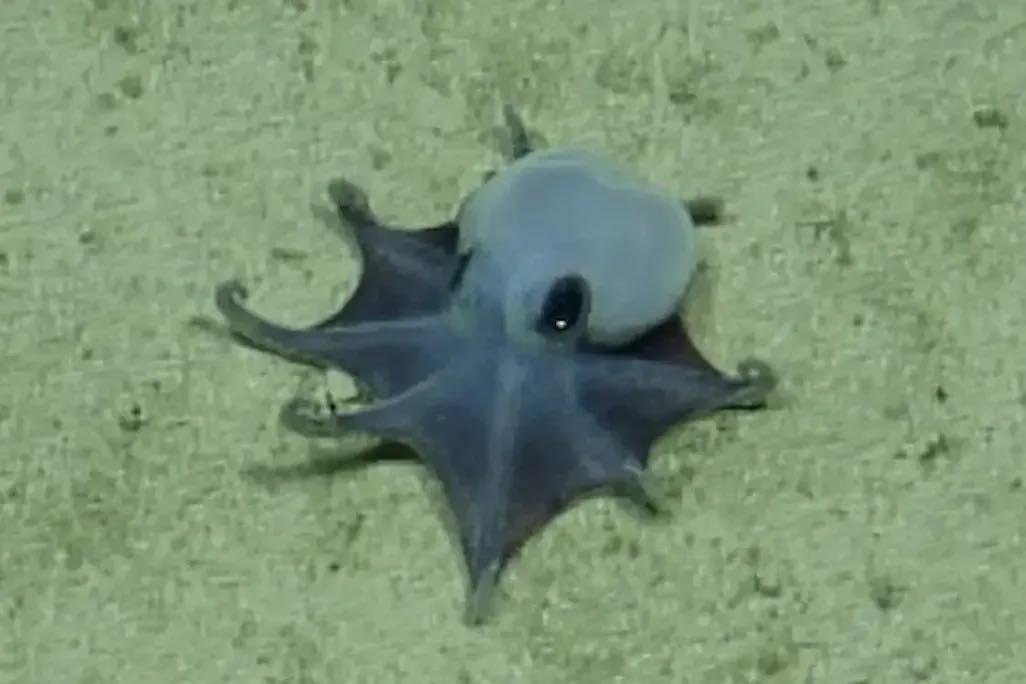

A remotely operated robot was crawling along the ocean floor near Darwin Island in the Galápagos in 2015 when it picked up something on camera: a small blue blob, barely golf-ball-sized, shuffling through the sediment with its arms curled upward like a boxer’s fists. The crew watching the feed had no idea what they were looking at. Neither, it turned out, did anyone else for nearly a decade.
That creature was a blue deep-sea octopus unlike anything previously described by science. In a study published in the journal Zootaxa in 2026, Janet Voight, curator emerita of invertebrates at the Field Museum in Chicago, identified the animal as a previously unknown species: Microeledone galapagensis. The name ties the creature to where it was found, and almost everything else about it defies what scientists thought they knew.
Paperwork and logistics delayed the research process for years after the E/V Nautilus crew first collected the specimen in collaboration with the Charles Darwin Foundation and the Galápagos National Park Directorate. The octopus didn’t even arrive at the Field Museum until 2022. From there, researchers had to figure out what they were dealing with using methods that hadn’t existed when the animal was first filmed. Here are six remarkable facts about this newly discovered species that explain why scientists are so excited.
6 Remarkable facts about this newly discovered octopus species
1. It Lives Nearly a Mile Below the Ocean Surface
Scientists were moving a remotely operated vehicle (ROV) along the seafloor, 5,800 feet (1,773 meters) below the water’s surface, when the camera picked up movement near an underwater mountain close to Darwin Island. That’s not merely “deep” in the casual sense. At that depth, no sunlight penetrates, pressure is crushing, and temperatures hover just above freezing.
The octopod fauna of the deep tropical Pacific Ocean remains poorly known, as is the octopod family Megaleledonidae. The Galápagos is famous worldwide for its biodiversity on land and in shallow waters, but the deep-sea zone below a thousand meters there remains almost entirely uncharted. This discovery is a direct result of the E/V Nautilus expedition giving researchers a rare look at that unexplored territory.
The depth also explains part of why identifying the specimen took so long. Sending a vehicle back to that precise spot on the ocean floor to collect a second specimen is extraordinarily difficult. Scientists had one animal to work with, and they had to make the most of it without destroying it in the process.
2. It’s About the Size of a Golf Ball, Making It the Tiniest in Its Family
The new species stands out for reasons other than its blue hue. The octopus appears to be the runt of the Megaleledonidae family, whose members are normally much larger and live in the Southern Ocean surrounding Antarctica. Finding a tiny member of this family near the equator wasn’t just unusual – it broke the rules scientists had written for the group.
The Megaleledonidae had long been defined as a family of large-bodied octopuses living exclusively in the cold, remote waters of the Southern Ocean. The newly described member of the family, named Microeledone galapagensis, fits neither description. Its small, compact body and short arms put it in a completely different physical category from its Antarctic relatives.
The species is very small and was found in extremely deep tropical Pacific waters near the equator. Researchers now believe the Megaleledonidae family is likely much more widely spread throughout the planet’s oceans than previously thought. A single golf ball-sized creature quietly rewrote the geography of an entire family of octopuses.
3. Its Blue Color Is Considered the Rarest in Nature
The new species stands out for its blue hue, which is believed to be the rarest color in nature. Blue pigmentation in animals is genuinely uncommon – most blue appearances in birds, butterflies, and fish are optical effects created by microscopic structures rather than true pigment. A true blue-bodied cephalopod (the group that includes octopuses, squid, and cuttlefish) is exceptional.
The animal’s two-tone coloration divides it neatly into two zones: a light blue back and a very deep purple underside. The pattern has a specific name – reverse countershading – and scientists believe it functions as active camouflage tailored to the pitch-black, bioluminescent environment the animal hunts in. That visibility to the ROV camera was, in hindsight, both lucky and ironic: the same coloring that caught researchers’ attention may help the animal stay invisible to its prey.
4. Its Reverse Countershading Is a Hunting blue deep-sea octopus Weapon
Most ocean animals use standard countershading – dark on top, pale on the belly – to blend in from both above and below. Microeledone galapagensis does the opposite, and the reason connects directly to what it eats.
Many organisms in the deep ocean produce their own light through bioluminescence – a chemical reaction that creates a faint glow. When a predator approaches glowing prey from below, a dark-bellied hunter blends into the surrounding darkness rather than creating a silhouette. The light blue back, meanwhile, mimics the faint downwelling light from above, making the octopus harder to spot from below as well.
This kind of color adaptation at depth is rare to document because collecting live or freshly preserved deep-sea specimens is so technically demanding. The coloring observed on this single preserved female may represent a broader pattern across the species, though researchers will need additional specimens to confirm it.
5. It Has One Row of Suckers and No Ink Sac
The structural anatomy of this blue deep-sea octopus is just as unusual as its coloring. Its “stubby little arms with only one row of suckers set it apart from most octopus we are familiar with,” according to Voight. Most well-known octopus species have two rows of suckers running the length of their arms, which provide gripping strength for catching prey and moving across surfaces. A single row is a significant anatomical departure.
Microeledones are small octopuses with a single row of suckers and no ink sac. The absence of an ink sac is equally notable. For shallow-water octopuses, the ability to eject a cloud of ink to confuse predators and escape is a primary defense mechanism. At 1,773 meters depth, in near-total darkness, that defense becomes largely pointless – there’s no visual predator to blind, and no ambient light to disrupt with a dark cloud.
The animal’s smooth skin, large rachidian tooth (a central biting tooth), and large funnel organ distinguished it from closely related genera, while its lack of an ink sac, crop diverticulum (a digestive pouch), and anal flaps complicated its precise classification within the Megaleledonidae family. These features were simultaneously what made it hard to classify and what ultimately confirmed it as a new species.
6. Scientists Used CT Scanning to Study It Without Cutting It Open
Describing a new octopus species typically requires dissection. To formally establish that an animal is a new species, taxonomists (scientists who classify living things) must examine internal structures including the beak, teeth, organs, and musculature. With only one specimen in hand, Voight refused to cut it apart.
Because securing a second specimen in the deep sea is extraordinarily difficult, the biologists turned to micro-computed tomography to peer inside the animal without cutting it open. “When you describe a new species of octopus, you have to look at all the parts, including the mouth, the beak, and the teeth. And to see those things, you have to cut the specimen open. We only had the one specimen, so I didn’t want to take it apart,” Voight said.
The team examined the octopus’s internal organs using micro-CT scanning, a technique that collects thousands of X-ray image slices of an object and assembles them into a super-high-resolution virtual model. Stephanie Smith, manager of the Field Museum’s X-ray computed tomography laboratory, helped create the highly detailed scans. The result was a complete three-dimensional picture of the animal’s insides, with no damage to the only physical specimen in existence.
Details of the octopus – including the relatively few suckers on its arms, its smooth skin, beak features, and the coloring around its organs and parts of the mantle – indicated a new species, now called Microeledone galapagensis. The team also found that the mature female had 13 eggs in its ovaries. Those eggs suggest the animal had not yet reproduced, adding another layer of significance to the single preserved specimen: it represents both a new species and a glimpse into its reproductive biology.
Read More: Deep-Sea Creature Older Than Dinosaurs Caught on Camera
What This Discovery Means for Ocean Science
Beyond the species itself, this discovery marks a significant personal milestone: it’s the first new octopus species that Voight has officially led a team of scientists in describing, in her four-decade career studying octopus evolution. That fact alone speaks to how rarely these moments occur, even for the most dedicated researchers in the field.
The discovery also carries direct implications for how the Megaleledonidae family is defined. Prior to this description, the family had been characterized as consisting of large-bodied animals endemic to the cold, deep waters of the Southern Ocean. M. galapagensis, collected near the equator, challenged that characterization entirely, leading the authors to revise the family diagnosis to focus on morphology rather than geographic distribution. Scientists had to update the textbook definition of an entire family of animals based on one tiny blue creature.
According to Salome Buglass, a marine scientist and co-author of the study who has conducted research with the Charles Darwin Foundation, the find reflects how little is known about deep-sea ecosystems in the region. “Discoveries like these remind us how much of the deep ocean in Galápagos remains unexplored,” she said. The tools exist to look – ROVs, micro-CT scanners, deep-sea sampling equipment – but the expeditions to use them are expensive, logistically complex, and still far too infrequent. Microeledone galapagensis spent over a decade waiting to be identified. There is no telling how many more discoveries are already sitting in sample jars, or still crawling across the seafloor, unseen.
AI Disclaimer: This article was created with the assistance of AI tools and reviewed by a human editor.
Lead Image Credit: Charles Darwin Foundation
Read More: Scientists Stunned by Discovery of Unique Golden Shark in Costa Rica