Scientists Discover a Hidden Coral World Beneath the Ocean — Nearly the Size of Vatican City
Scientists had been searching for cold seeps, the methane-leaking cracks in the seafloor, when their remotely operated vehicle’s cameras swept across something no one on the mission had expected: a living coral city stretching further across the seafloor than they could measure in a single dive. The reef wasn’t a modest cluster of organisms. Covering at least 0.4 square kilometers, the Bathelia reef is nearly the size of Vatican City. The species building it, Bathelia candida, had been known to science. What nobody knew was how far it had spread, or how much of Argentina’s continental shelf it occupied.
Bathelia candida has been documented throughout the Southwestern Atlantic Ocean, with the largest patches off the coast of Argentina, but scientists hadn’t understood its extent until this expedition. The team found Bathelia reefs 600 kilometers (373 miles) further south than its known range, at 43.5° latitude. That’s not a minor range extension. A 600-kilometer southward leap rewrites the distribution maps for an entire species and suggests the South Atlantic harbors ecosystems that decades of marine science had simply missed.
The scientists leading the work described their own surprise openly. “We were not expecting to see this level of biodiversity in the Argentine deep sea, and are so excited to see it teeming with life,” said the expedition’s chief scientist, Dr. María Emilia Bravo of the University of Buenos Aires and CONICET. “Seeing all the biodiversity, ecosystem functions, and connectivity unfolding together was incredible. We opened a window into our country’s biodiversity only to find there are so many more windows left to be opened.”
The Expedition: Two Voyages, One Transformative Deep Sea Coral Discovery
Over the course of two expeditions aboard the research vessel R/V Falkor (too), operated by the Schmidt Ocean Institute – a nonprofit that supports open-access ocean science globally – the science team traveled the entire length of Argentina’s coastline, from Buenos Aires in the north to waters offshore from Tierra del Fuego, documenting the largest known Bathelia candida coral reef in the global ocean, several other rich reef complexes, and 28 suspected new species. The first expedition ran in July 2025, followed by a second from December 2025 through January 2026.
Dr. María Emilia Bravo, a marine biologist who holds a permanent research position at IGeBA (CONICET) and the Faculty of Exact and Natural Sciences at the University of Buenos Aires, led the mission as chief scientist. She specializes in the benthic ecology of invertebrates and pioneered the first discoveries of chemosynthetic ecosystems in Argentina, both in coastal and deep waters. The geographic scale of the survey was itself remarkable – the team explored a previously undocumented cold-water coral reef system along a 900-kilometer (560-mile) stretch of Argentina’s continental margin.
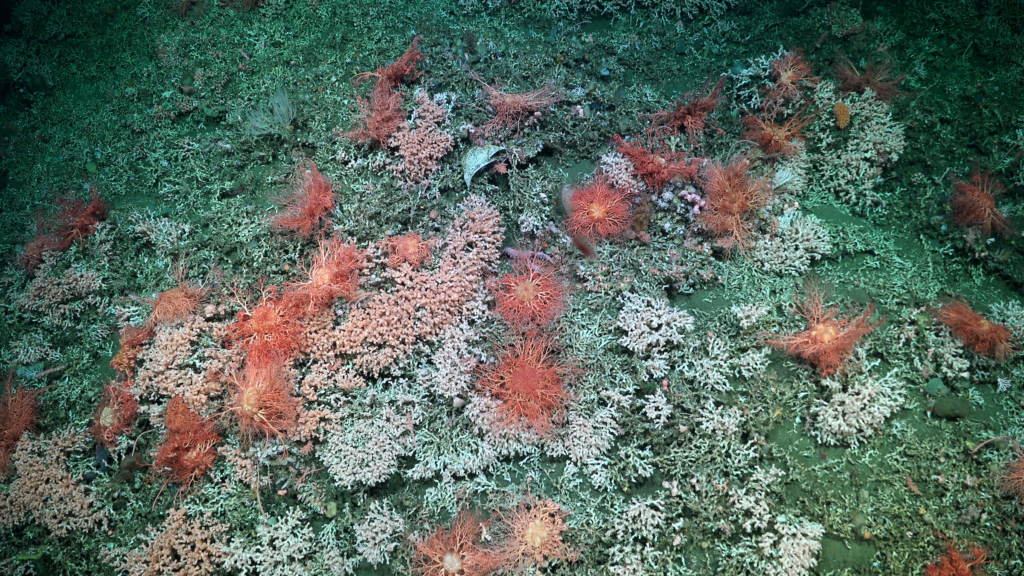
Deep-sea corals grow slowly and support rich marine ecosystems, making them vulnerable to threats such as bottom trawling. Here you see red and pink basket stars (Gorgonocephalus chilensis) sit atop white hard corals (Bathelia candida and Solenosmilia spp.), with both feeding on tiny particles and organisms carried by ocean currents. Image Credit: ROV SuBastian / Schmidt Ocean Institute
Erik Cordes, professor and chair of the Department of Biology at Temple University, and PhD candidate Morgan Will are part of a deep-sea research project in Argentina focused on discovering and restoring largely unknown cold-water coral reefs. Cordes had spent years studying cold-water reefs, but even his experience didn’t prepare him for what the cameras revealed. “It still amazes me when we can discover something this size still on our planet,” Cordes said. “It goes to show you how much more mapping there is to be done.”
Santiago Herrera, an Associate Professor in the Department of Biological Sciences at Lehigh University and Research Associate at the Smithsonian National Museum of Natural History, specializes in deep-sea biology, molecular ecology, and environmental DNA (eDNA) technology. He led the environmental DNA sampling during the July expedition to obtain an overall view of biodiversity in the ecosystem. His account of what he saw on the seafloor is worth reading alongside the satellite data. “I’ve never seen such a lush environment,” Herrera said. “There’s so much life, and it’s so abundant that you can lose perspective on where you are. A kilometer deep in the South Atlantic, if you didn’t know any better, you could picture being somewhere tropical.”
The research vessels were equipped with cameras that live-streamed videos of the seafloor to YouTube and Twitch, and the expedition captured the attention of millions with live video feeds from the deep seafloor. Over three weeks, nearly 4 million people tuned in to watch it unfold from their homes, classrooms, grocery stores, bars, and gyms. At its peak, the summer 2025 live stream had more than 92,000 simultaneous viewers, and it won a Martín Fierro Award, an Argentine award similar to an Emmy, for best video stream.
Bathelia candida: A Cold-Water Coral Most People Have Never Heard Of
Most people picture warm, sunlit shallows when they think of coral reefs. Unlike tropical reefs, deep-sea corals live from 150 feet to more than 10,000 feet below sea level, where sunlight is dim to nonexistent. They don’t depend on photosynthesis at all. Deep-sea coral colonies live in complete darkness, filter-feeding on detritus that falls from the surface rather than on the sugars produced by symbiotic plants, and many form huge mounds at the bottom of the ocean.
The reef discovered off Argentina is composed of the rare coral species Bathelia candida, a stony coral with soft tissue that appears pink, orange, or white. Most cold-water coral reefs in the Atlantic are typically dominated by Lophelia pertusa. The dominance of Bathelia at this site makes it scientifically distinct from nearly every other known Atlantic reef system.
Deep-sea corals are slow-growing and long-lived, often classified as Vulnerable Marine Ecosystems, or VMEs, because they support high biodiversity and are threatened by human activities such as bottom trawling. Some specimens have been found to be thousands of years old. Deep-sea coral species can grow just a few millimeters a year, compared to our fingernails that grow 2 to 3 millimeters a month. The reef off Argentina, spanning nearly the footprint of Vatican City, may have been accumulating for centuries or longer.
Recognized as a VME indicator species, Bathelia candida has been documented throughout the Southwestern Atlantic Ocean, with the largest patches off the coast of Argentina, but scientists hadn’t understood its extent until this expedition. Under international fisheries governance, VME indicator status triggers obligations to assess and avoid harm, though enforcement in international waters remains inconsistent.
This stony cold-water coral provides habitat for other organisms, such as fish, crustaceans, and octopuses. Besides the corals themselves, the team documented squat lobsters, glass squid, brittle stars, and an array of other species living in the reef system. These reefs are hotspots of biodiversity and play an important role in sequestering carbon from the environment.
28 Suspected New Species and the Organisms Found Among Them
The team documented the largest known Bathelia candida coral reef in the global ocean, several other rich reef complexes, and 28 suspected new species, including worms, corals, sea urchins, sea snails, and sea anemones. The number is provisional. Confirming a new species requires laboratory analysis, genetic sequencing, and peer-reviewed publication. But the sheer count of candidates from a single expedition in a previously understudied region signals how much of the Argentine deep sea remains uncharacterized.
The findings, announced in early February 2026, include sea snails, urchins, anemones, worms, and corals, many of them living within a cold-water reef so vast it rivals the footprint of Vatican City. Each of those candidate species represents a potential chain of ecological dependencies. Unknown species living within VME habitats face a particular conservation problem: they can be wiped out before they’re ever formally described.
According to the Smithsonian Ocean portal, scientists have discovered more species of deep-sea corals than shallow-water species. Scientists have identified more than 3,500 species of deep-sea corals, and the numbers keep climbing. The Argentine expedition adds a meaningful chapter to that ongoing tally.
The Phantom Jellyfish and a Whale’s Grave
Using ROV SuBastian, Schmidt Ocean Institute’s remotely operated vehicle capable of reaching depths up to 4,500 meters, the team captured images and video of species and coral formations that were previously unknown to science. Among the most striking: footage of a creature that has been formally documented fewer than 130 times in recorded history. The team stumbled upon a rare giant phantom jelly (Stygiomedusa gigantea). These titans of the deep ocean have four long arms that can grow up to 10 metres long, while their bell can reach up to 1 metre in diameter.
People have only spotted giant phantom jellyfish about 120 times since the first specimen was collected in 1899. Their preference for living in the “midnight zone,” depths between 3,000 and 13,100 feet, helps keep them hidden from view.
Giant phantom jellyfish (Stygiomedusa gigantea) differ from most other jellyfish in a key way. They lack stinging tentacles, so they grab prey using their ribbon-like arms and pull it into their mouths. Despite their size, they usually feed on plankton or small fish.
ROV pilots filmed the Stygiomedusa gigantea at 250 meters depth, well above the creature’s typical midnight-zone haunts – an observation that itself may interest researchers tracking vertical movement in deep-sea fauna. Juvenile fish were observed swimming around the jellyfish’s bell during filming, suggesting even rare megafauna serve as mobile habitat in the water column.
Deeper in the same survey area, the expedition made a more somber find. ROV pilots filmed the remains of a deceased whale that had dropped to the seafloor, called a whale fall, at about 3,890 meters deep during a dive. Whale falls serve as temporary ecosystems, providing food for animals including octopuses, sharks, and crabs. The Argentine whale fall, lying nearly four kilometers below the surface, appeared to consist mostly of bones, suggesting the carcass had presumably spent decades on the seafloor.
The scientists also observed ancient Bubblegum coral gardens (Paragorgia arborea) nestled among large sponges in the 3,000-meter-deep Malvinas Trough near Tierra del Fuego. These corals grow at a rate of approximately 1 centimeter a year. As colonies exceed 1 metre in height, it indicates they are likely hundreds of years old.
Cold Seeps: The Mission’s Original Target
The team’s primary goal was to locate cold seeps, deep-sea environments where methane and other chemicals released from the seafloor serve as energy for microbes, which provide sustenance for animals like clams, mussels, and tube worms. Cold seeps are powered not by sunlight but by chemical energy – a process called chemosynthesis. Bacteria consume methane and hydrogen sulfide rising from the seafloor, forming the base of a food web that sustains complex animal communities entirely independent of the sun.
The team found one active seep measuring 1 square kilometer – twice the size of the Bathelia reef – which included a large patch of chemosynthetic clams. Scientific understanding of how cold seeps and deep-sea coral reefs interact is still in its early stages, said Bravo. The Argentine expedition documented both habitat types in the same geographic corridor, creating a rare opportunity to study how they relate.
Even in these remote depths, researchers found traces of human activity: fishing gear, plastic debris, and a Korean-labeled VHS tape preserved by the cold, high-pressure environment. The VHS tape, intact and readable after what may have been decades on the seafloor, is a striking reminder of how far human waste travels and how long it persists.
The threat from bottom trawling is the most immediate. Even a single pass of a bottom trawl can flatten centuries of growth. Cold-water corals in the Argentine Exclusive Economic Zone face significant threats from climate change, ocean acidification, and the increasing industrialization of the deep ocean. Human activities such as offshore energy development, deep-sea mining, and pollution are encroaching on these fragile ecosystems.
Hard corals in Alaska have been dated to be hundreds to thousands of years old, and radiocarbon dating on the oldest known deep-sea corals indicates they are 4,200 years in age. These pillars of the ecosystem can be destroyed by one swipe of a bottom trawl.
The full geographic extent of deep-sea corals is far from known because we have mapped less than 0.05 percent of the seafloor. That figure puts the Argentine discovery in sharp relief: the reef was found on a margin that had never been formally surveyed. Comparable reef systems could exist along thousands of kilometers of other continental shelves that no ROV has yet reached.
Restoration Efforts Already Underway
The science team didn’t wait for formal publication before attempting to protect what they’d found. Researchers are testing restoration techniques, including the installation of 3D-printed “artificial corals,” which they hope will encourage the rapid growth of new corals.
They made artificial corals out of concrete and aragonite, which together create a structure akin to corals’ skeletons. The hope is that living corals, the tiny polyp-shaped creatures that grow in colonies within these skeletons, will populate the artificial structures. “People just haven’t really done this in the deep sea, and so we’re sort of making it up as we go along, borrowing a lot of ideas from shallow-water coral restoration,” said Erik Cordes.
Researchers are planning a future expedition to check on the artificial corals placed off the coast of Argentina, and they hope to explore more of the massive reef system. “We now think Argentina is home to one of the largest reef systems on earth,” said Cordes, noting that a year ago the reef’s scale was essentially unknown. Scientists also acknowledge that restoration at this depth is far harder than prevention. Daniel Lauretta, chief scientist at Schmidt Ocean Institute, said: “We still have a chance to do conservation instead of restoration. This is crucial because it’s much easier and simpler to protect rather than to restore, especially in the deep sea.”
The Argentine deep sea coral discovery is not a single isolated finding. It’s a correction. For decades, scientists worked from maps of the ocean floor that were less detailed than the surface of Mars. The Bathelia reef, spanning an area comparable to Vatican City and lying 600 kilometers south of where the species was thought to exist, was always there. The tools to find it simply weren’t deployed.
The reef spans at least 0.4 square kilometers and represents the largest known colony of Bathelia candida anywhere in the global ocean. The team also found Bathelia growing roughly 600 kilometers further south than its previously documented range, extending to 43.5° latitude. The 28 candidate new species collected from the same corridor will require years of laboratory work to fully describe. Some may yield compounds with pharmaceutical or industrial applications. Others will fill gaps in evolutionary biology.
The reef currently has no formal protected status. Researchers found signs of human impact, including fishing debris and possible trawling damage, and worry the reef area might also be targeted for oil and gas exploration. The pace of that threat moves faster than the growth rate of the corals it would destroy. A fishing net that crosses the Argentine reef in an afternoon could undo millennia of biological accumulation.
Data collected during these expeditions constitute a regional baseline for managing resources and monitoring the impacts of industrial activities and climate change. What was found along 900 kilometers of Argentina’s coast – a reef the size of a city-state, a whale fall four kilometers down, 28 animals new to science, and one of the rarest jellyfish on Earth – was found by a single expedition looking for something else entirely. The ocean’s inventory of undiscovered life is, by every current measure, enormous.
AI Disclaimer: This article was created with the assistance of AI tools and reviewed by a human editor.