
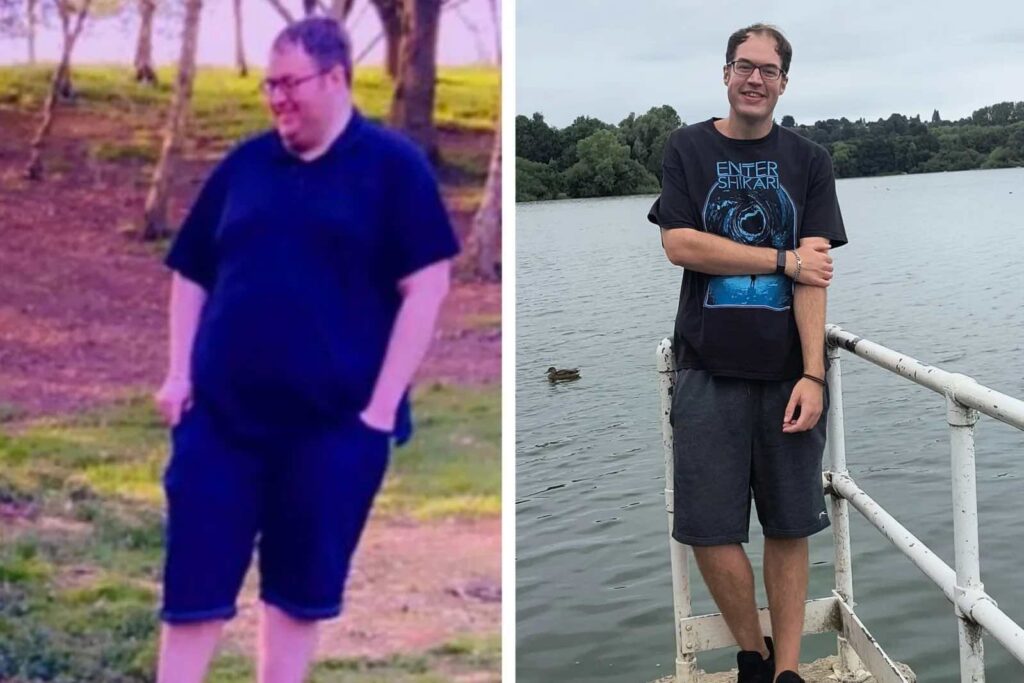
Anthony Piccaver wore through 22 pairs of sneakers before he lost 240 pounds. He didn’t run a single mile in them.
The 34-year-old retail worker from Nottingham, England, once weighed 467 pounds. Today he weighs 224. He described the journey simply: “I’ve lost over half my body weight and managed to bounce back.” No surgery, no crash diet, no gym membership. Just walking, an activity so ordinary that most people don’t count it as exercise at all. For Piccaver, it became the one daily habit weight loss researchers increasingly say may be more powerful than people give it credit for.
Unable to get a lift to a local coffee shop one day, he decided to walk instead, covering a single mile for a favorite drink that soon became four. That small inconvenience turned into a target of 10,000 steps a day. Before long, he was averaging 30,000 steps or more daily. Over the two years that followed, he logged more than 16 million steps, nearly 13,000 kilometers, and worn through 22 pairs of trainers. In one month alone, he completed 974,980 steps.
The Health Problem Walking Had to Overcome
Before his walking habit took hold, Piccaver’s body was working against him in ways he didn’t yet understand. He lost his job and his housing while making repeated trips to doctors complaining of constant fatigue, until doctors eventually diagnosed him with sleep apnea in 2017. He described the period bluntly: unable to do anything without falling asleep, eating for energy, and ballooning in weight as a result.
Sleep apnea, a condition where breathing repeatedly stops and starts during sleep, and obesity feed each other in a damaging loop. In December 2024, the FDA approved the prescription weight-loss drug Zepbound specifically as a treatment for moderate to severe obstructive sleep apnea in adults with obesity, a sign of how tightly the medical community now ties these two conditions together. The physical mechanism is straightforward: excess body fat, especially around the neck and chest, can narrow the airway and make collapse during sleep more likely, according to the American Sleep Apnea Association.
Piccaver was given a CPAP machine, a device that uses continuous air pressure to keep the airway open during sleep. It helped him sleep, but it didn’t address his weight on its own. Research from the University of Arkansas for Medical Sciences suggests the two approaches work better in combination: when obese patients with obstructive sleep apnea combine CPAP treatment with calorie restriction, they see greater absolute weight loss than those who diet without CPAP therapy. Piccaver is still on the machine today, but he is no longer the same man who needed it.
What Walking Actually Does to Your Body
During the lowest period of his life, Piccaver said he was so embarrassed by what had happened that he deactivated all social media and isolated himself from friends. Walking eventually gave him a way back, and not just physically. The mental shift it triggered matters as much as the calories it burned.
Daily walking helps manage weight by increasing calorie burn and boosting metabolism, with interval walking – alternating between brisk and slower paces – being especially effective at burning calories and reducing body fat, particularly around the midsection. The deeper mechanics go beyond calorie counting. Research from Baylor Scott & White Health shows that walking helps regulate hormones such as cortisol, which can influence where body fat accumulates. Chronically elevated cortisol, the body’s primary stress hormone, is directly linked to visceral fat storage, the kind of fat that sits around the organs and drives up metabolic risk. Walking keeps that system in check.
The cardiovascular gains are concrete. According to the CDC, for adults younger than 60, the risk of premature death levels off at around 8,000 to 10,000 steps per day, and for adults 60 and older, that threshold falls to roughly 6,000 to 8,000 steps. Even falling short of the higher targets carries real benefits: walking about 7,000 steps a day is linked with significantly lower risk of death and chronic diseases, according to AARP Health. For anyone worried about regaining weight after losing it, which is the far more common outcome, daily walking consistently around 8,500 steps may help prevent that weight creeping back after dieting.
The Mental Health Dimension Most People Miss
Piccaver’s social withdrawal was a symptom of something bigger than embarrassment. Obesity, sleep deprivation, and isolation compound each other. Walking cut through all three at once.
Regular walking physically reshapes the brain, quiets neural circuits driving rumination, and reduces anxiety and depression, according to Neurolaunch. The effect kicks in fast: a 10-minute walk produces measurable reductions in anxiety and improvements in energy and mood. For every 1,000 daily steps added, adults reduce their risk of developing depression by 9 percent, according to NPR.
Piccaver wasn’t following a program. He was just walking, but the neurological effects were accumulating with every mile. Sustaining 150 minutes of moderate-intensity walking per week enables hippocampal growth, the part of the brain involved in memory and mood regulation, along with lasting mood regulation and anxiety reduction, according to the same Neurolaunch research.
Why This Daily Habit Works When Diets Don’t
Most weight loss attempts fail in the long term. Research published in the American Journal of Clinical Nutrition found that only around 20 percent of overweight individuals are successful at long-term weight loss, defined as maintaining at least a 10 percent reduction in body weight beyond one year. Piccaver’s story illustrates why. He didn’t overhaul his diet. Aside from cutting back on chips, he continued enjoying coffee shop drinks and the foods he loved. The walking didn’t feel like punishment, which is precisely why he kept doing it.
Repetition without suffering is what makes walking stick as a daily habit weight loss strategy where structured diets fail. The CDC recommends that adults get at least 150 minutes of moderate-intensity physical activity per week, and walking is the most natural way most people hit it. The barrier to entry is zero: no equipment, no membership, no learning curve. The CDC also notes that walking is the most popular form of aerobic physical activity among American adults for exactly that reason.
Piccaver’s retail job kept him on his feet throughout the workday, and he added to those totals by walking to and from work, taking long weekend routes, and turning casual outings with friends into 20-mile treks. He wasn’t training for anything. He was just making walking the default way he moved through his day. For anyone building a similar routine from scratch, a structured 21-day walking plan can make the first weeks more manageable, starting with just 10 minutes and building gradually from there.
Read More: 15 Things That Happen to Your Body If You Walk Every Day
What This Means for You
Piccaver’s results are extraordinary, but the mechanism behind them isn’t. Every walk he took moved him away from the conditions – high cortisol, poor sleep, social withdrawal, sedentary metabolism – that had locked him into his weight for years. Walking works through accumulation, not intensity, and that is precisely why it outlasts every program built around suffering.
Start with 7,000 steps a day if 10,000 feels like too much. That’s roughly 3.5 miles, and the CDC step-count data and current research both confirm that number alone is enough to significantly cut mortality and chronic disease risk. If you’re working to keep weight off after dieting, push toward 8,500. If you want to protect your cardiovascular system and see meaningful drops in all-cause mortality, 9,000 to 10,000 is the target. The mental health gains begin immediately, even before your step count climbs.
Though Piccaver still relies on his CPAP machine, he says he feels like a different person – someone who has regained confidence and built a strong support system of friends who join him on his long walks. A coffee shop he couldn’t get a ride to turned into more than 16 million steps and half a body weight gone. The daily habit was never the hard part. Starting with one walk was.
Disclaimer: This information is not intended to be a substitute for professional medical advice, diagnosis, or treatment and is for information only. Always seek the advice of your physician or another qualified health provider with any questions about your medical condition and/or current medication. Do not disregard professional medical advice or delay seeking advice or treatment because of something you have read here.
AI Disclaimer: This article was created with the assistance of AI tools and reviewed by a human editor.
Read More: 5 Creatine Myths Debunked by Experts