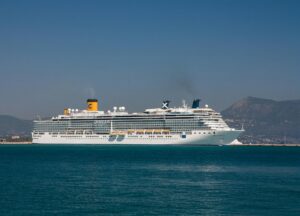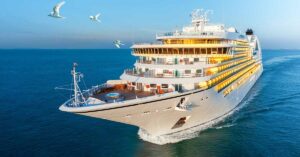

The largest cruise ship currently sailing, Icon of the Seas, stretches about 365 meters. The Freedom Ship floating city would be almost five times that length – and it would never stop moving. Nearly 30 years after the idea first appeared on paper, engineers still haven’t broken ground on anything.
Renewed talks about the Freedom Ship, a proposed “permanently mobile city at sea” designed to house up to 80,000 people and travel continuously around the globe, have reignited interest in the decades-old ambition of floating cities. The project is back in the news in 2026 with fresh momentum behind it – a named construction site, a new CEO, and a design team assembled.
The Freedom Ship was proposed in the late 1990s by engineer Norman Nixon, and the name reflects his vision of a mobile ocean colony free from the property, municipal, or federal laws of any nation state. Nixon’s original sketch was audacious enough. What the current team is proposing is even bigger.
What the Freedom Ship Floating City Would Actually Look Like
A city in the middle of the ocean, home to 80,000 people, with schools, a hospital, a water park, an internal tram system and no permanent port. The company behind the project says the vessel would stretch nearly 1.8 kilometers, making it far larger than any cruise ship currently at sea.
The latest designs describe a structure approximately 1.6 – 1.8 kilometers long – nearly a mile – and up to 250 meters wide, with 25 – 30 decks. According to a June 2026 Euronews report, it would weigh 2.3 million tonnes and stand 30 decks high.
A Newsweek report states the vessel is designed to accommodate 50,000 permanent residents, 10,000 guests and visitors, and 20,000 crew members. Those residents wouldn’t be cramped into berths like cruise passengers. Plans call for schools, colleges, shops, banks, entertainment facilities, green spaces, and an internal tram system connecting different sections of the city. The vessel would host a research hospital, primary-to-college schools, a convention centre, high-rise hotels, a 15,000-seat sports stadium, two museums, a symphony hall, and a water park, along with eight helipads, a tram system, 15 miles of walkways, and three acres of green parks.
“The Freedom Ship is envisioned as a permanently mobile city at sea – designed for long-term residence rather than short-term travel,” the company said. “It is not a cruise ship and not defined by destinations or itineraries.”
The design philosophy has a specific visual intent. CEO Roger Gooch has said the ship “should not be a monolithic piece but visually comfortable, so we softened all the edges,” adding that the team has “gone to great lengths to allow walkways and green spaces.” His quotes appear in a report from The Media Line covering the project’s latest development phase.
Never Docking, Always Moving
The Freedom Ship is designed to remain in international waters and circumnavigate the globe every two years at approximately seven knots. At that speed – roughly the pace of a brisk walk – the vessel would be continuously at sea, looping the planet on a two-year rotation.
Its scale is unprecedented: it cannot dock at standard ports and will rely on smaller ferries and tenders for transfers to land. The design includes eight helipads to handle aerial transfers when tenders aren’t practical.
The ship’s propulsion system is nuclear. The vessel is envisioned as an autonomous urban ecosystem, powered by nuclear energy to operate for extended periods without refueling. Supporters of the project argue that nuclear propulsion could reduce emissions compared with conventional heavy fuel oil shipping. Critics note that regulatory frameworks for nuclear-powered civilian vessels in international waters remain largely uncharted territory.
Developers have also suggested the Freedom Ship could host medical research facilities outside the reach of conventional regulatory bodies – a claim that is likely to attract scrutiny, given the complex legal frameworks governing medical research, patient safety, and international maritime jurisdiction.
The Construction Plan – and the Funding Gap
Roger Gooch, CEO and director of Freedom Cruise Line International, told Newsweek that “a primary construction location has been identified in Indonesia,” noting that the team now has architect and designer Kevin Schopfer and a project manager on board. The hull would be manufactured in sections before being assembled offshore, reflecting both the scale and complexity of the design.
Construction is projected to take up to four years, though Gooch has suggested that initial residents could move aboard while building is still ongoing.
Financing is the central obstacle. The Euronews report estimates the project would cost around £12 billion to bring to fruition. Other estimates run higher: by 2026, some cost projections had risen to US$15 billion, and then up to US$20 billion. No confirmed financing structure exists yet. Gooch has said publicly: “We feel very confident that we can put this together, but capitalization is key.”
Across decades of floating city proposals – from “seasteads” to luxury megayachts – various barriers have prevented these visions from becoming reality, ranging from a lack of investment to regulatory and political challenges involving local opposition and governance concerns, according to the Newsweek report. The Freedom Ship has been officially “revived” multiple times since Nixon’s original 1990s proposal. Each revival has generated press coverage. None has generated a hull.
Why the Idea Keeps Coming Back
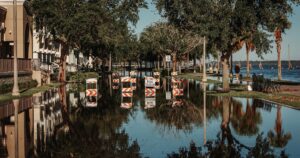
Two out of every five people in the world live within 100 kilometers of the coast, and 90 percent of megacities worldwide are vulnerable to rising sea levels, according to UN-Habitat. The World Economic Forum reports that more than 800 million people, living in 570 cities around the world, could be at risk from sea level rise by 2050 if emissions don’t decrease. A 2024 study found that sea level along US coastlines is projected to rise by 0.25 – 0.3 meters by 2050.
The appeal of floating infrastructure to coastal communities is practical, not philosophical. Floating cities are buoyant and therefore inherently flood-proof – they rise and fall with water levels rather than resisting them. That structural property makes them attractive as climate adaptation tools in ways that seawalls and land reclamation simply cannot match.
Researchers studying floating architecture argue that the biggest challenges will be legal and political – not technological. Who governs a city that spends its time in international waters? Whose laws apply? Who owns the ocean beneath it? These questions don’t have settled answers, and any serious financing effort would require them to be resolved first.
Read More: What to Expect From Our Changing World by 2050
The Projects Already Under Construction
While the Freedom Ship remains in the funding phase, two other floating city projects are materially further along. In April 2022, UN-Habitat, the Busan Metropolitan City of the Republic of Korea, and OCEANIX unveiled at the UN Headquarters the design of the world’s first prototype sustainable floating city. OCEANIX Busan, designed by the Bjarke Ingels Group, differs from the Freedom Ship in almost every meaningful way: it’s anchored near a coast rather than mobile, designed for climate adaptation rather than lifestyle novelty, and built with international institutional backing.
OCEANIX Busan is designed as three interconnected platforms totalling 15.5 acres to initially house a community of 12,000 people. Phase 1 of its construction reportedly broke ground in 2023, and the project was “being implemented off Busan’s shores,” UN-Habitat said in May 2024. OCEANIX Busan has six integrated systems – zero waste, closed-loop water, food, net zero energy, innovative mobility, and coastal habitat regeneration – designed to generate 100% of the required operational energy on site through floating and rooftop photovoltaic panels.
A separate project is under construction in the Indian Ocean. In a turquoise lagoon just 10 minutes by boat from Male, the Maldivian capital, a floating city big enough to house 20,000 people is being constructed, consisting of 5,000 floating units including houses, restaurants, shops, and schools, with canals running in between. Satellite imagery provided to Newsweek by Maxar Technologies shows the state of construction of the Maldives Floating City, which is scheduled to be completed in 2027. The project – a joint venture between property developer Dutch Docklands and the Government of the Maldives – is not meant as a wild experiment: it’s being built as a practical solution to the harsh reality of sea-level rise.
The Maldives is the world’s lowest-lying country, with an average elevation of just five feet above sea level. According to estimates cited by NASA, up to 80 percent of the country could be uninhabitable by the middle of the century due to sea-level rise. For a nation facing those projections, a floating city isn’t a thought experiment – it’s emergency infrastructure.
Concrete Steps, Still No Concrete
The Freedom Ship floating city and its counterparts represent three distinct visions of ocean living arriving simultaneously. One is an ultra-luxury mobile metropolis still waiting for its first dollar of committed financing. Two others are actively being built, driven by a very different motivation: the rising water that is already rewriting coastlines.
Floating communities designed from scratch can integrate food, energy, and water systems that land-based cities struggle to retrofit. That’s the design argument for building on the ocean – not escaping land, but building a better version of it somewhere that can literally keep pace with rising seas.
The Freedom Ship’s 2026 revival follows a familiar pattern: announcement, press coverage, funding challenge, silence. Despite repeated revivals over the years, it remains firmly in the conceptual phase, with no confirmed construction timeline or financing structure capable of supporting a project of this scale. The construction site has been named, and the design team is assembled. And the case for living on water – for reasons that have nothing to do with novelty – gets stronger every year that coastal flood projections are updated.
AI Disclaimer: This article was created with the assistance of AI tools and reviewed by a human editor.
Read More: Floating islands bring a new type of public park to Copenhagen