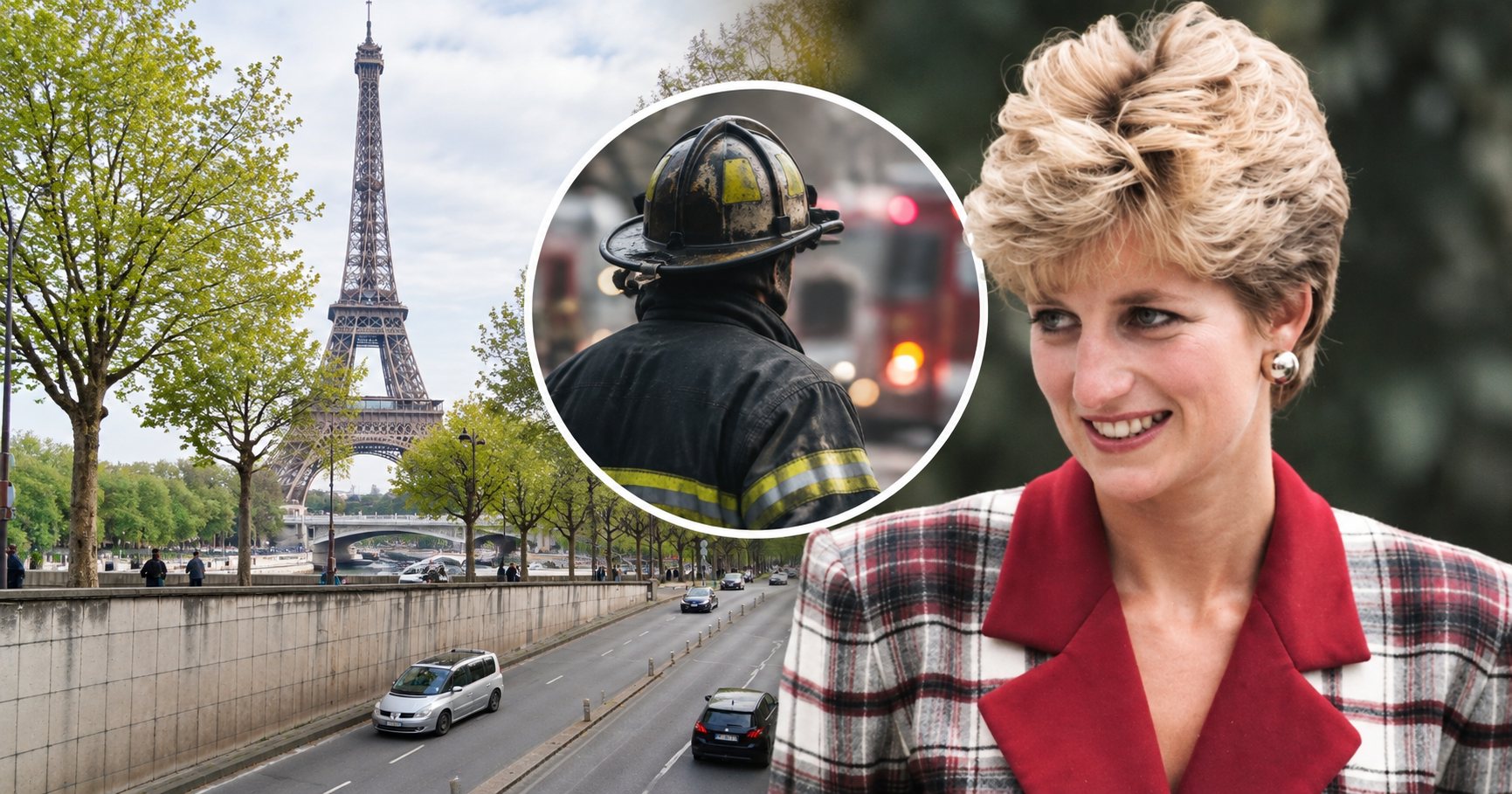

When French firefighter Xavier Gourmelon arrived at the wreckage of a car inside a Paris tunnel shortly after midnight, he had no idea that one of the injured passengers was Princess Diana.
She was conscious. She had her eyes open. And from what Gourmelon could see, there was little to suggest that her injuries would prove fatal.
He held her hand and tried to reassure her as emergency crews worked around them.
Then Diana spoke.
According to Gourmelon, she asked, “My God, what’s happened?”
Moments later, she went into cardiac arrest.
Nearly three decades after Diana’s death, those words continue to attract attention as what may have been the last thing she ever said. But they don’t come from an official report or recording. They come from Gourmelon’s recollection of the night, an account he wasn’t able to share publicly until many years later.
What makes his story particularly haunting is that he believed Diana would survive.
The crash itself had unfolded in a matter of minutes. Diana and Dodi Fayed had arrived in Paris the previous day after vacationing in the French Riviera. Shortly after midnight on August 31, 1997, they left the Ritz Paris Hotel for Fayed’s apartment on Rue Arsène Houssaye.
Their Mercedes was pursued by paparazzi before entering the Pont de l’Alma tunnel, where driver Henri Paul lost control and slammed into a concrete pillar.
By the time Gourmelon reached the wreckage, two of the four people inside were already dead.
Diana was still alive.
The Crash That Shocked the World
The car struck a white Fiat, swerved across the two-lane carriageway, and collided head-on with the 13th concrete column supporting the tunnel roof. It was traveling at an estimated speed of 105 km/h (65 mph), more than twice the tunnel’s 50 km/h speed limit. Henri Paul, the driver, was later found to have been intoxicated and driving under the influence of prescription drugs.
Princess Diana was one of the most popular public figures in the world, but in those first moments inside the tunnel, none of that was visible or relevant. According to Gourmelon’s account given to Rolling Stone, the princess was conscious and had her eyes open when he reached her inside the wrecked Mercedes. Two of the car’s four occupants were already dead. Gourmelon recalled how Diana’s bodyguard, Trevor Rees-Jones, kept trying to reach the princess from the front seat, though he was also injured, repeatedly asking, “Where is she? Where is she?”
Diana was moving very slightly. Gourmelon could see she was alive. He noted a slight injury to her right shoulder but nothing that appeared significant. There was no visible blood on her at all. From everything he could observe, the woman he’d reached appeared to be in distress but not in mortal danger.
What Gourmelon Saw – and Didn’t Know
Xavier Gourmelon, the firefighter who was among the first on the scene, later said his team approached the crash and dealt with it like any road accident, getting straight to work to assess who needed help and who was alive. He wasn’t scanning faces. He was doing his job.
Gourmelon said that at the time, he did not realize the woman he’d reached was Princess Diana. A paramedic told him only after Diana had already been loaded into the ambulance. “I was so shocked,” he said. “I knew who she was, but don’t follow British royalty closely. I went to the ambulance and looked in and that’s when I recognized her.”
That moment of recognition – standing at the back of an ambulance, looking at a face he had just spent frantic minutes trying to save – is the detail Gourmelon has described as permanently fixed in his memory. He had been holding her hand, urging her to stay calm, performing CPR on a woman he thought was simply an injured car-crash victim. The scale of what he had unknowingly witnessed only became clear to him after the fact.
French firefighters are considered part of the military and are therefore not allowed to speak to the press under normal circumstances, which is why Gourmelon’s account took so long to surface. He eventually spoke publicly on the 20th anniversary of Diana’s death in 2017, appearing on Good Morning Britain and giving a separate interview to The Sun.
Princess Diana’s Last Words, According to Gourmelon
According to Gourmelon’s own account, Diana said to him, “My God, what’s happened?” Those were, he has said, the last words she spoke. She then went into cardiac arrest.
Gourmelon and his crew lifted her onto a stretcher, where she suffered the cardiac arrest. “I massaged her heart and a few seconds later she was breathing again,” he said. “It was a relief of course because, as a first responder, you want to save lives – and that’s what I thought I had done.”
He told interviewers two decades after Diana died that as far as he knew when she was placed in the ambulance, she was alive, and he expected her to live. “It was very upsetting,” he said, learning later that she had died in hospital.
Diana’s last words are attributed to Gourmelon and to him alone, with no corroborating official record.
The Injury That Explained Everything
The gap between how Diana appeared at the scene and what was actually killing her from the inside was explained years later by forensic pathologist Dr. Richard Shepherd, who examined the evidence during a British police inquiry into her death and later wrote about the case in his book Unnatural Causes. Dr. Shepherd found that Diana died from a tiny tear in a vein in one of her lungs – an injury he described as one he had never encountered in his career.
That injury explains why Diana was initially conscious and able to speak to rescuers while her condition rapidly deteriorated beneath the surface. The vein was buried deep in her chest. The bleeding was internal and invisible. There was nothing on the outside of her body to indicate how serious the damage was.
In the ambulance, she gradually lost consciousness. When she suffered a cardiac arrest, every effort was made to resuscitate her, and in hospital she went into surgery, where surgeons identified the problem and attempted to repair the vein. By then, it was too late.
Dr. Shepherd noted that if Diana had been wearing a seatbelt, she may have survived the crash with far less severe injuries. He framed the case in his book not as a failure of medicine but as a tragic confluence of physics and anatomy – the wrong injury in the wrong place. Diana was transported to Pitié-Salpêtrière Hospital following the crash, and according to History.com, she was declared dead at 6:00 am on August 31, 1997. She was 36 years old.
The World That Woke Up to the News
The grief that followed was unlike anything most people alive in 1997 had witnessed. Mourners began visiting Kensington Palace immediately, leaving bouquets at the home where the princess would never return. Flowers, cards, candles, and mementos stacked some 30 feet out from the palace gates. Princess Diana, along with Dodi Fayed and their driver Henri Paul, had died in a high-speed crash following a dinner at the Ritz Hotel in Paris.
According to History.com, Diana’s funeral on September 6, 1997, was watched by an estimated 2.5 billion viewers worldwide – one of the largest television audiences in history. A 2008 British inquest ruled the deaths were unlawful, citing the reckless pursuit by paparazzi photographers alongside the grossly negligent driving of Henri Paul.
What Gourmelon’s Account Means, Nearly 30 Years Later
For 20 years, Xavier Gourmelon rarely spoke publicly about what happened inside the Pont de l’Alma tunnel.
When he eventually did, one detail stood out.
He hadn’t known the woman whose hand he was holding was Princess Diana.
To Gourmelon, she was simply an injured passenger who needed help. She was conscious, frightened, and asking what had happened. When her heart stopped, he performed CPR and got her breathing again.
He believed he had saved her.
Only after Diana had been placed in the ambulance did another member of the emergency team tell him who she was. Gourmelon went to look again and recognized the woman whose face was known around the world.
He would later learn that Diana had died at the hospital.
There is no recording or official document confirming the words Gourmelon remembers hearing that night. His account remains the recollection of one first responder working amid the confusion of a catastrophic crash.
But perhaps that is also what makes the story so striking.
For a few minutes in a Paris tunnel, Diana wasn’t one of the most photographed women in the world. She wasn’t a princess or an international celebrity.
She was an injured 36-year-old woman holding a firefighter’s hand and trying to understand what had just happened.
And the firefighter holding hers had no idea who she was.
AI Disclaimer: This article was created with the assistance of AI tools and reviewed by a human editor.
Lead image credit: Princess Diana photo: Rick / Flickr, licensed under CC BY 2.0. Paris image: Shutterstock. Composite created by The Hearty Soul using AI.
Read More: King Charles Opens Up: ‘It Gets Much Harder’ as He Battles Cancer at 77