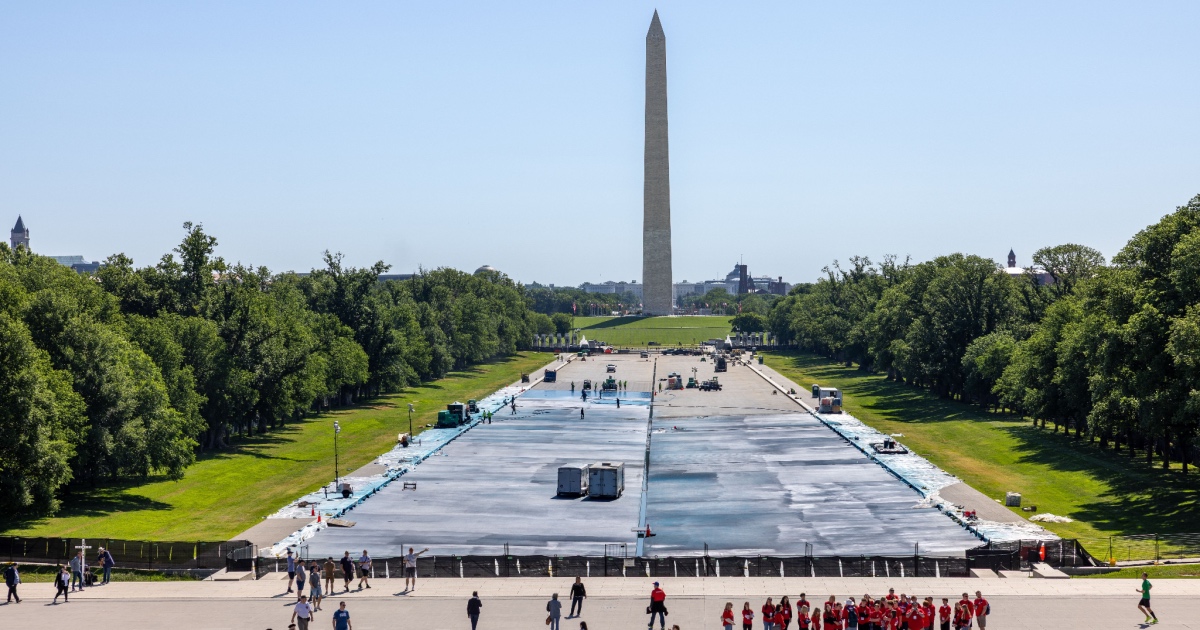

Trump told reporters in the Oval Office in April that he had “a guy who’s unbelievable at doing swimming pools.” What followed is one of the stranger episodes in recent presidential history: a more-than-$16 million public works project for a national monument that opened with algae on day one, paint peeling within days, a series of ever-growing vandalism claims with no supporting evidence, and a sitting president insisting he had “gotten rid of the algae, which they put in.”
That last line requires some unpacking. Delivering remarks in Medora, North Dakota, Trump accused his predecessors of actively introducing algae into the Lincoln Memorial Reflecting Pool and repeated his claim that the pool had “never worked” under Barack Obama or Joe Biden. He accused both former presidents of failing to fix the pool despite spending millions of dollars “trying” to do so. The problem with that story is that it doesn’t hold up to scrutiny on a single factual point.
The algae, the peeling paint, the soaring costs, and the mysterious gash that kept changing size: each piece of the Trump reflecting pool claim tells a different version of the same story. All of them are contradicted by the public record.
What the Pool Actually Cost – and Who Actually Spent What
Trump first announced his plans to renovate the Reflecting Pool in April, claiming it would only cost $1.5 million. The renovations have since exceeded $16 million. That ballooning figure is documented in federal contracting records and confirmed by ABC News, which reported the final cost crossed $14.65 million for the painting and sealing work alone, before additional cleanup and repair expenses.
The Obama administration replaced the pool’s basin and water circulation system – which drew water from the Tidal Basin – for approximately $35 million. That is a substantially different kind of project: a structural overhaul that replaced the pool’s plumbing from the ground up, not a surface repainting. Trump has repeatedly described that project as a failure, eventually inflating the cost to “$100 million” with no corroboration. His White House could not provide any evidence for the much larger figure when CNN inquired in May.
The Biden administration is a separate matter. It did not go ahead with any major Reflecting Pool repair project. Chuck Sams, who served as director of the National Park Service under Biden, told CNN that they had received a cost estimate “above $100 million” for a “full rehabilitation” but had not gone ahead with that work. A FactCheck.org review found no record of any major work done during Biden’s term, meaning Trump’s claim that Biden “spent millions of dollars trying to fix it” describes a project that never happened.
The Contracts, the Contractor, and the Questions That Followed
The Department of the Interior awarded a no-bid contract on April 3 to Atlantic Industrial Coatings to paint the Reflecting Pool, with supplemental agreements issued through June 15 bringing the total to $14.7 million. The agency justified not seeking bids from other contractors by saying the project was urgent and needed to be completed by July 4.
Trump’s explanation for choosing the firm was personal. The New York Times reported that Trump publicly stated he had “a guy who’s unbelievable at doing swimming pools” and claimed he had consulted three companies that had previously worked on his personal swimming pools before choosing one that had worked at Trump National Golf Club in Sterling, Virginia. Contracting records show the firm had never previously held a federal contract.
Major outlets reported they could not independently verify that Atlantic had physically completed swimming-pool work at the Trump golf club despite the president’s statement. A separate $1.7 million no-bid contract went to Green Water Solutions for a nanobubble water purification system intended to control algae. The contract was awarded without a full competitive bidding process.
Why the Algae Was Never Going to Stay Away
The shallow, sunny waters of the Reflecting Pool are an ideal incubator for algae growth in the summertime, and experts say the recent renovation may have helped accelerate it. The pool measures more than 2,000 feet long and sits fully exposed to the summer sun. Algae convert sunlight to chemical energy through photosynthesis, which allows them to grow and multiply, and the shallow, broad footprint of the Reflecting Pool means that organisms get plenty of sunlight to fuel that growth.
The new paint choice made things worse. The pool was refilled after Trump had its neutral grey bottom repainted “American flag blue.” A White House spokesperson told NPR that the new lining and industrial grade materials would “permanently seal the Reflecting Pool, which previously leaked 16 million gallons per year.” But the dark color created a new problem. NPR reported that the new dark blue paint absorbs more heat, warming the water and making it more hospitable to algae growth – the opposite of what the renovation was supposed to achieve.
Within days of the pool being refilled on June 9, patches of vivid green algae bloomed across the surface, particularly near the Lincoln and World War II memorials. This was not unprecedented. The Obama-era renovation also ended in algae, and according to Newsweek, blooms appeared within weeks of that pool’s reopening in 2012, prompting crews to drain and clean it again. The Reflecting Pool has been an algae problem since 1922. The new paint and a first-time federal contractor did not change that underlying reality.
Rosalina Stancheva Christova, a professor of aquatic ecology at George Mason University, took water samples from the pool and identified the 2026 bloom as a Desmodesmus species that is “growing in excessive amounts” but is not toxic or harmful to humans or animals. The algae itself was never the real concern. The real toxicity concern, per reporting on contractor materials, lies in the epoxy resin used for the pool’s new lining, which carries explicit long-term aquatic toxicity warnings.
The Vandalism Claim That Kept Growing
On June 20, Trump began asserting, without providing evidence, that the visible problems with the Reflecting Pool were caused by “Vandals” rather than the recent rapid repair project he had claimed would immediately make the pool “much more beautiful” than it was when it was built in the 1920s.
The alleged gash evolved quickly. Trump described it on Saturday as a 250-foot gash, then on Monday as a 300-foot gash, later Monday as a 350-foot slit, and Tuesday as “actually numerous slashes over a very long 350-foot length.” When asked for photographic evidence, Trump suggested it existed but told a reporter asking him to release the photos, “You’ll see it in court.”
What the National Park Service’s own court filing actually described was narrower than Trump’s account. In a June 24 court filing, NPS Deputy Director Frank Lands stated that on June 9, after the rehabilitation project was substantially complete, U.S. Park Police responded to a report of damage, including a caulk over foam sealant that was cut with a sharp knife or razor, and approximately 70 fence post tops thrown into the pool. That is meaningfully different from a 350-foot knife gash that somehow caused all the algae and peeling paint.
There has been no extended period since the pool was refilled in early June when it looked pristine. Algae was visible within days of the refilling, and it kept appearing even after the Trump administration declared that the water had been made “crystal clear.” Internal government documents obtained by The New York Times showed that while workers did find cuts in sections of foam between the pool’s expansion joints, those were not directly related to the “American flag blue” coating that was peeling, or to the algae bloom.
Steve Goodale, an aquatic systems consultant known online as “Swimming Pool Steve,” told PolitiFact that although creating a gash in polyurea coating is not impossible, he has a hard time imagining a tool that could cause more than superficial damage. The administration released surveillance footage to Fox News, but even Fox News host Jesse Watters said of the video, “We don’t know if they’re committing a crime.”
Another potential culprit for the peeling, according to Goodale, is the hydrogen peroxide that Park Service workers poured into the pool to kill the algae, which may have disrupted the bond between the surface and the coating, though it is hard to say without more data.
The Bottom Line
The Trump reflecting pool claim has moved through several phases since April – ballooning cost, persistent algae, peeling paint, and now a vandalism theory that keeps changing dimensions. Each phase has been accompanied by claims from the president that contradict federal contracting records, court filings, and on-the-ground scientific sampling.
The pool reopened in August 2012 and has been open for the vast majority of the days since, directly contradicting Trump’s assertion that it “never even opened” after Obama’s renovation. The Obama-era work cost approximately $35 million and addressed structural plumbing, not just surface aesthetics. The Biden administration did not conduct any major Reflecting Pool repair project. Trump’s project cost more than $16 million in no-bid contracts, used a contractor with no prior federal contracting history, and produced algae and peeling paint within days of completion. The algae was identified as biologically harmless. The vandalism claims remain unsubstantiated by any publicly released evidence matching the scale Trump described.
While arrests have been made and security tightened, the public evidence available so far does not appear to show actions consistent with the most serious claims. When the numbers keep changing and the evidence keeps getting pushed to “later,” the simplest explanation tends to be the same one pool contractor Steve Goodale offered: polyurea coatings applied under pressure, in summer heat, by crews racing a July 4 deadline, fail all on their own.
AI Disclaimer: This article was created with the assistance of AI tools and reviewed by a human editor.
Read More: Trump Wants AI Companies to Share Profits With the Public. Here’s How.