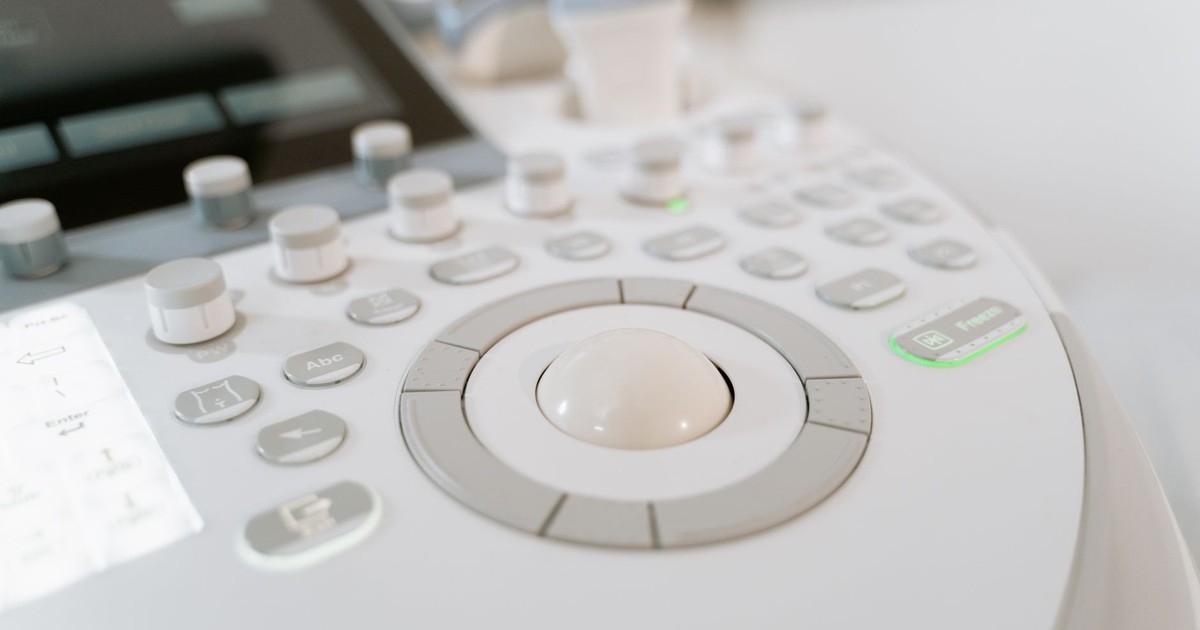

The hospital-grade ultrasound machine in a clinical imaging suite can do more than produce pictures. In lab experiments published in Scientific Reports in 2026, precisely tuned sound waves shattered the protective outer shells of two common respiratory viruses, leaving them unable to infect cells. The machines used were identical to standard diagnostic equipment, and the frequencies applied were the same ones already used in clinical settings.
The mechanism comes down to geometry, vibration, and acoustic resonance. A sound wave tuned to match the natural resonant frequency of a spherical object can cause that object to vibrate so intensely that it tears itself apart from the inside. Spherical enveloped viruses absorb ultrasound wave energy more effectively than other shapes, and researchers at the University of São Paulo in Brazil now believe that spherical geometry is their structural weak point.
Their work represents some of the most concrete evidence yet that ultrasound can destroy viruses through a purely mechanical process – without drugs, without chemicals, and without harming surrounding human cells. The findings are preliminary and have not been tested in animals or humans, but the underlying mechanism is specific, testable, and grounded in established physics.
How Ultrasound Can Destroy Viruses Through Resonance
The study demonstrated that high-frequency ultrasound in the 3 to 20 MHz range can effectively disrupt the structural integrity of both influenza A (H1N1) and SARS-CoV-2 through a resonance-driven mechanism distinct from classical cavitation, which operates at kilohertz frequencies.
Cavitation and acoustic resonance are fundamentally different processes. Cavitation occurs at low frequencies and destroys both viruses and tissues through the collapse of gas bubbles – it is indiscriminate, damaging biological tissue as readily as it destroys pathogens. Ultrasonic dental cleaners use cavitation to sterilize instruments. Acoustic resonance, operating at 3 to 20 MHz, works differently.
Acoustic resonance is selective. Sound energy couples with the viral structure, exciting internal vibrations that lead to mechanical rupture of the viral envelope without altering the temperature or pH of the surrounding medium. The virus vibrates at its own natural frequency; that vibration amplifies, and the outer membrane eventually fails – comparable to a wine glass cracking when a singer sustains the matching pitch.
Under these conditions, viral particles underwent pronounced alterations, including fragmentation, envelope rupture, and loss of morphological uniformity, consistent with direct mechanical destabilization rather than thermal or bubble-mediated effects.
Why the Shape of a Virus Makes All the Difference
One of the most striking aspects of this research is that it targets physical geometry rather than biochemical identity. Lead researcher Odemir Martinez Bruno, a professor at the São Carlos Institute of Physics at the University of São Paulo, described the mechanism directly: “The phenomenon is entirely geometric. Spherical particles, such as many enveloped viruses, absorb ultrasound wave energy more effectively, and it is the accumulation of energy inside the particle that causes changes in the structure of the viral envelope until it ruptures.”
Both SARS-CoV-2 and H1N1 are enveloped viruses – they carry a lipid bilayer, a thin fatty outer membrane, around their protein core. This membrane is central to how they infect human cells, and it is precisely what ultrasound targets. Acoustic resonance causes structural changes in the membrane until the viral particle ruptures and becomes inactivated.
Acoustic resonance depends primarily on viral geometry – size and shape – rather than biochemical composition. A mutated virus is just as vulnerable as the original strain provided its shape has not changed, since the effect is geometry-dependent and unaffected by viral mutations. Drug treatments, by contrast, can lose effectiveness when a virus mutates the specific molecular target a drug is designed to block.
What the Lab Results Actually Showed
Researchers at the University of São Paulo exposed samples of SARS-CoV-2 and influenza A (H1N1) to high-frequency ultrasound using hospital-grade imaging equipment. After treatment, the viruses could no longer infect cells in culture. Microscopy images showed clear damage and rupture of the viral envelope, the outer membrane that helps these pathogens invade host cells.
The damage was confined to the viruses. Analysis confirmed that the temperature and pH of the surrounding cells remained stable, ruling out thermal or chemical damage as the explanation for the breakdown of the viral particles. High-frequency ultrasound waves in the 3 to 20 MHz range induced acoustic resonance in spherical, enveloped viruses, causing structural rupture and inactivation without damaging human cells.
Human cells are far larger and structurally more complex than viral particles and do not absorb energy at the same frequencies. The result is a mechanism that, at least under controlled lab conditions, appears to affect only the virus.
A “Green” Alternative to Chemical Antivirals
High-frequency ultrasound can rupture viral envelopes in pathogens such as SARS-CoV-2 and H1N1 through a physical mechanism, opening a possible route to antiviral treatment that does not promote resistance. Because the mechanism targets geometry rather than biochemical pathways, viral mutation alone does not render the approach ineffective.
The team at the University of São Paulo also highlighted the environmental profile of their method. Flávio Protásio Veras, a pharmacologist and FAPESP postdoctoral fellow at the Federal University of Alfenas, told ScienceAlert the approach is a green solution to viral disease, noting that it “generates no waste, causes no environmental impact, and doesn’t promote viral resistance.”
The researchers are already looking beyond COVID and flu. They have begun investigating whether dengue, Zika, and Chikungunya could be targeted in the same way. All three are enveloped viruses with the spherical geometry that makes them theoretically susceptible to the same acoustic mechanism, which could make this a broad-spectrum antiviral platform rather than a single-target tool.
Read More: Scientists Discover Brazilian Tree With Surprising COVID-Fighting Potential
What This Means for You
The researchers described the finding as pointing to a potential therapeutic route for viral diseases, while noting the approach is experimental and not yet close to clinical use. Microscopic vibrations from ultrasound were sufficient to rupture viral membranes and render viruses inactive in lab conditions – but lab conditions are a long way from a hospital treatment room, and the study involved only two virus types with no animal or human trials conducted.
Diagnostic ultrasound equipment is non-invasive, widely available, painless, and already operated safely in clinical settings worldwide. That existing infrastructure is part of what makes the research worth following – if frequency parameters can be optimized and safety profiles confirmed in living systems, the path to clinical application would involve refining an existing tool rather than building an entirely new one.
For now, this is early-stage science with a clear and testable rationale. Viral shape, not viral genetics, is the target – a genuinely different approach to antiviral treatment that, if it holds up in further testing, may one day add sound waves to the tools available to fight respiratory infections.
Disclaimer: This information is not intended to be a substitute for professional medical advice, diagnosis, or treatment and is for information only. Always seek the advice of your physician or another qualified health provider with any questions about your medical condition and/or current medication. Do not disregard professional medical advice or delay seeking advice or treatment because of something you have read here.
AI Disclaimer: This article was created with the assistance of AI tools and reviewed by a human editor.
Read More: What The Economist Who Called 2008 and COVID Fallout Has To Say About Our Future