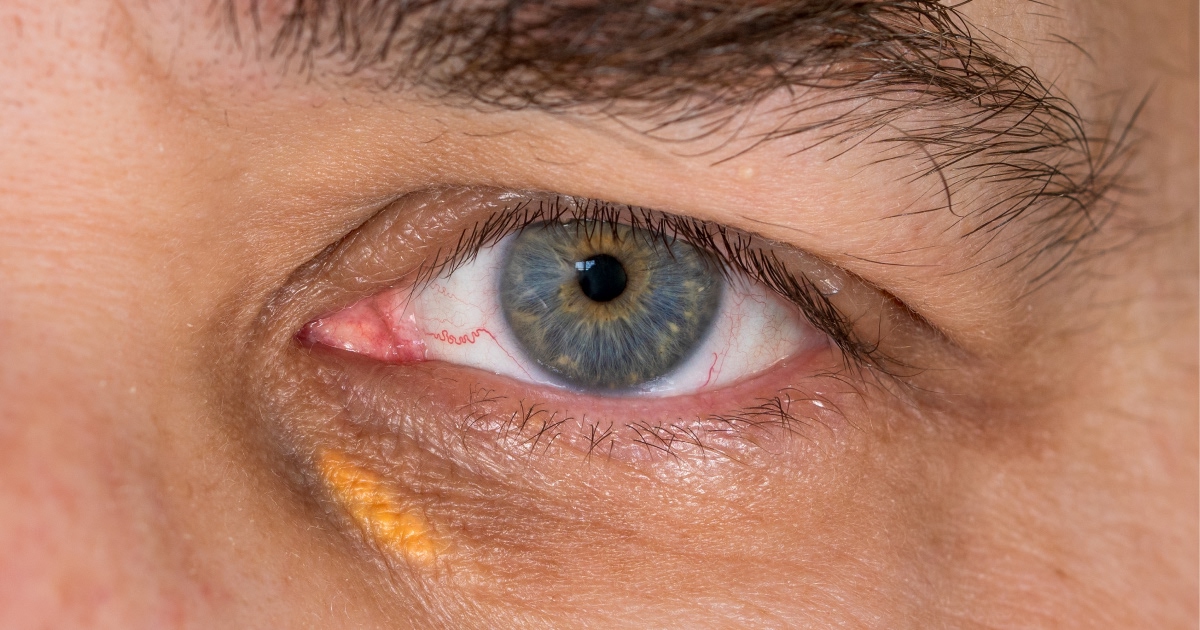

Yellowish patches around the eyelids are easy to write off as a cosmetic issue. They usually don’t hurt, and for many people, the biggest concern is simply how they look. But those small patches may be revealing something happening much deeper inside the body.
They’re called xanthelasma (zan-theh-LAZ-mah), and a large 2026 Stanford study suggests they could be an outward sign of cardiovascular risk. Researchers analyzing nearly 36,000 people found that those with xanthelasma had roughly three times the one-year rate of heart attack and stroke compared with matched controls. Perhaps most surprisingly, the association remained even when cholesterol levels appeared normal.
The findings, published in Atherosclerosis, add to evidence that these seemingly harmless patches may deserve more than a cosmetic glance. Atherosclerosis, the buildup of fatty plaque inside artery walls, can develop quietly for years before triggering a heart attack or stroke. That makes the possibility of a visible warning sign particularly intriguing.
What is xanthelasma, and who gets it?
Xanthelasma appears as soft, yellowish patches or raised areas around the eyelids, forming when immune cells called macrophages collect cholesterol and other fats under the skin. Most cases appear between ages 35 and 55, though the condition can develop between the ages of 20 and 70.
Xanthelasma is not always associated with abnormal lipid profiles. Nearly 50 percent of those with the condition have high cholesterol or another lipid disorder, meaning the other half do not. That biological ambiguity has long made xanthelasma a contested topic in cardiology – some clinicians treat it as a reliable cholesterol warning, while others argue it adds nothing beyond what a standard blood test would already reveal.
The patches are generally harmless and do not usually affect vision, but they are associated with higher cholesterol and other cardiovascular risk factors. The condition can also signal thyroid issues or diabetes, according to the Cleveland Clinic, making it a potential window into several overlapping metabolic conditions simultaneously.
A significant number of xanthelasma cases occur alongside smoking, central obesity, hypertension, diabetes, and dyslipidemia, each of which represents an independent major risk factor for coronary artery disease. That cluster of co-occurring risks may help explain why the patches carry such a strong cardiovascular signal in large population datasets.
The Stanford study: design, scale, and key findings
Researchers used TriNetX, a global platform of electronic health records spanning more than 13,000 clinical sites across 20 countries, to compare cardiovascular events in 17,925 adults aged 18 to 90 with eyelid xanthelasma against 17,925 matched controls without the condition. The control group was matched with people diagnosed with presbyopia (age-related farsightedness), a condition requiring an eye exam, ensuring that control participants had actually been evaluated and confirmed not to have xanthelasma. That design reduces the risk that the apparent xanthelasma risk was simply a result of controls being examined less often.
Patients were matched using propensity score matching, controlling for demographics including age, sex, race, and ethnicity, as well as lipid profile (total cholesterol, LDL cholesterol, and triglycerides) and cardiovascular risk factors including hypertension, diabetes, high lipids, family history, overweight and obesity, and nicotine dependence.
At the one-year mark, around 1 percent of those with xanthelasma had suffered a heart attack, compared with 0.35 percent of controls. For strokes, the rate was 0.95 percent among people with xanthelasma, compared with 0.3 percent in the control group, according to the American Academy of Ophthalmology. For transient ischemic attack (TIA) – a temporary interruption of blood flow to the brain commonly called a mini-stroke – the rate was 0.6 percent in the xanthelasma group versus 0.19 percent in controls.
The gap between the two groups narrowed slightly over time, but xanthelasma was associated with higher incidence of major adverse cardio-cerebrovascular events (MACCEs) at both the five- and ten-year follow-ups. The Stanford research team concluded that xanthelasma is associated with higher short- and long-term incidence of MACCEs up to 10 years, reinforcing its value as a clinical marker for cardiocerebrovascular risk stratification and preventive management.
The cholesterol-independent risk: why xanthelasma and heart attack risk are connected
The elevated cardiovascular risk in xanthelasma patients was observed even among those without abnormally high blood cholesterol levels. The conventional clinical assumption has been that xanthelasma is only worth flagging when a patient’s lipid panel comes back abnormal. If the patches signal elevated cardiovascular risk independent of measured cholesterol, the clinical calculus changes: the patches become a standalone prompt for cardiovascular investigation, not merely a confirmation of what blood work has already shown.
The researchers concluded that xanthelasma can be considered a risk factor for future major adverse cardio-cerebrovascular events, and that most patients with xanthelasma are seen by dermatologists for cosmetic reasons while potentially carrying undiagnosed or uncontrolled cardiovascular risk factors. They described xanthelasma as a visible marker to initiate comprehensive risk assessment and preventive management.
A separate 2026 study in Ophthalmic Plastic and Reconstructive Surgery, conducted by researchers at Massachusetts Eye and Ear and the Bascom Palmer Eye Institute at the University of Miami, analyzed more than 40,000 patients using the same TriNetX database and arrived at a complementary conclusion: xanthelasma palpebrarum is significantly associated with atherogenic lipid profiles, greater use of lipid-lowering medications, and an increased risk of cardiovascular events.
For patients with xanthelasma who are not already on cardiovascular monitoring, these findings support proactive evaluation. The patches may represent an early, visible signal of systemic lipid dysregulation that has not yet crossed conventional diagnostic thresholds but is already beginning to affect arterial tissue.
Read More: 10 Skin Changes Doctors Say May Signal Heart Disease
Where the science is still unsettled
A 2025 case-control study published in Ophthalmology, conducted at Sheba Medical Center in Israel, concluded that xanthelasma palpebrarum was not associated with increased rates of dyslipidemia or cardiovascular disease, questioning the extent to which the condition serves as an indicative marker for heightened systemic risk.
That study was conducted at a single tertiary care center, drawing participants examined at a medical screening institute from 2001 through 2020. Its narrower scope and single-site design may account for some of the divergence from the Stanford findings. Population differences, referral patterns, and the characteristics of who gets evaluated at a screening institute versus who appears in a general health records network can all influence outcomes substantially.
The deposits themselves do not mean a person will have a heart attack or stroke, and the Stanford study cannot prove they cause cardiovascular disease. Observational studies of this kind identify associations, not causal mechanisms. The biological pathway linking xanthelasma specifically to cardiac events, beyond the shared presence of lipid dysregulation, remains incompletely understood. More research is needed to determine why people with xanthelasma appear to have a higher risk and whether routine heart screening for people with the condition could actually prevent future heart attacks and strokes.
The scale of the Stanford dataset, and the consistency of findings across one, five, and ten-year follow-ups, give the association enough statistical weight to inform clinical practice, even before the mechanisms are fully mapped.
What clinicians and patients should do now
Most patients with xanthelasma are seen by dermatologists for cosmetic reasons. Cosmetic removal – using laser treatment, chemical cauterization, or minor surgical excision – addresses the visible symptom without touching the underlying systemic question.
Regular monitoring and management by primary care physicians can help implement preventive measures such as lifestyle modifications, anti-lipemic drug therapy, and blood pressure control. The Stanford researchers wrote that early evaluation of patients with xanthelasma can help identify and control underlying systemic conditions, helping to prevent potential cardio-cerebrovascular events.
A person who notices xanthelasma on their eyelids, or whose clinician spots it during an examination, has research-backed grounds to request a comprehensive cardiovascular work-up. That would typically include a full fasting lipid panel (total cholesterol, LDL, HDL, and triglycerides), blood pressure measurement, fasting blood glucose to screen for diabetes, and a discussion of family history and lifestyle risk factors. For patients already in a high-risk category, referral to a cardiologist for additional evaluation may be warranted.
Xanthelasma joins a growing list of external physical markers – alongside findings like corneal arcus and earlobe crease patterns – that clinicians are re-evaluating as meaningful signals rather than cosmetic footnotes.
What this means for you
Yellow patches near the eyes should not be self-diagnosed as a definitive indicator of imminent cardiovascular crisis, and they do not inevitably lead to a heart attack or stroke. The current evidence supports that xanthelasma warrants a cardiovascular conversation, not a cosmetic one alone. Research now suggests these patches may signal an increased risk of cardiovascular disease regardless of whether blood cholesterol appears normal on a standard panel.
If you have xanthelasma, or notice it developing, bring it to your primary care physician’s attention and ask specifically about cardiovascular risk assessment. Request a fasting lipid panel if you have not had one recently, and have blood pressure and blood glucose checked at the same visit. For adults in the 35-to-55 age window where xanthelasma most commonly appears, that conversation could translate into earlier intervention – whether through lifestyle changes, medication, or closer monitoring – before arterial changes reach a clinical event.
Disclaimer: This information is not intended to be a substitute for professional medical advice, diagnosis, or treatment and is for information only. Always seek the advice of your physician or another qualified health provider with any questions about your medical condition and/or current medication. Do not disregard professional medical advice or delay seeking advice or treatment because of something you have read here.
AI Disclaimer: This article was created with the assistance of AI tools and reviewed by a human editor.
Read More: Heart Doctor Reveals 8 Warning Signs of a Heart Attack — Even If You Seem Healthy