
Every four years, somebody finds a pattern in the World Cup logo colors that appears to predict the winner. Three tournaments in a row, that pattern appeared to hold. So when a woman named Paige posted a video in late June 2026 claiming to have decoded the official color palette of the 2026 tournament – and concluded that the winner’s identity had been hiding in plain sight all along – the clip spread across TikTok, X, and Reddit with a speed that even FIFA’s communications team probably didn’t anticipate.
The theory is simple enough to explain in two sentences. Paige argued that every World Cup has its own official color palette, and that those colors have corresponded to the winner every single year for at least the last three tournaments. But the evidence she presents is worth examining carefully – both what it gets right and where it quietly falls apart.
Her claim isn’t framed as a guess. She claimed that FIFA may have left a clue to the 2026 winner in plain sight through the official tournament colors, though she acknowledged there is no evidence the tournament has been fixed or that any actual FIFA document has been leaked. The phrase “FIFA script,” borrowed wholesale from professional wrestling fandom, is pure internet theater. What she actually identified is a color-matching pattern – which is a different, and more interesting, thing to pick apart.

The Historical Case She Makes for the 2026 World Cup Prediction
The argument traces back through three previous tournaments: the 2014 World Cup logo featured bright green, yellow, and red – Germany won; the 2018 branding ran dark blue, red, and gold – France lifted the trophy; the 2022 palette was light blue, white, and gold – Argentina celebrated in their blue and white stripes.
On the surface, three-for-three is the kind of batting average that makes people stop scrolling. In a follow-up interview, Paige said she began looking into the theory after noticing a similar trend around Super Bowl logos, adding that the 2022 World Cup colors “were legitimately the same colors as Argentina” before working further back to find what she believed was the same pattern in 2018 and 2014. The NFL Super Bowl color theory – in which some fans believe the custom logo released at the start of each season shows which teams will compete in the game, based on the color scheme – has circulated for years in American sports forums, and Paige appears to have transplanted the logic to soccer.
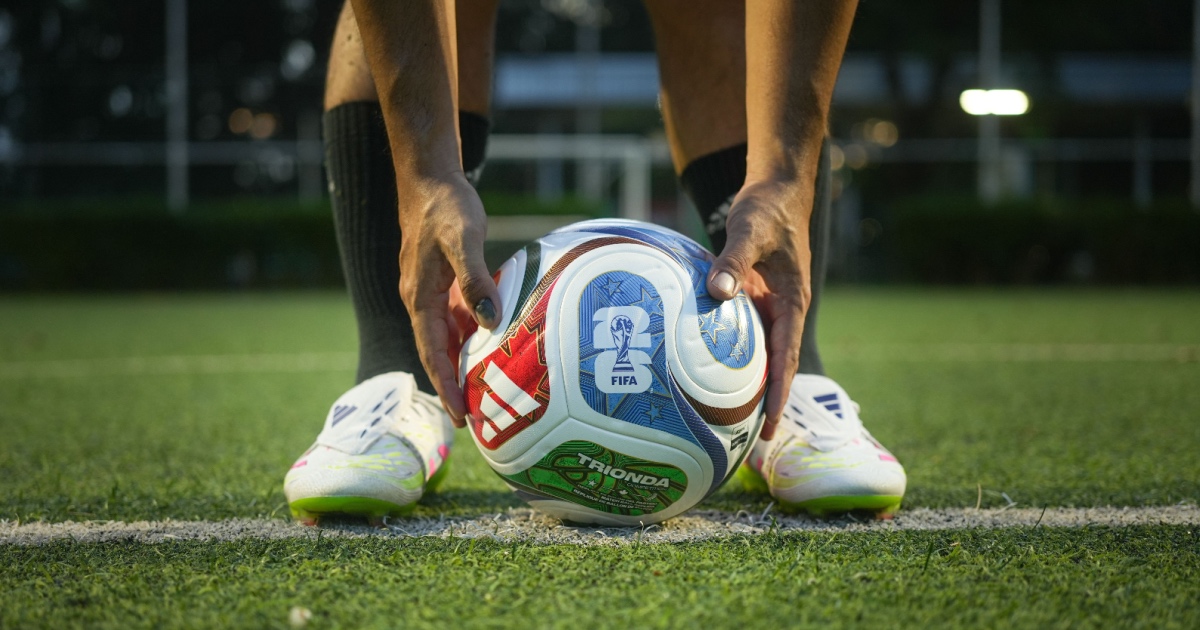
The official 2026 World Cup logo palette lands on deep red, forest green, clear blue, and gray. For the 2026 World Cup prediction, her theory produces the logic that runs as follows: Paige focuses on the colors green, red, blue, and grey for 2026, with her initial instinct pointing toward Morocco due to the red and green presence, but she later argued that Portugal was a more complete match because of the blue shields on the Portuguese flag.
Why Portugal and Not Morocco
Early internet sleuths flagged Morocco as the predicted winner given the green and red presence, but the viral video went further, drilling into the specific color matrix and concluding the exact shades mirror the Portuguese flag – red, green, and the blue drawn from the five heraldic shields in the crest. The shields, which are navy blue, appear as small geometric shapes within Portugal’s flag – easy to miss at a glance, which is partly what gives the theory its “aha” quality when pointed out.
The theory officially concludes that Portugal is the mathematically scripted winner of the 2026 World Cup, with the exact shades of red and green used by FIFA mirroring the Portuguese flag. Whether you call that a match or a stretch depends on your appetite for confirmation bias – the tendency to notice information that supports a pre-existing conclusion while filtering out the rest.
Portugal’s Actual Performance at the 2026 World Cup
Whatever the logo colors may or may not suggest, Portugal’s on-pitch form at this tournament has given conspiracy theorists little to complain about. The 2026 FIFA World Cup in Canada, Mexico, and the United States kicked off on June 11 and concludes with the final in East Rutherford on July 19.
Group K of the 2026 FIFA World Cup took place from June 17 to 27, 2026. The group consisted of Portugal, DR Congo, Uzbekistan, and Colombia. Colombia secured their advancement to the round of 32 after two group game wins, topping the group after earning a draw against Portugal. Portugal also advanced as runners-up after a crucial victory against Uzbekistan.
Portugal’s most decisive group stage result was a 5-0 demolition of Uzbekistan, with Cristiano Ronaldo scoring twice in that match to stake his claim in a tournament he has spent decades trying to conquer. Cristiano Ronaldo’s inclusion in Portugal’s starting lineup for the round-of-32 win against Croatia at the 2026 FIFA World Cup allowed him to make more history, setting another record later in the match: at 41 years and 147 days old, he became the oldest player ever to appear in a World Cup knockout stage.
Portugal survived a late scare against Croatia as Ronaldo’s 68th-minute penalty and Ramos’ 94th-minute header sent them through. The 2-1 result was dramatic enough to fuel every narrative running about this squad – including the color theory, which resurfaced loudly on social media within minutes of the final whistle.
Portugal’s next fixture is a Round of 16 clash against Spain in Dallas on July 6. The Opta supercomputer rates that as a bruising encounter for Portugal: Spain entered the knockout stage among the leading contenders, and a potential last-16 clash with Portugal looks like a demanding encounter arriving a round earlier than it should, with Spain still expected to be favorites.
The Ronaldo Narrative Adds Fuel to the Theory
Conspiracy theories need a story engine, and Cristiano Ronaldo provides one. Portugal likely enters this tournament in what is considered the final World Cup of Ronaldo’s legendary career, with the Portuguese arriving as reigning UEFA Nations League champions. The farewell-tour arc – legendary player, sixth and final World Cup, the one trophy that has always evaded him – is tailor-made for a certain kind of internet mythology.
This prediction isn’t the only one to favor Portugal either. A separate viral theory holds that The Simpsons’ Season 9 episode “The Cartridge Family”, which first aired in 1997, predicted a Mexico vs. Portugal World Cup final – both of which will be music to Ronaldo’s ears, as this is his final chance of winning a World Cup. The episode features a fictional TV advertisement promoting a soccer match between Mexico and Portugal in Springfield. Euronews confirmed the clip is real, but the claim is fake: the episode never mentions the year 2026, makes no reference to the FIFA World Cup, and never identifies the match as a final.
The clip continues circulating due to the absence of a time reference in the original scene, allowing it to be reused across multiple World Cup cycles. As fact-checkers at Euronews noted, the identical claim previously circulated during both the 2018 and 2022 World Cups, gaining fresh momentum in 2026 simply because Mexico is one of the host nations. Short-form video platforms have further amplified the spread through edited versions that remove context and add captions implying predictive meaning.
What the Data Actually Says About 2026 World Cup Predictions
The color theory is entertaining. It is not, however, predictive in any meaningful sense. Opta’s supercomputer does not identify Portugal as the most likely winner. After the group stage concluded, the Opta supercomputer updated its forecast by simulating the tournament 25,000 times, with France given the highest probability of winning at 18.7%, followed by Argentina at 16.3%, Spain at 13.5%, England at 9.7%, and Brazil at 6.5%.
Portugal’s chances in Opta’s model sit at 5.05% – real enough to be a legitimate contender in a 48-team field, but nowhere near the top of the analytical pecking order. That gap between what the color theory claims and what the data models project is worth sitting with. According to Opta’s pre-tournament simulations, also running 25,000 iterations, Spain were the most likely winners at 16.1%, with France, England, and Argentina all winning the World Cup in more than 10% of simulations.
Modern analytical tools go far beyond jersey color. According to research from WSC Sports, modern AI models hit 75 to 85% accuracy in predicting game winners, whereas older statistical models hovered around 50 to 60%. Those models incorporate passing networks, pressing intensity, injury data, squad depth, historical head-to-head records, and tournament bracket paths – none of which are captured by a color palette comparison.
The tournament itself is also structurally different from anything that came before. For the first time, 48 nations are competing to lift the World Cup trophy in an expanded tournament, jointly hosted by the United States, Mexico, and Canada across 16 stadiums. More teams, more rounds, and a revised format mean more variables – and fewer predictive shortcuts that held in smaller draws.
Why We’re Drawn to This Kind of Theory
The psychological pull of the color theory is worth acknowledging directly, because it’s strong, and it’s not accidental. Patterns feel meaningful to human brains even when they’re not. Research published in Routledge Open Research found that conspiratorial ideation tends to be related to less accuracy in reasoning and more overconfidence in conclusions – not because the people who believe these theories are less intelligent, but because the pattern-recognition mechanisms that make humans exceptional are also the mechanisms that generate false positives.
The color theory’s three-tournament “track record” doesn’t hold up under scrutiny either. Picking a winner from a field of 32 teams means there are 32 possible flag color combinations in play. With that many options, at least one plausible-looking match will almost always exist for whichever team wins. The FIFA conspiracy theory mirrors the long-running NFL Super Bowl logo color theory, in which the branding palette supposedly foreshadows the winner each season, with the video claiming the color scheme of the last three World Cup logos corresponds to the chosen winner. The pattern started with a small sample size, was selected retroactively, and has never been tested prospectively – meaning it was never used to make a prediction before the fact and then verified.
Football remains far less predictable than a colour chart. Form, injuries, tactics, weather, penalties, and individual mistakes can all change a tournament in seconds. Portugal may well be good enough to go deep into the World Cup. That does not mean the winner has been hidden in a branding guide. The “FIFA script” claim is best understood as a viral fan theory rather than a revelation.
Read More: Edgar Cayce: Clairvoyant Who Foresaw World War I Makes Startling Prediction for 2026
What This Means for You
As of July 3, 2026, Portugal are through to the Round of 16 after a dramatic 2-1 victory over Croatia, with Ronaldo’s penalty and Ramos’ injury-time header doing the work. Whether they go further depends on a Spain side that the Opta model still rates as the tournament’s most clinical outfit. The color theory can’t help you there.
What the theory does do – and does well – is illustrate why sports capture our imagination the way they do. The 2026 World Cup is already the largest in history, with the final scheduled for July 19 at MetLife Stadium in New Jersey, and the winning team set to receive a record $50 million in prize money. Portugal’s best-ever finish remains third place, achieved at their very first World Cup appearance in 1966. A title in 2026 would be, by any measure, the most significant achievement in the country’s football history.
If you’re following the tournament and want to make sense of Portugal’s actual chances, check the Opta supercomputer’s live knockout-stage predictions, which update after every result. A color chart won’t tell you whether Ronaldo scores in Dallas on July 6. Pressing stats, squad fitness reports, and head-to-head data might get you closer. But not even a supercomputer running 25,000 simulations will tell you with certainty – and that uncertainty is precisely what makes the next three weeks worth watching.
AI Disclaimer: This article was created with the assistance of AI tools and reviewed by a human editor.