China Just Photographed Earth’s Mysterious ‘Second Moon’ for the Very First Time
A space rock roughly the size of a school bus has been quietly shadowing Earth for at least a century, orbiting the Sun in perfect step with our planet, never too close and never quite gone. Astronomers knew it was out there. They’d cataloged it, named it, and debated its origins for years. But until this month, no one had ever seen it up close.
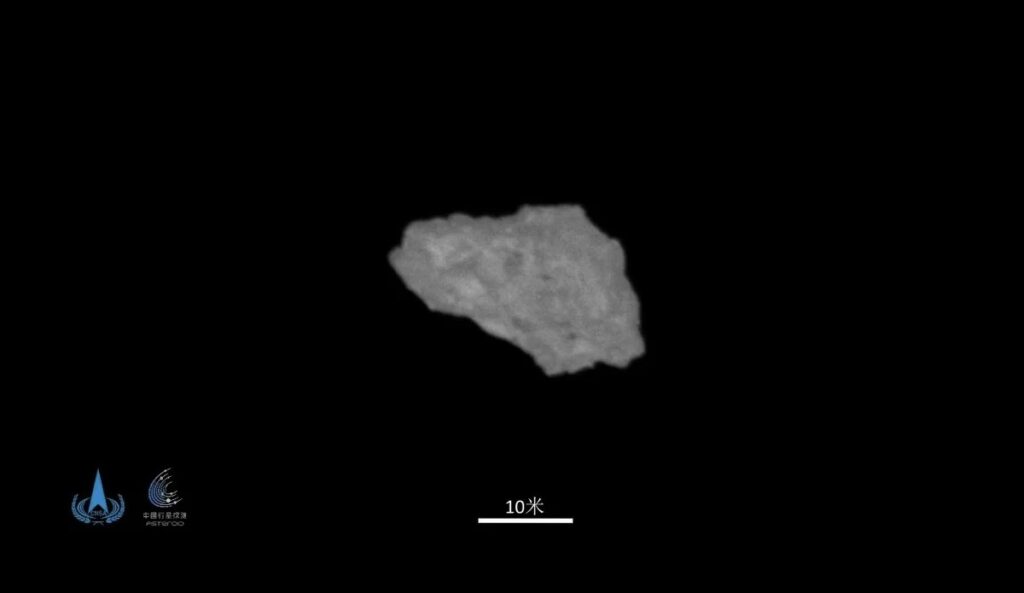
That changed on July 2, 2026, when China’s Tianwen-2 spacecraft sent back the first photograph ever taken of Kamoʻoalewa from close range. The image showed a small, oblong rocky body tumbling through space. The photo was taken from a distance of about 12 miles, or 20 kilometers, and released publicly by China’s National Space Administration (CNSA). What the image revealed wasn’t just the shape of an asteroid. It also immediately upended years of assumptions about what this object actually is.
Kamoʻoalewa, pronounced kah-MOH-oh-ah-LEH-wah, is classified as what scientists call a quasi-satellite. It’s not a true satellite of Earth. Instead, it’s a rare type of asteroid that orbits the Sun while remaining in sync with Earth’s orbit. The space rock loops by Earth, coming as close as 9 million miles and as far as 25 million miles from our planet. Its Hawaiian name reflects this strange, dancing motion: the name means “oscillating celestial object” in Hawaiian. Astronomers have tracked it for a decade, but the first close-up image has only just arrived.
What Earth’s “Second Moon” Actually Looks Like
Astronomers using the Pan-STARRS 1 asteroid survey telescope on Haleakalā, Hawaii, first discovered Kamoʻoalewa in 2016. In the years that followed, scientists estimated its size through indirect methods – measuring the brightness of reflected sunlight and modeling what object could produce that signal. Ground-based estimates put its diameter at somewhere between 40 and 100 meters. The first spacecraft image told a different story.
The image released by CNSA suggests a diameter of just over 20 meters. This matches closely with a preprint posted on July 1 by Benjamin Sharkey and colleagues at the University of Arizona’s Lunar and Planetary Laboratory, which estimated a diameter of around 18 meters based on observations made by NASA’s James Webb Space Telescope. If confirmed, that size would make Kamoʻoalewa one of the smallest asteroids ever visited by a spacecraft in history.
The asteroid is elongated and spins fast. The rock rotates on its axis every 28 minutes. That rapid spin creates real engineering challenges for any mission hoping to land on or collect a sample from its surface. The spacecraft that achieved this first image – Tianwen-2 – was designed specifically to handle exactly that problem.
China’s Tianwen-2 Mission Captures Images of Near-Earth Asteroid Kamoʻoalewa. Image Credit: CNSA
A 400-Day Journey Across a Billion Kilometers
Tianwen-2 launched on May 29, 2025, and traveled around 1 billion kilometers across 400 days to arrive at a distance of 20 kilometers from the asteroid. The mission launched from the Xichang Satellite Launch Center in southwestern China aboard a Long March 3B rocket, marking the first time that launch vehicle had delivered a payload directly onto an Earth-escape trajectory.
The approach to Kamoʻoalewa was methodical. Tianwen-2 arrived at 30,000 kilometers from the asteroid on June 7, closing to 2,000 kilometers by June 19. The spacecraft then settled into a station-keeping position roughly 20 kilometers from the surface, where it took the first close-up image on July 2 before CNSA publicly announced the mission’s arrival on July 6.
Tianwen-2 carries a suite of 11 science instruments for studying both Kamoʻoalewa and its later target, including cameras, laser ranging equipment, spectrometers, sounding radar, and particle analyzers. According to Scientific American, the spacecraft will spend nearly a year studying the asteroid before attempting to collect a sample from its surface.
The Moon Fragment Theory – and Why the New Image Complicates It
The most debated question surrounding Kamoʻoalewa isn’t its size or its spin. It’s where it came from.
In 2021, researchers led by Benjamin Sharkey at the University of Arizona used the Large Binocular Telescope in Arizona over five years of observations to study the asteroid’s spectrum – the pattern of light it reflects. The result was striking: Kamoʻoalewa displays an extremely red reflectance spectrum typical of space weathering of lunar-like silicate material, raising the possibility that it is formed from material originating from the Moon. The study found striking similarities between the spectrum of the quasi-satellite and a lunar sample brought back to Earth by the Apollo 14 mission.
That 2021 finding, published in Communications Earth & Environment, sparked a wave of follow-up work. A 2024 study in Nature Astronomy used numerical simulations to propose a specific origin story. The research suggested Kamoʻoalewa was liberated by an asteroid impact between 1 million and 10 million years ago – a smashup that created the Moon’s 13.7-mile-wide Giordano Bruno crater on the lunar far side. The impact that carved that crater, the researchers estimated, would have been caused by a projectile about a mile wide.
But that leading theory now faces fresh scrutiny. The first spacecraft image shows Kamoʻoalewa to be roughly 20 meters across, consistent with the Sharkey preprint that estimated a diameter of 18 meters based on JWST thermal emission modeling. The size revision matters because a much smaller object at the same observed brightness implies a higher reflectivity – and lunar rocks simply don’t reflect that much light. The JWST-derived albedo figures are far too high to match lunar highland or mare material, which eliminates the reflectance analog that anchored the 2021 lunar-ejecta hypothesis.
A separate line of research has proposed an alternative origin altogether. A 2025 study published in The Innovation compared Kamoʻoalewa’s spectrum with data collected by China’s Yutu-1 rover and Chang’E-5 lander on the lunar surface. The authors found that the asteroid’s spectrum closely matches in-situ spectra observed by the Yutu-1 rover and laboratory measurements of Chang’E-5 lunar soils, and their impact modeling suggested that only fragments ejected from Tycho crater could escape the Earth-Moon system to become Earth’s co-orbitals.
Scientists who favor a main-belt asteroid origin point to statistical models suggesting an asteroid on Kamoʻoalewa’s orbit is far more likely to have drifted inward from the asteroid belt than to have been blasted off the Moon. A spectral match is a strong hint, not a verdict. It is drawn from reflected light rather than from the rock itself, and some researchers still argue that Kamoʻoalewa came from the main asteroid belt and merely drifted into its current orbit. The lunar origin story is the leading idea, but it remains a hypothesis.
The only way to settle the debate is to bring back a piece of the rock itself.
How Tianwen-2 Plans to Grab a Sample
The sampling phase of this mission presents one of the more technically demanding operations in the history of robotic spaceflight. The target is small, spinning rapidly, and its surface properties are essentially unknown. The mission aims to collect between 20 and 100 milligrams of material from Kamoʻoalewa, and Tianwen-2 is capable of three different sampling techniques: hovering sampling, touch-and-go, and anchoring and attachment sampling.
The hovering method keeps the spacecraft near the surface without landing, collecting dust and fine particles. The touch-and-go approach, used previously by NASA’s OSIRIS-REx mission at asteroid Bennu and by Japan’s Hayabusa2 at asteroid Ryugu, involves briefly contacting the surface with a gas-driven collection head. The anchor-and-attach method – the most aggressive of the three – involves physically latching onto the asteroid surface, which would allow access to subsurface material. The spacecraft will conduct a detailed survey of the asteroid at progressively closer distances, approaching to about 1.9 miles, then 600 meters, and finally 300 meters, to build a detailed map and select optimal sampling sites.
That fast 28-minute rotation creates specific complications for the anchor-and-attach method. Any hardware designed to grip the surface has to account for the fact that Kamoʻoalewa is constantly moving beneath the spacecraft. Which technique the mission ultimately uses will depend on what detailed imaging reveals about the asteroid’s surface texture and cohesion.
The spacecraft is scheduled to depart Kamoʻoalewa in April 2027 before releasing a return capsule that could land on Earth in November 2027. Following the sample delivery, Tianwen-2 will use a gravity-assist maneuver to slingshot toward comet 311P/PANSTARRS, with an expected arrival at the comet in January 2035. That second leg of the mission would make Tianwen-2 the first spacecraft ever to visit both an asteroid and a main-belt comet.
What the Samples Could Reveal
A physical sample of Kamoʻoalewa examined in a laboratory would do something no telescope on Earth or in orbit can: reveal the asteroid’s exact mineral composition and isotopic fingerprint. Isotopes – variants of chemical elements with different numbers of neutrons – carry distinct signatures depending on where in the solar system a rock formed. Lunar rocks brought back by Apollo astronauts have a known isotopic profile. If Kamoʻoalewa’s sample matches it, the Moon-fragment hypothesis survives. If the sample looks like a common silicate asteroid, the lunar story falls away.
If the material matches the isotopic composition of lunar rocks, the “moon fragment” theory would gain strong confirmation. Mikael Granvik, an astronomer at the University of Helsinki and Luleå University of Technology, told reporters that the first Tianwen-2 image “basically confirms” the high geometric albedo suggested by the Sharkey preprint – and that high albedo is incompatible with a Moon origin. A main-belt result would carry different implications too, suggesting that extreme space weathering alone – the gradual chemical transformation caused by bombardment from solar wind and micrometeorites – can make an ordinary asteroid look like a piece of the Moon.
Either outcome matters. The findings also have ramifications for understanding the near-Earth object population, implying that a larger proportion of these bodies than suspected could have been created by impacts on the Moon or upon other solar system bodies.
Kamoʻoalewa isn’t a threat and won’t suddenly shift into a collision course with Earth. It is not gravitationally bound to Earth and could drift away over long timescales, but for now it is the steadiest of the seven known quasi-moons of Earth, and it is expected to keep pace with our planet for centuries. Its discovery and the subsequent mission to visit it represent something different: a reminder that Earth isn’t as alone in space as it appears, and that the solar system’s history is still being written in the rocks scattered across nearby orbits.
The sample Tianwen-2 is preparing to collect could arrive on Earth as early as November 2027. When it does, a few dozen milligrams of this ancient material – less than the weight of a paper clip – will either confirm or overturn a five-year-old hypothesis about how a piece of the Moon ended up quietly circling alongside us. Whatever the result, the answer will come from the rock itself, not from light bouncing off a surface 9 million miles away. That distinction is the whole point of the mission.
AI Disclaimer: This article was created with the assistance of AI tools and reviewed by a human editor.