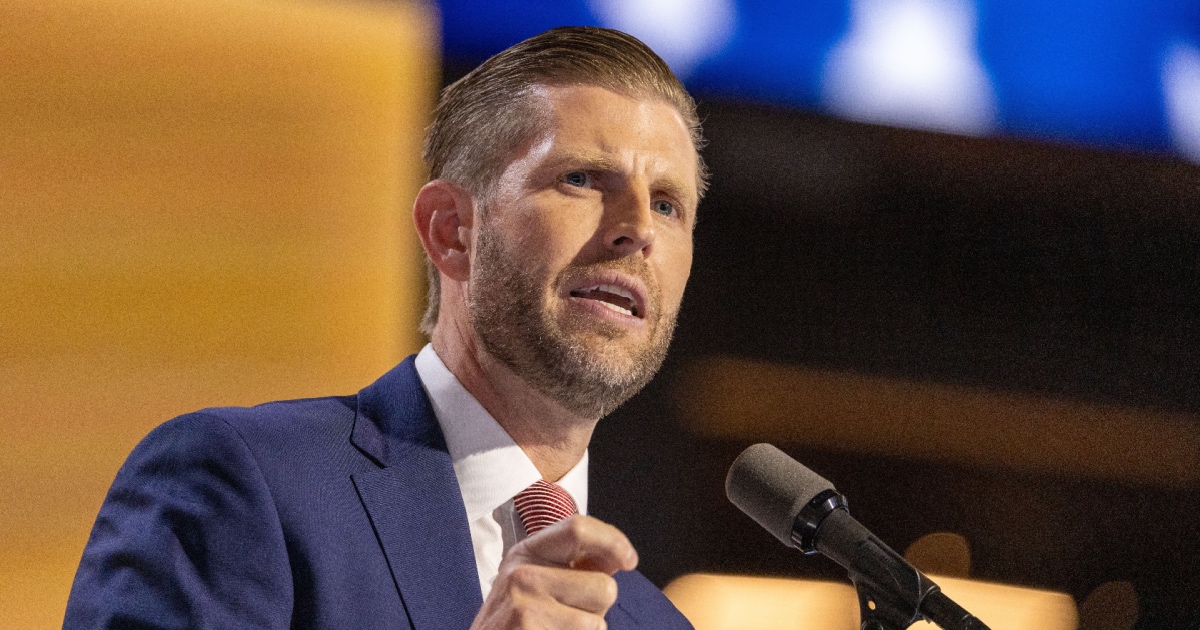

On the same week that American Bitcoin’s stock hit an all-time low, its co-founder and chief strategy officer was in Las Vegas telling a crowd at the Bitcoin Conference 2026 to stay calm. “We are in the greatest period in the history of crypto,” Eric Trump said. “Just hold on guys, just hold on.” The audience was made up largely of retail investors whose portfolios told a very different story.
American Bitcoin stuck with its crypto strategy and saw its shares slump more than 95% from their peak, erasing more than $600 million from the market value of Eric Trump’s stake over the past 10 months, according to Bloomberg calculations. That collapse also forced one of the most embarrassing corporate maneuvers a Nasdaq-listed company can undergo. The plunge in American Bitcoin’s shares forced the company into a 1-for-15 reverse stock split to maintain its Nasdaq listing.
Nasdaq requires listed companies to maintain a minimum share price of $1. If a stock trades below that level for 30 consecutive business days, Nasdaq typically issues a deficiency notice, after which the company is given a set period – usually 180 days – to regain compliance, often by executing a reverse split. A reverse split mechanically redistributes the same capital over fewer shares without adding value. Markets read it as a distress signal, and in American Bitcoin’s case, they responded accordingly.
How the Trump Family Fortune Got Tangled in Bitcoin
American Bitcoin, a US-based Bitcoin mining and treasury company co-founded by Eric Trump, Donald Trump Jr., and digital infrastructure firm Hut 8, has lost more than 95% from its peak as investors reward rivals that can turn data centers toward AI. The company launched in March 2025 and went public through a reverse merger with Gryphon Digital Mining Inc., beginning trading on the Nasdaq in early September of that year. The stock price peaked five trading days later, closing at a high of $139.65 on September 9, according to Bloomberg.
Eric Trump owns roughly 6% of American Bitcoin and serves as the company’s chief strategy officer, according to the same Bloomberg reporting. Donald Trump Jr., an adviser to the company, has not disclosed his ownership stake. The premise behind the venture was simple: mine Bitcoin, accumulate it on the balance sheet, and let the underlying asset’s rise do the heavy lifting. For a few weeks, it worked beautifully. Then the market changed, and American Bitcoin didn’t.
The reversal in Bitcoin’s price set the stage for what followed. As Bitcoin sank into a bear market and demand for artificial intelligence surged, investors increasingly favored miners that could repurpose their infrastructure for AI-focused data centers. On July 1, 2026, American Bitcoin shares fell to $0.61, marking a new all-time low. The 1-for-15 reverse split executed the following day reduced outstanding shares from about 1.09 billion to 73 million, aiming to boost the share price and preserve Nasdaq listing compliance.
The AI Pivot That American Bitcoin Missed
While many publicly traded Bitcoin miners have benefited this year by expanding into AI-focused data centers, American Bitcoin has remained committed to its cryptocurrency mining strategy. Competitors, including Riot Platforms, Cipher Mining, MARA Holdings, and TeraWulf, have gained an average of more than 60% in 2026 after announcing AI infrastructure initiatives, while American Bitcoin shares have fallen 77%.
The machines used to mine cryptocurrency – rows of power-hungry processors in large warehouses – can be redeployed to run AI workloads. Miners who made that pivot kept their infrastructure working and their revenue growing. American Bitcoin chose to stay the course.
The company’s main assets are its mining rigs and Bitcoin holdings. The power, sites, hosting infrastructure, and day-to-day mining operations are provided by Hut 8, American Bitcoin’s majority owner, under exclusive service arrangements. That leaves much of the AI data-center optionality with Hut 8, which has leaned into that strategy through a rebrand around power infrastructure and multibillion-dollar AI data center leases. Hut 8’s shares have more than doubled this year.
American Bitcoin’s CEO Mike Ho argued on the Q1 2026 earnings call, as reported by Benzinga, that competitors shifting toward AI are actually helping American Bitcoin by reducing mining difficulty. “We’re seeing hundreds of megawatts from the leading public miners shift towards AI, which resulted in the network difficulty dropping about 6% this quarter,” he said, arguing that fewer machines chasing Bitcoin rewards means a larger share for those that stay.
Mark Palmer, an analyst at Benchmark Co., put the tension plainly in comments reported by Yahoo Finance: “From the standpoint of fleet efficiency, fleet size and the ability to produce Bitcoin, the company is very well positioned. The issue, of course, is that the price of Bitcoin needs to be moving up for the business model to work.”
The Numbers Behind the Slide
The company posted a $118.2 million operating loss in Q1 after marking down its Bitcoin treasury by $117.2 million. Revenue that quarter came in at $62.1 million, a 20.7% decline from the prior quarter. At the same time, management points to real cost improvements: American Bitcoin reduced its per-Bitcoin mining expense by 23%, enabling the company to sustain gross profit margins above 50%.
The company’s Bitcoin treasury remains substantial. American Bitcoin holds more than 8,000 Bitcoin on its balance sheet. Despite the selloff, Eric Trump has indicated the company has no plans to reduce its Bitcoin holdings, saying on a recent podcast that it would take circumstances “beyond catastrophic” to justify selling. Bloomberg also noted that American Bitcoin recently added another 500 Bitcoin to its balance sheet, underscoring its long-term commitment to the digital asset.
ABTC shed more than 70% of its value in 2026 alone. The broader crypto mining sector’s shift toward AI isn’t temporary, either. Industry data from Cryptonews suggests listed miners could derive as much as 70% of their revenue from AI by the end of 2026, up from roughly 30% today – a structural change that leaves pure-play crypto miners increasingly exposed.
The Bigger Picture for the Trump Family Fortune
The trump family fortune from crypto doesn’t begin and end with American Bitcoin. The picture across the family’s various digital asset ventures is sharply uneven. Donald Trump earned more than $1.4 billion from his family’s crypto ventures last year, according to his 2025 annual financial disclosure, released by the U.S. Office of Government Ethics. The 927-page disclosure showed that crypto was the largest source of Trump’s income last year, dwarfing his earnings from real estate and legal settlements.
Trump reported earning more than $550 million from World Liberty Financial (WLF) sales of crypto tokens. He also disclosed receiving $635 million in royalties from what the filing described as “Celebration Coins,” connected to his meme coin business. Across all of the family’s cryptocurrency ventures, Yahoo Finance reported the President’s family made approximately $2.3 billion in profit as of the end of April 2026.
The contrast with retail investors is stark. According to blockchain analytics firm Nansen, as reported by Fortune, about 989,000 wallets holding Trump’s meme coin had net losses totaling $3.81 billion since it began trading in January 2025. Eric Trump’s $600 million paper loss at American Bitcoin fits the same pattern: the family has extracted enormous gains from the crypto ecosystem while those who followed them in have largely absorbed the downside.
You can read more about how Trump’s presidency intersects with his family’s financial interests in our coverage of Trump’s ethics warnings.
Read More: Trump’s America First Contradictions: The Complete List
What This Means for Investors Watching the Trump Name
American Bitcoin’s collapse isn’t just a story about one bad bet. The reversal illustrates just how quickly investors have soured on crypto pure-plays. Success is no longer determined by who can produce the most Bitcoin, but by who has the flexibility to monetize their electricity, land, and computing infrastructure. A company built around a single asset class with no optionality to pivot faces a fundamental structural problem when that asset enters a prolonged downturn.
Reverse splits are often viewed negatively by investors. Even though they do not change the underlying value of a company, they signal that a stock had fallen too low to maintain its listing without intervention. For a company carrying the Trump name – a brand built on projecting wealth and winning – being forced into a share consolidation to avoid delisting carries its own symbolic weight.
Eric Trump’s position is that the market is wrong, that Bitcoin will recover, and that those who held through the downturn will be rewarded. That may prove correct. If Bitcoin recovers, American Bitcoin’s focus on the cryptocurrency could eventually pay off, especially as competitors that shifted focus can’t easily re-enter the space. But for investors who bought near the $139.65 peak and are now sitting on losses of 95%, the wait has already cost them most of their principal. The lesson from American Bitcoin’s trajectory isn’t that crypto is a bad investment, or that the Trump family can’t generate returns from digital assets – the broader financial disclosures prove otherwise. The lesson is that a single-asset strategy with no structural flexibility is extremely vulnerable when the market decides it has moved on.
Disclaimer: This information is not intended to be a substitute for professional financial advice, investment advice, tax advice, or legal advice, and is provided for informational purposes only. Always seek the guidance of a qualified financial advisor, accountant, or other licensed professional regarding your personal financial situation or investment decisions. Do not make financial, investment, or tax decisions based solely on information presented here. Past performance is not indicative of future results, and all investments carry risk, including the potential loss of principal.
AI Disclaimer: This article was created with the assistance of AI tools and reviewed by a human editor.
Read More: Trump Accounts Launch on July 4: Who Qualifies for the $1,000 Payment?