Scientists Find a 5-Million-Year-Old Whale Graveyard 23,000 Feet Below the Indian Ocean
Nearly 500 whale skeletons are scattered across more than 700 miles of seafloor in the southeastern Indian Ocean, and some of those bones have been sitting in the dark for over five million years. That’s not the surprising part. What left researchers genuinely stunned was that many of those ancient remains are still very much alive with activity, hosting thriving ecosystems that had never been documented at anywhere near these depths.
The story begins in February 2023, when Chinese scientists lowered a crewed submersible into a remote seabed region called the Diamantina Fracture Zone. During that first dive, researchers aboard the submersible Fendouzhe spotted a single whale fall – the term for a whale carcass that has sunk to the ocean floor. In the weeks that followed, they dove 32 more times, and what they found left them astonished. The findings were published in June 2026 in this 2026 Nature study, and they immediately rewrote what scientists thought they knew about deep-sea life.
The Diamantina Zone sits between Australia and Antarctica. It extends roughly 1,200 kilometers along the seafloor of the southeastern Indian Ocean, and until this expedition, nobody had connected it to whale remains of any kind. The fracture zone plunges to extraordinary depths. In total, the researchers identified 476 whale fossils and five carcasses of more recently deceased whales at depths of between 13,800 and 23,000 feet – that’s 4,200 to 7,000 meters below the surface. That 23,000-foot figure is roughly four times the height of Mount Rainier.
The World’s Largest, Oldest Whale Graveyard
Along 745 miles of the Diamantina Fracture Zone, the research team documented an unprecedented necropolis containing the remains of nearly 500 whales, some of those bones dating back 5.3 million years – long before humans existed. It’s the biggest, deepest, and oldest whale graveyard ever found, and it may have been accumulating continuously for millions of years.
Researchers from the Institute of Deep-sea Science and Engineering (IDSSE) of the Chinese Academy of Sciences, working alongside colleagues at the University of Pisa in Italy and Earth Sciences New Zealand in Wellington, led the study. Lead study author Xiaotong Peng of the Chinese Academy of Sciences said the researchers were “astonished” when the scale of their discovery became clear. It was known that when whales die and drop to the seafloor, their sunken bodies provide a source of food to bottom-dwelling creatures. “But discovering a necropolis of this scale was completely unexpected. The size of distribution, the depth and the age range were far beyond anything we had imagined.”
The sheer density of remains in certain areas is difficult to comprehend. Researchers documented concentrations reaching up to 759 whale individuals per square kilometer in some sections, and by extrapolating that data, they estimate the Diamantina Zone may contain over 10 million whale carcasses in total. No comparable site has ever been recorded anywhere on Earth.
So why this particular stretch of ocean? Two things appear to have conspired to make the Diamantina Zone a perfect archive. The V-shaped topography of the zone funnels carcasses down onto the trench floor. Normally, ancient remains on the seabed would be buried by sediment from eroded rocks. But the sedimentation rate in the Diamantina Zone is incredibly low – just 0.02 to 0.22 inches per 1,000 years – meaning skeletal remains could be exposed for hundreds of thousands of years at flat sections and for millions of years on uplifted slopes. The bones just stay there, generation after generation, piling up in silence.
A Graveyard That Is Also a Nursery
Whale falls are biodiversity oases on seabeds, yet their record from the oceans has historically remained sparse and fragmentary. What the Diamantina discovery does is demonstrate that these ecosystems can persist at depths far greater than previously thought possible.
This discovery dramatically extends the known depth range of whale-fall habitats by over 2,500 meters, offering new insight into the evolutionary and ecological dynamics operating in some of Earth’s most extreme marine environments. At these pressures and temperatures, sunlight is irrelevant. Life runs on chemistry instead.
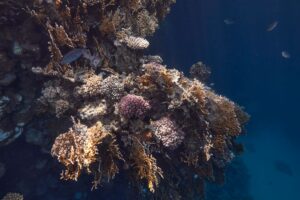
The carcasses host specialized communities dominated by brittle stars, bone-boring worms, and chemosynthesis-based bivalves. Chemosynthesis – where organisms produce energy from chemical reactions rather than sunlight – is the same process that powers life around deep-sea hydrothermal vents. Whale remains support diverse chemosynthetic communities, including species shared with cold seeps and hydrothermal vents, suggesting that whale falls act as stepping stones that help deep-sea fauna spread and connect across vast distances.
Peng explained that the Diamantina Zone may constitute a previously unrecognized “whale-fall chemosynthetic life corridor” across the southeastern Indian Ocean, offering significant value for understanding the dispersal and connectivity of deep-sea chemosynthetic life systems. When a whale dies and sinks, it doesn’t just decay – it becomes a way station, a biological bridge connecting isolated pockets of life across hundreds of miles of otherwise barren ocean floor.
A New Species – and Clues to Whale Evolution
The team also identified an entirely new species among the recovered remains, which they have named Pterocetus diamantinae after the location. Fossils from five beaked whale species and one baleen whale species were recovered and dated using strontium isotope analysis.
Most of the remains belonged to beaked whales – a family of elusive deep-sea mammals named for their dolphin-like snouts that scientists know relatively little about. Because beaked whales spend most of their time in the deep ocean and rarely strand on beaches, they’re among the hardest cetaceans to study. The Diamantina Zone is now, unexpectedly, the richest fossil record of beaked whales in existence.
Isotopic dating confirms that whale falls in this region have occurred since at least 5.3 million years ago, and researchers say the findings establish deep-sea floors as a fossil archive for tracing cetacean evolution over geological time. That’s a record that rivals many land-based fossil sites, all of it preserved in the cold and the dark, undiscovered until a team of scientists happened to look.
Nick Pyenson, a curator of fossil marine mammals at the Smithsonian National Museum of Natural History, who was not involved in the study, told Live Science: “Megasite is a totally appropriate term. I think they’ve uncovered something really special.”
The discovery puts a sharp point on a persistent reality about deep-sea science. According to NOAA Ocean Exploration, as of April 2026, only 28.7% of the global seafloor had been mapped with modern high-resolution technology – and explorers have visually seen less than 0.001% of the deep ocean seafloor, an area roughly the size of Rhode Island. The Diamantina Zone had no documented whale falls before 2023 – not because they weren’t there, but because no submersible had ever looked.
The submersible that made this possible, Fendouzhe – the name translates to “Striver” in Chinese – is no ordinary research vessel. Fendouzhe had previously visited the bottom of Challenger Deep in the Mariana Trench, the deepest spot on Earth, in 2020. For the Diamantina expedition, the team captured images of the necropolis using the submersible’s robotic arm to collect 43 fossils as well as some of the scavenging animals, using a device called a slurp sampler.
Whale falls form when whale carcasses sink to the seafloor, creating localized concentrations of biodiversity in the deep ocean. Besides playing a role in long-term carbon sequestration, whale falls help scientists understand the evolution and dispersal of deep-sea life. The soft tissue and lipids inside that many carcasses “translates to roughly 6.7 million tonnes of sequestered carbon,” Xiaotong Peng said. The Diamantina necropolis, with its enormous scale, represents a large, previously unquantified carbon sink – a detail with implications beyond biology, touching on how ocean systems regulate Earth’s carbon cycle over millions of years.
Researchers think there might be other similar necropolises off South Africa, the Iberian Peninsula, and near the remote Crozet and Kerguelen islands close to Antarctica, where some fossils have already been discovered by trawling. The Diamantina find, in that sense, may be just the first of several. The research effort was supported in part by the Global Hadal Exploration Programme, a ten-year United Nations Ocean Decade initiative dedicated to exploring the deepest regions of the ocean – meaning the pace of discovery in places like the Diamantina Zone is expected to accelerate.
What This Means for You
Five million years of continuous life, thriving in total darkness at crushing pressure, fueled by the chemical energy locked inside whale bones – the Diamantina Zone is not an empty void. The isolation imposed by extreme pressures and cold temperatures at these depths has given rise to a distinct community comprising species that appear entirely new to science.
For scientists, the practical implications are significant. The findings establish some deep-sea floors as fossil archives for tracing cetacean evolution over geological time, which means future expeditions to analogous zones could fill in enormous gaps in our understanding of how whales evolved and dispersed across Earth’s oceans. Stephen J. Godfrey of the Calvert Marine Museum wrote in Nature that the site “seems likely to hold many other exciting finds, and it will no doubt inspire more submersible dives in similar environments.”
For the rest of us, the message is simpler: every time a submersible descends into the deep ocean, the picture of life on Earth gets a little more complete. The next time a whale dies and sinks into the abyss, it doesn’t disappear. It becomes a city.
AI Disclaimer: This article was created with the assistance of AI tools and reviewed by a human editor.